
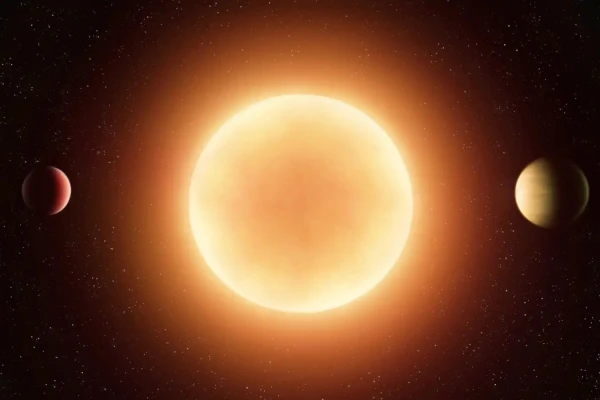
Exosyzygy, the alignment of two planets and a star in a straight line, is expected to occur in April of this year, but it seems we will not see it.
An extraordinary and rare astronomical event, the alignment of two distant planets and their star, which is set to occur on April 1, 2026, is likely to go unnoticed by humanity. The reason is that astronomers have not been given time for observations using telescopes, writes New Scientist.
This rare astronomical event is called syzygy, meaning the alignment of three or more celestial bodies in a straight line. In the Solar System, for example, this could be the alignment of the Sun, Earth, and Moon. Since this event will occur outside the Solar System, it has been termed exosyzygy, analogous to the name for planets outside the Solar System, which are called exoplanets.
The only known example of such an event occurred in 2010 and was discovered by Teruyuki Hirano from the Tokyo Institute of Technology (Japan) and his colleagues while analyzing data from NASA's Kepler space telescope.
The Kepler telescope detected planets by observing changes in the brightness of their stars when they were temporarily obscured by passing worlds. Astronomers observed a star called Kepler-89 and saw a signal indicating the simultaneous transit of two planets in front of the star, after which, to their surprise, the brightness of the star briefly increased. This could only happen if the two planets aligned in a straight line with their star when viewed from Earth, creating an exosyzygy.
In 2013, scientists predicted that the next similar alignment of planets and the star Kepler-89 would occur on April 1, 2026, and would last about 2 hours.
Now that date is fast approaching. Hirano and his colleagues have applied for observation time using both NASA's Hubble Space Telescope and the European Space Agency's CHEOPS telescope, but to no avail, partly because astronomers from space agencies believed that new observations could only confirm already known data.
Hirano says that there are still questions surrounding the prediction, as the orbits of the planets around the star Kepler-89, of which there are four, are very complex.
According to Hirano, calculations suggest that the alignment of the planets is highly likely to occur on April 1 of this year, but this will depend on many factors, including the actual masses of the planets, dynamic interactions between the planets, and the presence or absence of external, additional planets in the system.
In addition to observing the rare event, Hirano says that it would provide more information about the system, such as the masses of the planets. But if observation time with telescopes is not granted, he will not give up and plans to calculate when the next alignment of distant planets will occur.















Leave a comment