
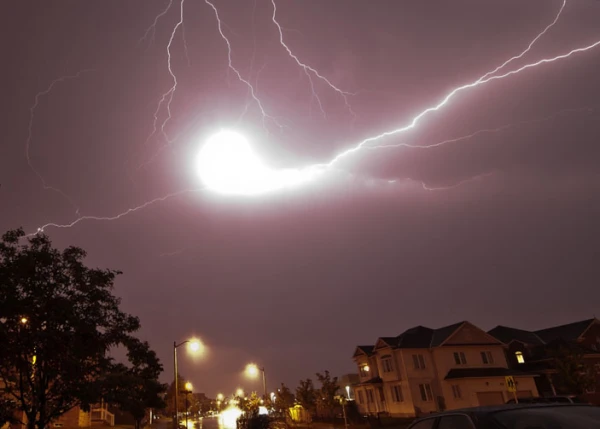
This physical phenomenon put scientists on the edge of reality.
In the second half of the 20th century, the problem of ball lightning occupied a unique place in Soviet science. This phenomenon balanced on the edge between an established fact and an anomaly: thousands of eyewitnesses saw glowing spheres, but physics could not explain their existence. For decades, this research was conducted in closed institutes. We explain what Soviet physicists hoped to discover.
The main problem with ball lightning: it should not exist. From the standpoint of classical physics, any plasma clump in the atmosphere must cool and disintegrate within fractions of a second.
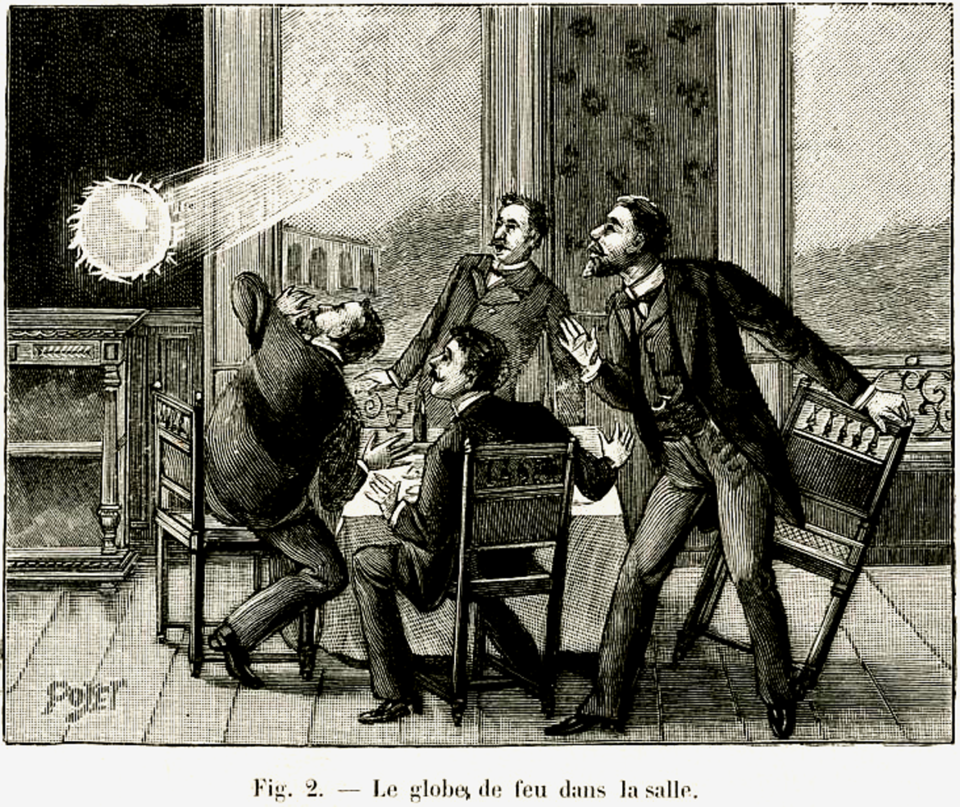
However, Soviet scientists gathered evidence that these objects can last from 10 seconds to several minutes. Ball lightning violates several rules:
-
Lifetime. Instead of instant disappearance, it floats in the air for minutes.
-
Temperature. While glowing at thousands of degrees, it may not burn when passing nearby.
-
Energy. In a small volume comparable to a soccer ball, energy is stored that can vaporize water or melt metal.
Moreover, this object violates the virial theorem. In electrodynamics, this rule states: charged particles cannot be held together solely by their own forces; they need external pressure or a solid core. Ball lightning has none of this, yet it does not disintegrate. The search for a hidden mechanism that holds this sphere became the main task for physicists.
In the early 1970s, at the height of the Cold War, interest in the topic became purely practical. The military sought ways to shoot down ballistic missiles and bombers. Lasers at that time were too bulky, and their operation required a clean atmosphere.
Plasmoid — an artificial ball lightning — seemed like the perfect solution. In 1971, development began on creating plasma weapons, including within the framework of the secret project 'Prometheus'. The idea was beautiful: to create a plasma clump in the path of a missile. Upon contact, it was supposed to:
-
Burn out electronics with a powerful electromagnetic pulse.
-
Create a thermal shock that would destroy the shell.
-
Change the aerodynamics, causing the missile to veer off course.
Giant installations were built at testing grounds. Scientists tried to create plasma by focusing microwave radiation beams or using powerful capacitor banks. But nothing worked: artificial spheres lived only as long as the installation operated. Once the switch was turned off, the plasmoid disappeared.
In a deadlock situation, physicists turned to the theory of Nobel laureate Pyotr Kapitsa. Back in 1955, he suggested: if energy cannot be stored inside the sphere for long, then it must come from outside.
According to Kapitsa, ball lightning operates like a receiver of radio waves. During a thunderstorm, electromagnetic oscillations arise between clouds and the ground. Where the waves overlap, the air becomes ionized and begins to glow. This theory explained a lot:
-
The sphere does not extinguish as long as there is external radio radiation.
-
It enters homes through chimneys and windows because they act as waveguides for radio waves.
-
Its size depends on the wavelength of the radio waves.
Kapitsa even confirmed this experimentally. In his laboratory, he produced glowing balls in microwave resonators. But there was one problem: in nature, radio waves of such power are practically nonexistent. The theory was beautiful but not universal.
Popular Statistics and Stakhanov Clusters While the military built generators, physicist Igor Stakhanov took a different path. In 1976, he appealed to the entire country through the magazine 'Science and Life', asking for descriptions of encounters with ball lightning. This was a breakthrough. Scientists received over 1,000 detailed letters. After processing them, Stakhanov created an accurate portrait of the phenomenon:
-
Color: most often orange, yellow, or white.
-
Size: 10–20 cm in diameter.
-
Finale: in 40% of cases, it explodes; in 60% it quietly extinguishes.
Based on this data, Stakhanov proposed a cluster model. He believed that ball lightning is not just hot gas, but ions surrounded by a "fur coat" of water molecules. This water shell prevents charges from neutralizing each other, acting like a battery. This explained why lightning behaves like a bouncy ball and can remain hot for a long time.
Missiles Against Clouds
In the 1980s, attempts to "catch" lightning became more ambitious. Scientists decided not to create it in the laboratory but to invoke it in the sky.
Small rockets were launched into thunderclouds, trailing a thin metal wire. The wire served as a lightning rod, provoking a linear lightning strike in the desired location. Physicists hoped that when the wire evaporated, ball lightning would also appear.
Hundreds of rockets went into the sky, provoking powerful discharges. But artificial ball lightning was never born. It became clear that its appearance required not only energy but also a rare combination of circumstances — special humidity, dust, or air composition.
How It All Ended
By the late 1980s, military programs were curtailed. Creating plasma weapons was unsuccessful, and funding for science was sharply reduced. The topic of ball lightning migrated from secret laboratories to the pages of tabloid press, where it began to be associated with UFOs and aliens.
However, Soviet physicists did not waste their time. In the pursuit of the elusive sphere, they developed unique statistics on the natural phenomenon and created a theory of cluster plasma, which proved useful in other fields. The study of ball lightning also demonstrated the extreme capabilities of electromagnetic impulses on technology, laying the groundwork for modern electronic warfare systems.
Ball lightning was never tamed, but attempts to do so significantly advanced the fields of plasma physics and electrodynamics.













Leave a comment