
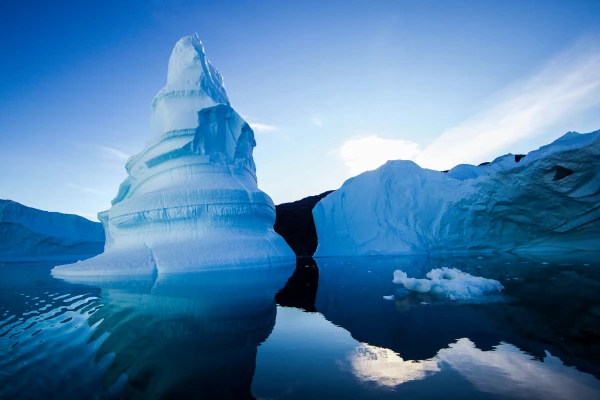
The first study as part of the GreenDrill project made a troubling discovery: the Greenland ice cap Prudhoe Dome completely disappeared only 7,000 years ago — that is, much later than scientists had thought.
The first study conducted as part of the GreenDrill project and led by the University at Buffalo focused on collecting samples of rock and sediment buried beneath the Greenland ice sheet. Scientists examined the samples and made a troubling discovery: the Prudhoe Dome ice cap completely disappeared approximately 7,000 years ago — in simple terms, much later than previously thought, reports PHYS.org.
The results of the new work suggest that this high point on the northwestern part of the ice sheet is very sensitive to relatively mild Holocene temperatures — an interglacial period that began 11,000 years ago and continues to this day.
According to project co-leader, Professor Jason Briner from the College of Arts and Sciences at the University at Buffalo, this period in Earth's history is known for its climatic stability, when humans first began to develop agriculture and take the first steps toward civilization. Thus, natural, moderate climate changes of that time melted the Prudhoe Dome ice cap and kept the glacier retreating for potentially thousands of years. If this is the case, it may only be a matter of time before it begins to peel away under the influence of current climate changes.
During the study, scientists analyzed core samples taken from a depth of 500 meters during an expedition to the top of Prudhoe Dome in 2023. The team then applied a luminescence dating method to the sediments.
According to the scientists, when sediments are buried, electrons can become trapped within their mineral grains due to natural radiation and remain there until the sediments are once again exposed to light. After which, they emit measurable luminescence. The scientists used the intensity of this luminescence and found that the Prudhoe Dome sediments were last exposed to daylight approximately 6,000–8,200 years ago.
The data indicate that the glacier melted sometime before this period — presumably occurring in the early Holocene when temperatures were about 3–5 degrees Celsius warmer than today. However, the most concerning aspect, according to the scientists, is that some forecasts suggest we could reach such a level of warming in Prudhoe Dome by the year 2100.
The results of the new work also have implications for predicting sea level rise. Analyzing vulnerable areas along the edge of the ice sheet, such as Prudhoe Dome, can provide scientists with insights into where the glacier will melt first and, consequently, which coastal communities are at the greatest immediate risk.













Leave a comment