
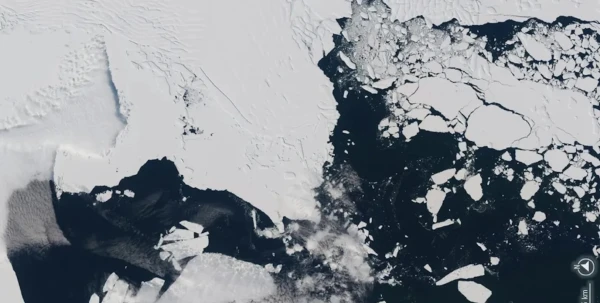
Until now, only a small number of such earthquakes had been detected on the icy continent. However, new research proves that in reality, hundreds of tremors are occurring.
Glacial earthquakes are shaking the Doomsday Glacier in Antarctica. It was previously thought that only a small number of such earthquakes occurred on the icy continent. However, in a new study, scientists provide evidence that there were hundreds of them from 2010 to 2023, reports Live Science.
Glacial Earthquakes
Glacial earthquakes are a special type of earthquake that occurs in cold icy regions. This type of earthquake was first discovered in the Northern Hemisphere more than 20 years ago, and it is now known that they occur when huge chunks of ice break off glaciers and fall into the sea.
A glacial earthquake occurs when tall, thin icebergs fall from the end of a glacier into the ocean. When these icebergs flip over, they collide with the "parent" glacier, and this collision generates strong mechanical vibrations in the ground, or seismic waves, that propagate for thousands of kilometers.
The uniqueness of glacial earthquakes lies in the fact that they do not generate high-frequency seismic waves. It is important to note that these waves play a crucial role in detecting and locating typical seismic sources such as:
- earthquakes;
- volcanoes;
- nuclear explosions.
This distinction is what led scientists to discover glacial earthquakes only relatively recently. By the way, most of the previously detected glacial earthquakes were localized near the ends of Greenland's glaciers.
Earthquakes Shake Antarctica
Although Antarctica is the largest ice sheet on Earth, direct evidence of glacial earthquakes has so far eluded scientists. Most previous attempts to detect Antarctic glacial earthquakes used a global network of seismic detectors.
However, in the new study, scientists found that Antarctic glacial earthquakes have much lower magnitudes than those in Greenland, and therefore the global network is unable to detect them.
In the new study, scientists used seismic stations located in Antarctica itself. As a result, the search revealed more than 360 glacial seismic events, most of which have not yet been included in any earthquake catalog.
The data indicate that the detected earthquakes can be divided into two groups:
- near the Thwaites Glacier (the Doomsday Glacier);
- near the Pine Island Glacier.
By the way, these glaciers are the largest sources of sea level rise in Antarctica.
The Doomsday Glacier is Shaking
The Thwaites Glacier is sometimes referred to as the Doomsday Glacier. The reason is that its complete destruction could lead to a global sea level rise of 3 meters. Even more concerning is that it could collapse very quickly.
According to the authors of the study, about two-thirds of the detected earthquakes, 245 out of 362, occurred near the marine end of the Thwaites Glacier. Most of these events are likely glacial earthquakes caused by the overturning of icebergs.
Scientists note that the strongest factor causing such events is likely not the annual fluctuation in air temperature. Instead, the most active period of glacial earthquakes in the Thwaites area, from 2018 to 2020, coincides with a period of accelerated movement of the glacier's ice tongue towards the sea. As a result, scientists concluded that the acceleration may have been caused by oceanic conditions, the influence of which remains poorly understood.















Leave a comment