
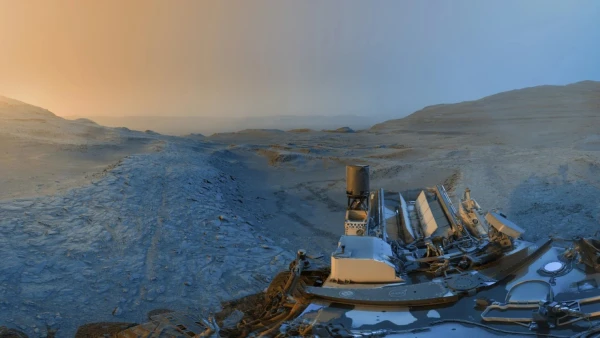
The Curiosity rover captured an amazing panoramic photograph that shows how lighting changes on Mars throughout the day.
NASA's Curiosity rover has sent a new photograph of the Martian surface, showcasing the local landscape. This image was taken from the slope of Aeolis Mons, a 5-kilometer high mountain located in the center of Gale Crater. Curiosity has been in this crater since 2012, gathering data necessary to understand how Mars transformed from a warm, wet world into the dry and cold planet it is today, according to Space.
The new image, presented by NASA scientists, is a panoramic shot created from two different photographs. They were taken in November 2025 using the rover's navigation cameras. The images were captured at 4:15 PM local Martian time on the 4722nd day of the mission and at 8:20 AM on the 4723rd day of the mission.
Afterward, scientists combined the two black-and-white photos into one and colored it with cool blues and warm yellows to illustrate how lighting changes throughout the day on Mars. This addition helps highlight various details of the Martian landscape, the scientists say.
The new photograph shows that the Curiosity rover is on a ridge on the slope of Aeolis Mons, which offers a view of a region called the "box formation." This region contains mineral-rich ridges that remained after groundwater flowed through cracks in the rock billions of years ago.
Over time, the wind has eroded the softer rocks, exposing hardened mineral veins. These features of the local landscape preserve evidence that liquid water once flowed on the surface of Mars and how environmental conditions changed.
In the foreground, the tracks of the rover's wheels are visible as it slowly moves along the slope of Aeolis Mons in Gale Crater. The Curiosity rover has been collecting rock samples and studying the terrain here for over 13 years. Further in the image, the bottom of the crater can be seen, and on the horizon, about 40 kilometers away, the rim of Gale Crater is visible.
The Curiosity rover studies the local topography and sedimentary rocks that hold evidence of how Mars transitioned from a warm, wet, potentially habitable world to a cold and dry planet.
By analyzing the chemical composition of the rocks, their texture, and mineral veins, the rover continues to piece together the story of how water once flowed through Gale Crater and whether extraterrestrial microbial life could have existed in this environment.












Leave a comment