
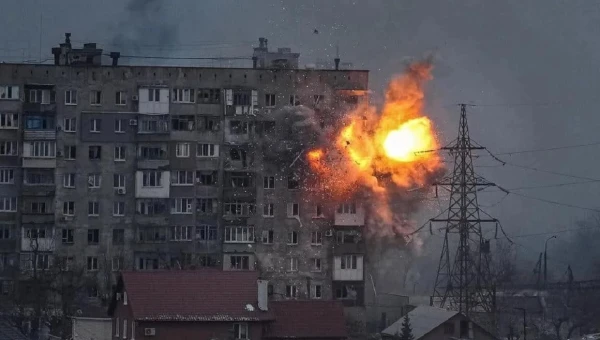
Many European countries did not believe until the last moment that Putin would dare to go to war.
In the Kremlin before the start of the war with Ukraine in February 2022, there was confidence that the overwhelming majority of Ukrainians would support the Russian invasion.
According to The Guardian, citing European intelligence data, Moscow assessed that only 10% of Ukrainians would be willing to resist the occupying forces. The remaining 90%, it was believed in the Kremlin, would either actively support the introduction of the Russian army or eventually accept it after some grumbling.
The person who had information about Ukraine that differed from what everyone else was saying was Sergey Naryshkin — the head of the Foreign Intelligence Service. He became notorious for his stuttering and incoherent speech at a historic meeting in the Kremlin, where Vladimir Putin asked the members of the Security Council for their opinions on Ukraine.
Naryshkin, according to sources from The Guardian, knew what others did not. "But he is weak and indecisive, and Putin wanted everyone to be part of this decision. So you saw the behavior (of Naryshkin — TMT) that you saw," a source told the publication. Naryshkin looked frightened but ultimately supported Putin.
The only person who openly opposed at the Kremlin meeting was Deputy Head of the Presidential Administration Dmitry Kozak, one of Putin's oldest allies, who had known him since the mid-1990s. Kozak was horrified by Putin's plans but only realized what was happening on the day of the meeting in the Kremlin, a source close to him told The Guardian.
According to the publication, during that meeting, Kozak argued with Putin not from a moral but from a strategic point of view that the invasion of Ukraine would turn into a catastrophe, although he did not know what exactly Putin was planning — a limited operation to capture Donbas or a full-scale war. After the meeting, Kozak was left alone with Putin and continued to argue with him, the source reported to The Guardian. Kozak's speech was cut from the television broadcast. At the end of 2025, he resigned from all positions in the Presidential Administration.
The Kremlin's expectations of support from Ukrainians for the Russian invasion turned out to be hopelessly optimistic, writes The Guardian. However, even based on Moscow's estimates, about 4 million people could have opposed the occupying army. The forces that Putin had gathered by that time, stationed at the Ukrainian borders, were clearly insufficient to overcome such resistance, European intelligence believed.
Partly for this reason, many European countries did not believe until the last moment that Putin would dare to go to war. The French ambassador learned of the invasion only when he was awakened by the sound of Russian rockets in his Kyiv apartment, writes The Guardian.
Bruno Kahl, head of the German foreign intelligence service BND, flew to Kyiv on February 23, when American, British, and Polish intelligence agencies had already established that an order had been given for an attack from Russia. Even when the German ambassador in Kyiv received an order to evacuate diplomats from the city, Kahl ignored this warning and casually planned meetings for the next day. Kahl had to be evacuated from Kyiv on the day of the invasion with the help of Polish intelligence along roads clogged with fleeing Ukrainians.
"We did not believe this would happen because we thought the idea that they could enter Kyiv and simply establish a puppet government was completely insane," one European intelligence official told The Guardian. "As it turned out, it was indeed completely insane."













Leave a comment