
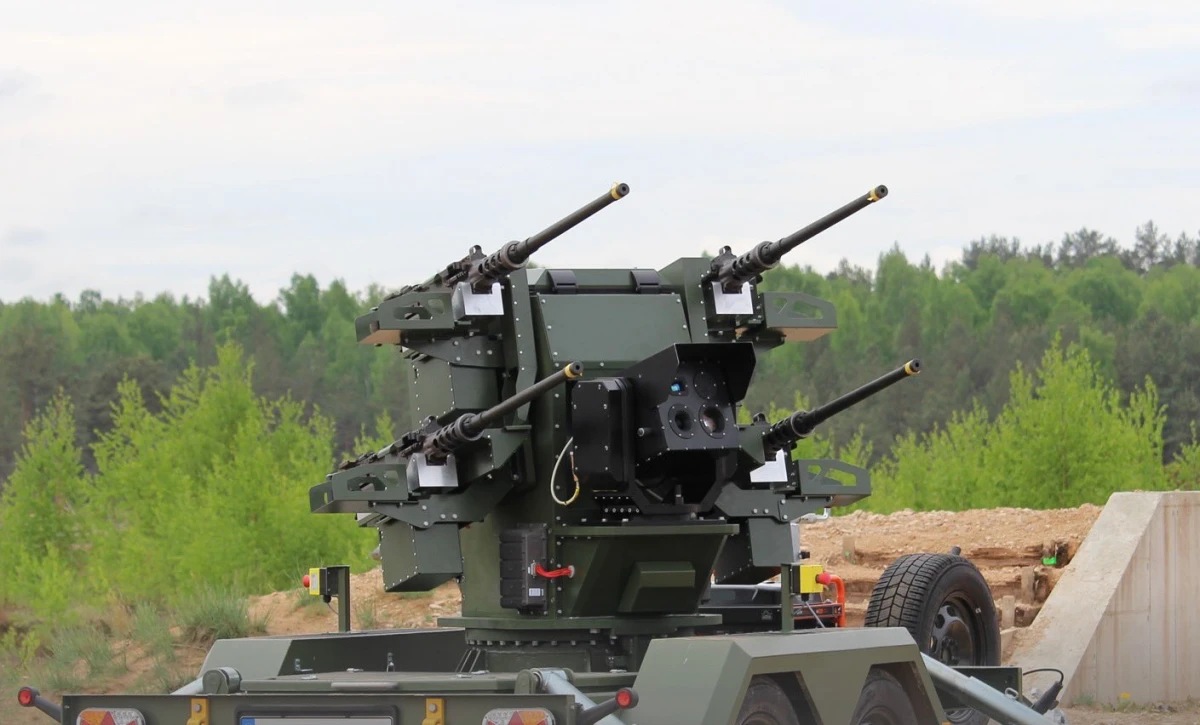
In the coming days, Latvia will deploy drone interceptor units on its eastern border, as well as towers equipped with remotely controlled automatic guns.
Major Modris Kairišs, head of the Latvian Autonomous Systems Competence Center (ASCC), shared this information, as reported by Euractiv.
Kairišs noted that the military has completed tests of the interceptors and is preparing to deploy units within a few days.
"Soon, very soon, I hope, in a couple of days we will officially deploy the interceptor units," Major Kairišs said on Tuesday at a briefing with representatives of several media outlets.
He added that a "fully remotely controlled" automatic turret system armed with 50-mm caliber guns has also been developed in Riga.
Kairišs acknowledged that "the most difficult part is detecting drones and relaying information to the right place." At the same time, he stated that interception is simpler. In addition to acoustic sensors, Latvia has also deployed tactical radars and optical camera systems to create what Kairišs described as a multi-layered detection network.
According to him, small drones flying at altitudes of 50 to 100 meters are difficult to consistently detect using radar alone due to the terrain and ground reflections.
One of the main challenges is resources, Kairišs said, emphasizing that supporting border defense in the manner of Ukraine during peacetime will create a huge burden on Latvia's military personnel, requiring "thousands" of soldiers.
Another issue in countering drones is information sharing. The Latvian armed forces face the challenge of how to quickly disseminate information about low-security targets among intercepting teams on the front lines without relying on cumbersome centralized command systems.
Kairišs noted that sensor data is typically centralized and classified, making it difficult to quickly relay information about targets to mobile intercepting teams near the border. He stated that lengthy accreditation procedures and secure communication requirements slow down tactical responses.
"One of the biggest problems in NATO is the outdated approach to command and control systems," Kairišs said.
Local craftsmen are also not sitting idly. Last week, practical testing of an automated remotely controlled machine gun turret for shooting down drones began at the Adazi military base. The paired machine guns (in the photo) were developed by the Latvian company WeMPS and named "DUURE Systems."












Leave a comment