
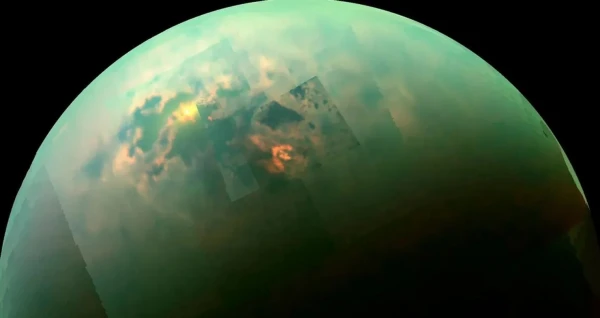
Scientists believe that beneath the icy surface of Saturn's largest moon, pockets of liquid water are hidden. But it is unclear whether this makes Titan more or less suitable for life, reports Focus.
A new study has shown that Saturn's largest moon Titan may not conceal a global ocean of liquid water beneath its icy surface, but rather extensive pockets of water. The study is published in the journal Nature, reports Space.
Titan is the largest of Saturn's 274 moons, and it is larger than the planet Mercury. It is the only moon in the Solar System known to have an atmosphere, as well as liquid on its surface. However, this is not water, but liquid methane, which exists in rivers and lakes.
Astronomers have long suspected that beneath Titan's icy surface there could be a global ocean of liquid water, which might provide all the conditions necessary for the development and maintenance of life. The way Titan deforms under Saturn's gravity suggests the presence of an underground ocean.
The authors of the new study used improved data analysis methods from spacecraft, which reduced uncertainty regarding Titan's internal structure.
Unexpectedly, scientists found that Titan's internal structure resists deformation under Saturn's gravity much more than previously thought. This indicates that Titan likely does not have a hidden underground ocean, but rather a layer of ice close to its melting point that does not fully melt under high pressure. This results in an icy slurry, which likely contains pockets of liquid water.
It is possible that in the distant past, Titan had an underground ocean of water. Perhaps the heat from radioactive elements in its core was insufficient to prevent this ocean from freezing. There is a possibility that internal heating on Titan is currently increasing.
The authors of the study believe that oceanic worlds may be less common than previously thought. Astronomers also do not yet know whether Titan's presence of pockets of liquid water instead of a global underground ocean makes it more or less suitable for life.
The upcoming NASA Dragonfly mission will help clarify this. The launch of this mission is scheduled for 2028. A nuclear-powered helicopter is set to be sent to Titan to uncover the mysteries of Saturn's moon, as previously reported by Focus.













Leave a comment