
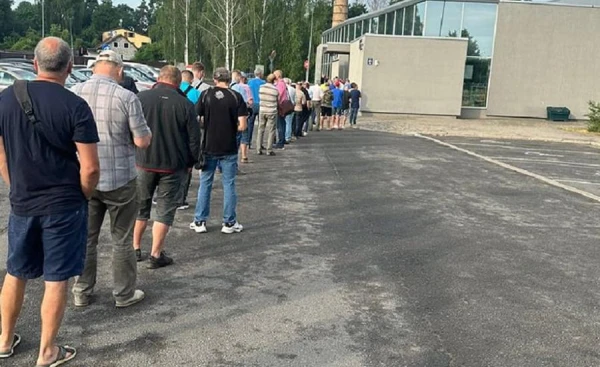
Vehicle inspections in Latvia are a monopoly of CSDD. In many European countries, this annual inspection can also be conducted in certified auto services. The Competition Council has previously warned: such a closed market is unfair. However, instead of revising it, the Ministry of Transport decided to merge with CSDD an agency subordinate to the Ministry of Agriculture that inspects tractors and forestry equipment. This point was included in the plan to reduce bureaucracy. It is precisely because of this that a serious conflict arose between the coalition parties CC and Progressives, reports the program Nekā personīga (TV3).
The organization of vehicle and motorcycle inspections in Latvia is carried out by CSDD on behalf of the state. However, the inspections themselves are performed by private firms, which CSDD pays for the work done. For many years, only a few companies were in a privileged position. In 2023, what was claimed to be the largest tender in recent years was announced — for a period of 10 years and for an amount of about 230 million euros. In 32 out of 33 CSDD branches across Latvia, only those firms that had previously worked in specific locations applied. The Competition Council (CC) has repeatedly pointed out that the vehicle inspection market in Latvia is unjustifiably restricted.
Contract Amounts with CSDD:
- "Auteko & TUV" – 82,597,678 euros
- "Autests" – 78,882,834 euros
- "Scantest" – 70,127,488 euros
- "Venttests" – 4,889,968 euros
"From a competition standpoint, the situation remains the same. We are losing 10 years simply because we cannot quickly break this scheme. If we had not announced the tender but opened the market, people would already have more choices," said Antis Apsitis, director of the CC's competition promotion department.
In other countries, inspections can be conducted, for example, in licensed and strictly controlled services. But clear rules are needed for this. Alongside the large tender from CSDD, two years ago in the Saeima, former CC head Skaidrīte Abrahama, along with other deputies, achieved amendments to the Road Traffic Law.
It states that by the end of 2025, the Cabinet of Ministers must adopt new rules describing the control and regulation mechanisms for services wishing to participate in inspections.
The amendment to the Road Traffic Law states: "Changes to paragraph 16, part three, come into effect on January 1, 2026. By this date, the Cabinet must adopt regulations describing the accreditation requirements for persons conducting technical condition control of vehicles within the framework of state inspections."
Saeima deputies explain that this happened a month after the announcement of the new tender. As a result of the competition, no new participants applied. According to some of them, "CSDD is just a facade. Inspections have always been conducted by private firms. Essentially, there are two owners in Latvia. Two enterprises controlling all the stations. This is business."
According to the amendments, the Ministry of Transport must develop and present to the Cabinet a new procedure by the end of the year that would allow, as in Germany, the Netherlands, France, or Italy, to open the market to more participants. However, the ministry is delaying, and the document will not be ready on time. Although there were more than two years for development, the ministry believes that there is no rush — possible changes in EU directives must be taken into account and discussed with the industry.
"The vehicle inspection in Latvia is conducted according to the information message approved by the Cabinet on August 11, 2020, which describes the service development model for the period 2021–2030. According to this document, CSDD conducts state inspections, oversees the process, collects payments, and performs delegated functions. The service is provided by entrepreneurs selected through a tender. In 2023, contracts were concluded for a period of 10 years," the ministry stated.
Currently, the accreditation process for existing stations under the current scheme is almost complete. The new Cabinet rules, which will establish requirements for the accreditation of inspection personnel, are still in development. They must comply with both Directive 2014/45/EU and Regulation No. 295. Existing stations are accredited for 10 years — this means that the new rules will only start to apply after 2033. Therefore, there is no need to rush their adoption; it is necessary to discuss them thoroughly with the industry. Moreover, work is currently underway on a new version of the mentioned EU directive, which provides for new control methods.
"I am not against the discussion continuing. But we should consider — will we lower the quality standards? Technologies are evolving, including electric vehicles, and their inspection requires expensive equipment. I am open to discussion, but we need to see what benefit this will bring to society," noted Minister of Transport (Progressives) Aitis Švinka.
To reduce bureaucracy, the Ministry of Transport proposed to merge with CSDD an agency subordinate to the Ministry of Agriculture that inspects tractors and forestry equipment. This has sparked a sharp dispute between the CC and the Progressives.
Despite recommendations to limit CSDD's monopoly, the Ministry of Transport is trying to expand it. The plan to combat bureaucracy included a point about merging the State Technical Inspection Agency (VTUA), which conducts inspections of heavy equipment, with CSDD. The idea went through public discussion but caused sharp discontent from farmer organizations.
"Yes, this was a proposal from the Ministry of Transport — to combine control and reduce costs. I met with representatives of the associations. But the CC was strongly opposed," explained Švinka.
"This idea is old. CSDD just wants to profit at the expense of farmers. Let me remind you: if an agency performs the function — the goal is not profit. But CSDD aims to earn. This means that services will become more expensive. The Progressives wanted to transfer this function to CSDD," responded Minister of Agriculture (CC) Armands Krauze.
NP: Was this an attempt by the Progressives to take revenge on the CC by taking this function away from them?
"By no means. I do not believe that anyone has 'ownership.' We are one state, one society," asserts Minister of Transport Aitis Švinka.
The work of the Technical Inspection Agency is funded by the farmers themselves through their payments. Only the Karlis Ulmanis Museum and the Agricultural Museum, which are part of the agency's structure, receive state subsidies. Agency inspectors travel to farms to meet with equipment owners. The agency's director is confident: if this function is transferred to another, the cost of services will rise because CSDD's goal is profit. The agency operates on a self-financing principle.
"This story is old. Every time there is unrest in the country, the question arises from CSDD: let’s merge. And this time too. Understanding that farmers are against it, an information report was still prepared and brought to discussion. Simply because there is a paying clientele here. I do not think it is about anything else. Just a calculation," believes the director of the Technical Inspection Agency, Armand Binovskis.
"It should be understood that we, the entrepreneurs, fund VTUA. Farmers, the forestry sector, road construction. All the money goes to the operation of VTUA. I have not heard of a board of directors in VTUA, as in CSDD. But CSDD has one — and it is well-paid. I think the director of VTUA has never received and will never receive a salary like, for example, Mr. Aksenok — about 130,000 euros a year. The Prime Minister does not earn that much. If I am not mistaken, CSDD contributed 2 million euros in the last budget. They plan to contribute 4 million next year. Then the question arises: is CSDD a money-collecting machine or an institution responsible for road safety and the technical condition of vehicles?" notes board member of the Farmers' Saeima organization, Martiņš Trons.
"Claims about salaries are subjective. What is a lot for one is little for another. I do not think that CSDD's services will become more expensive just because the council has a high salary — that is an incorrect argument," assures the head of the technical department of CSDD, Paul Beinarovich.
NP: Does the idea come from you or from politicians?
"From politicians. CSDD has no goal — to take over VTUA for profit and salaries. If the government assigns it — we will do it with full responsibility. But this is not our initiative."
This week, a new "fighter against bureaucracy" — Jānis Endziņš — began his work. He does not promise to expose institutions that buy expensive cars or inflate salaries. His team will look for functions that can be canceled or reduced. The failed merger of CSDD and VTUA he calls a telling example of the fact that his work is advisory in nature, and final decisions are up to the politicians.
"Unfortunately, we face this regularly. This case is typical. In my opinion, the merger would be the right step from various perspectives. But it did not happen. I hope that with my arrival, we can eliminate the 'feudal' approach. To view bureaucracy as a common problem, solved regardless of which party supervises the institution," believes Endziņš.
Why do you think you will succeed?
"Usually, I succeed. First of all. Secondly — I believe in this strategy. If I did not believe — I would not have taken it on. I still believe that there are enough smart people in Latvia who want good for the country. And that means — it will succeed."
After protests from farmers, the plan to merge the agency with CSDD has not been canceled. Minister of Transport Aitis Švinka stated: discussions will continue. Meanwhile, the Farmers' Saeima organization suggests that the "fighter against bureaucracy" Endziņš also review the work of the Road Transport Directorate. For example, currently, farmers are required to purchase special permits for self-transportation to transport their harvested grain, potatoes, or cabbage in their trucks. This, in their opinion, is a meaningless and unnecessary requirement for which they also have to pay.







Leave a comment