
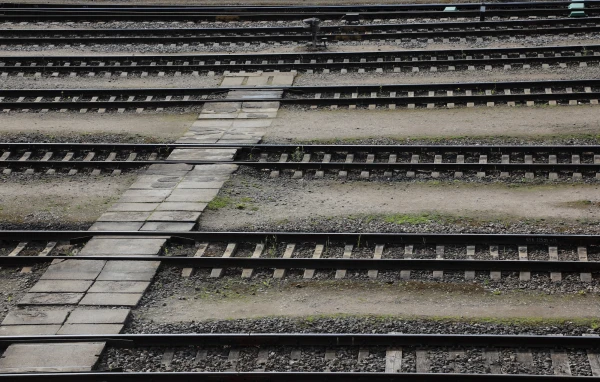
"If we decide to do this, then it must be done together," said Estonian President Alar Karis this week about the dismantling of railway tracks after a meeting of the Baltic states' presidents. Politicians in Latvia are still evasive about specific statements regarding the demolition of tracks in the border area, citing the need for assessments of the consequences for the national economy. The main argument is the losses for Latvian Railways and ports. Meanwhile, the volumes of freight transported by rail in Latvia have been declining for five consecutive years, as well as the number of trains arriving from Russia and Belarus, reports the program Nekā personīga (TV3).
Latvia is connected to Russia by two railway lines, both of which pass through the Ludza region, which borders the eastern neighbor. One branch goes through Kraslava, the other through Zilupe. The branch through Zilupe is used for freight transportation most often.
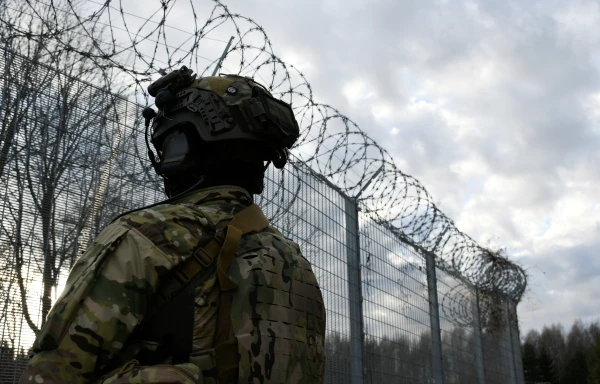
At this location, about 3.5 kilometers from the center of Zilupe, the rails cross the Latvian-Russian border. While politicians do not have a unified opinion on the demolition of the tracks, the head of the border municipality says: if the National Armed Forces (NAF) believe that this needs to be done, then it should be done.
In the region, there is a sense that residents are aware of the potential threat and are actively preparing for the so-called hour X. It is quiet and deserted at the border. The railway crosses the border in a lowland between two low hills.
The embankment runs through marshy terrain. This is the easiest way to cross the border in the district — it is used by both illegal immigrants and smugglers. A few kilometers away is a dirt road leading to Russia, but it has not been used for many years and, according to border guards, cannot be traversed from the Russian side.
The road leads to the city of Sebezh, located about 30 kilometers from the border, and further to Moscow. Passenger services were discontinued back in 2020, but the branch is still used for freight transportation.
The first control point after crossing the border is the center of Zilupe, where border guards check trains. The line is actively used: this year, 822 trains crossed the border here — almost as many as last year.
About 2,000 people live in Kraslava. The second railway line towards Russia runs through the city. The border strip is populated — homesteads stretch along the road. A bridge connects both sides of the border.
In this section, the border runs along the river for several kilometers on both sides, and the railway bridge is the only crossing point. It is about half an hour's walk from the center of Kraslava to the bridge.
The rails are covered with rust, indicating that traffic here is rare. A border guard confirms: the last train was seen a few days ago. This year, 50 trains crossed the border here — almost five times less than last year (242).
Ludza is one of the largest border municipalities. The external border with Russia stretches here for more than 100 kilometers. About 20,000 people live in the region. As reported by the program Nekā personīga, analysts from the USA and Latvia have warned about the dangers of these railway connections.
"Experts, including the National Armed Forces, are assessing how quickly this can be implemented if a threat arises... I cannot say because I do not have complete information. When I have it, I will be able to express an objective opinion. But it is also necessary to assess how significant the railway transit is, what revenues it brings to the state, and what potential losses there may be," said the chairman of the Ludza Regional Council (LRC) Edgars Mekshs.
Nekā personīga: Maybe you have a personal feeling — should this be done or not?
"If the National Armed Forces believe that it is necessary and that the preservation of the rails poses a threat, then it should be done," Mekshs said.
The National Armed Forces have called for action and the dismantling of the rails, but politicians are still being evasive — assessments of the impact of the decision on the national economy are needed. Four ministries and state security must present their assessments to the government by the end of the year.
"The discussion of this topic has caused a certain resonance, but I do not consider that we are talking about any serious threat that could not be overcome. Absolutely not — that is not the case. Therefore, I think society needs to be reassured: the situation in which the enemy could use this infrastructure is unlikely," assured the Minister of the Interior (New Unity) Rihards Kozlovskis.
NP: Why are you so sure about this? The example of Ukraine is quite illustrative.
"Our capability. We are a NATO member country with all that entails — both in terms of intelligence and our capabilities," Kozlovskis stated.
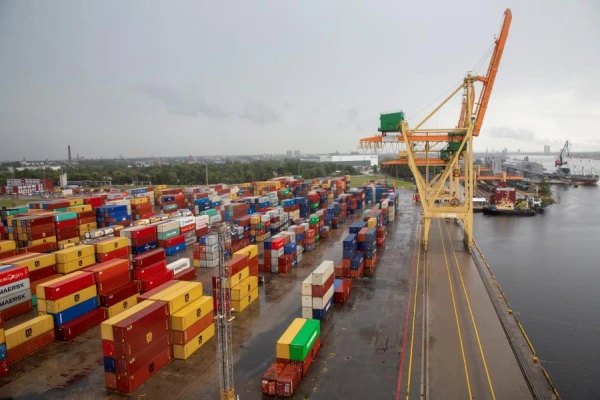
The main argument against the dismantling of the rails is that the railway connects Latvia with Central Asia, for example, Kazakhstan. Its closure would harm Latvian Railways and ports. How significant the impact could be is still unclear. This is being handled by the Ministry of Transport.
"This means that we will almost exclusively have passenger transport within Latvia, as domestic transport constitutes a small volume — about one million tons per year, and the potential there is also limited. Infrastructure costs are mainly fixed," said the State Secretary of the Ministry of Transport Andulis Zhidkov. "It is clear that without state support, which is provided for by EU regulations, the railway system in Latvia currently cannot function. The need for this is about 100 million euros annually already now."
Over the past 10 years, the volume of freight transported by rail has decreased more than sevenfold — from 55.6 million tons in 2015 to 8.5 million tons this year. In 2023, almost half of the freight was Russian, but now Russian freight constitutes only a quarter. This year, the most imported goods were animal feed — about 0.5 million tons and grain products — about 0.2 million tons.
For the first time this year, the majority of freight transported by rail came from the Baltic states. One-fifth of the goods were from Central Asia, 11% from Belarus.
A month ago, the government approved a railway development strategy. The program Nekā personīga has a project prepared two years ago, which has not yet been considered by the Cabinet of Ministers. It also assessed the scenario of terminating communication with Russia and Belarus: at that time, the volume of transported freight would decrease to 3.8 million tons per year — about half of the current level.
NP: "Can we say that we are now approaching such a scenario?"
"The situation is not changing so rapidly, but yes, it is something similar. Already now, in the railway system, the main transport is passenger transport. Ten years ago, it was the opposite — freight transport dominated. Now both public transport and passenger transport also need state support. Hence the significant budget expenditures. And here the question is what we can afford in the budget," Zhidkov explained.
Leaders of the countries emphasize: the dismantling of the tracks must be agreed upon among all Baltic states. This issue was discussed by the presidents at a meeting held this week. Specific decisions have not yet been made.
"Of course, Lithuania and Estonia are in a different situation compared to Latvia, as Russia has communication with Central Asia and other countries of the world. Therefore, if we decide to do this, it will only be together. This is a new topic, and we have passed it on for discussion and decision-making to our ministers," previously stated Estonian President Alar Karis.
"Of course, we are very interested in this new initiative — to dismantle the tracks in the eastern direction. I think this could be part of anti-mobilization measures, as it is hard to imagine that we continue to operate as before while simultaneously implementing anti-mobility measures," added Lithuanian President Gitanas Nausėda.
Latvia also has railway communication with Russia's ally — Belarus. The route runs through the village of Indra in the Kraslava region. The intensity of traffic there is also decreasing — this year, 525 trains crossed the border there — almost 200 fewer than last year.








Leave a comment