
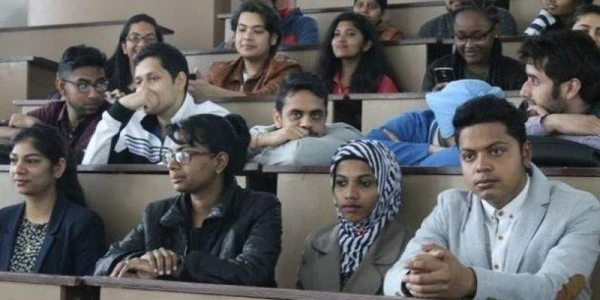
It is currently impossible to accurately determine how many graduates from higher education institutions from third countries actually continue to work in Latvia, as the available data provides different figures.
This is stated in the study by the Baltic International Centre for Economic Policy Studies "Integration of Foreign Students and Employment Opportunities in Latvia."
In the 2024/2025 academic year, there were 66,952 students enrolled in Latvian higher education institutions, including 15% foreigners. Among these students, more than half, or 6,575 individuals, were citizens of third countries residing in Latvia on the basis of a temporary residence permit for study.
Compared to the previous academic year, the number of students from third countries increased by three percentage points. Since 2015, the trend has been positive, except for the pandemic period from 2020 to 2022, when educational opportunities were limited.
Most students from third countries come from India, Uzbekistan, and Sri Lanka. Latvian universities mainly compete within a narrow group of countries. This means that interest in studying in Latvia is concentrated in a few specific countries, researchers note. Since 2017, the number of students from India has grown the fastest, followed by Uzbekistan and Sri Lanka.
The concentration of foreign students varies across different universities. The highest number of students from third countries was at Riga Technical University - 2,606 individuals, accounting for about 85% of mobile students. At the University of Stradiņš in Riga, most students are from EU countries, while students from third countries make up only 10%, or 322. At the University of Latvia, students from third countries constituted about half of the total number of foreign students - 316 individuals.
According to the Central Statistical Bureau, in 2024, Latvian higher education institutions graduated 878 citizens of third countries. The largest number of graduates came from India (298), Uzbekistan (143), Ukraine (99), and Sri Lanka (79). The least came from Russia, Azerbaijan, and Turkey, while the number of graduates from other countries was less than 17 individuals.
According to researchers, data on how many students from third countries actually complete their studies and remain to work in Latvia would provide valuable information about the effectiveness of programs, student motivation, and the true goals of their education. It is impossible to accurately calculate the proportion of students from third countries who start studying in Latvia and complete their studies.
The report also points out discrepancies in different data sources regarding how many citizens of third countries continue to work in Latvia after graduation. According to cautious estimates by researchers, this could be between 30% and 40% of graduates from third countries.
Data from Eurostat shows that in 2024, 270 citizens of third countries changed their residence status from study to work. However, the interpretation of this data may be limited: some students continue their studies in master's or doctoral programs or change their status for other reasons, such as marriage.
In 2024, 283 citizens of third countries started working in Latvia immediately after graduation, and another 139 received work permits. Thus, in total, about 43% of graduates remained in Latvia to work or seek employment, researchers calculated. Compared to previous years, this figure is roughly the same - about 48% in 2023 and 58% in 2022.
Most of them work in the information and communication technology sector, as well as in professional, scientific, and technical services. However, compared to Latvian graduates, citizens of third countries more often work in less qualified professions, the report states.









Leave a comment