
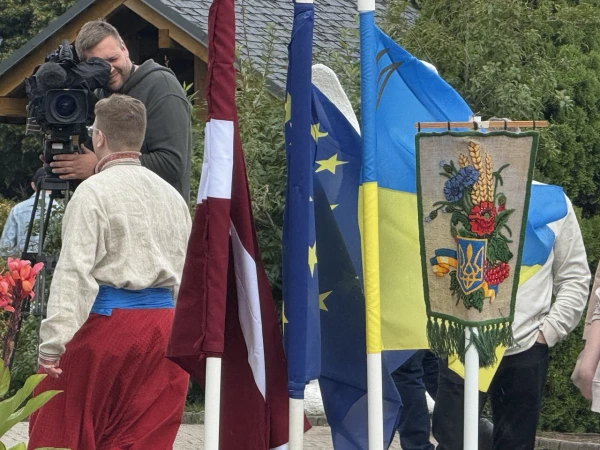
Nearly four years of war have passed, yet it has not been enough for the Latvian authorities to determine how the future of Ukrainians who fled the war will look, reports LTV.
At the beginning of 2022, Anastasia was in her sixth year of studying medicine in Zaporizhzhia. Her graduation exams were scheduled for May of that year, followed by an internship either there or in Kyiv. However, Russia's invasion of Ukraine disrupted the usual order of life. In search of a safe refuge, she and her family headed to western Ukraine. After spending two months there, she realized that life could not remain in limbo. She invested her last money in retraining and completed courses in the IT field.
"I finished the courses and started applying for jobs — basically anywhere. I just began sending out my resume through LinkedIn. And one Latvian company said they were ready to hire me if I could move to Latvia," she said.
The woman moved to Latvia, received a temporary residence permit, began working, learning the Latvian language, and integrating into the local community. The temporary residence permit was issued to her based on the temporary protection provided — a special status of international protection that grants Ukrainians the right to live, work, and study in Latvia.
Since next year will mark five years since Anastasia has been living in Latvia, she began to inquire about the possibility of obtaining a permanent residence permit. And she found that it might not be so simple.
New Immigration Bill
To obtain a permanent residence permit, a number of conditions must be met, including continuous residence in Latvia for at least five years. Although in essence, these five years will be completed next year, according to the new immigration bill currently being considered by the Saeima, this period may not be counted. A permanent residence permit will not be granted if a foreigner in Latvia has been provided with temporary protection.
"I have already built my life here — I have friends. I have a partner, and like any couple, we are making plans for the future. And I really don’t want this life to end because I genuinely like it. I like the people. I like my community here," says the Ukrainian.
Interior Minister Rihards Kozlovskis, under whose ministry the bill was developed, promises to find a solution this year. According to him, a residence permit is essentially an intermediate stage of integration, and the next step is naturalization. Those who truly feel a sense of belonging to Latvia and work here will be able to find a way to stay and integrate more closely.
Uncertainty of the Future
According to the Office of Citizenship and Migration Affairs, there are currently about 31,000 Ukrainians with temporary protection status in Latvia. This status has been extended multiple times and is currently valid until March 2027.
However, extensions occur for a limited period, and each time people do not know until the last moment whether the permit will be extended and under what conditions.
If there is no extension — do they need to return home? Is there a possibility to obtain another type of document? Such uncertainty causes anxiety, representatives of public organizations note.
Do you speak Latvian?
A 2024 study by "Providus" showed that many Ukrainians in Latvia work in less qualified positions than in Ukraine, and their standard of living has decreased — mainly due to the language barrier. If a person perceives their stay as temporary, the motivation to learn the language is lower. If they plan their future here — the motivation increases.
From this year, the requirements have tightened: within two years of receiving temporary protection, Ukrainians must learn the Latvian language to at least A2 level to be eligible to work. Language and cultural orientation courses are planned anew each year, which creates breaks in education.
From this year, after completing the courses, it is mandatory to pass a language exam. In case of failure, the retake will be at the individual's expense. Support is gradually decreasing, as most Ukrainians have been living in Latvia for four years now.
Another important aspect of long-term integration is the inclusion of children in the Latvian education system. Studies show that there is also a lack of a clear long-term plan in this area, and much depends on the initiative of specific schools, resources, and the involvement of municipalities.





Leave a comment