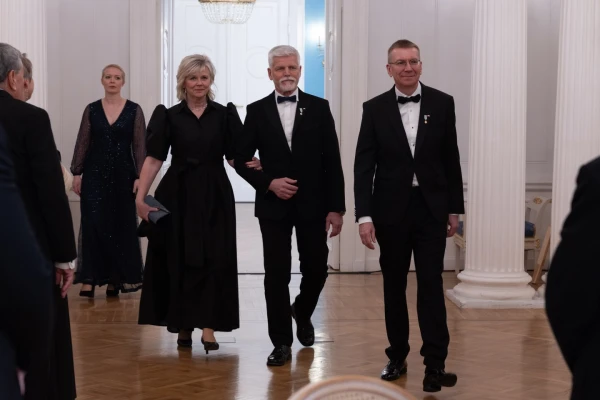
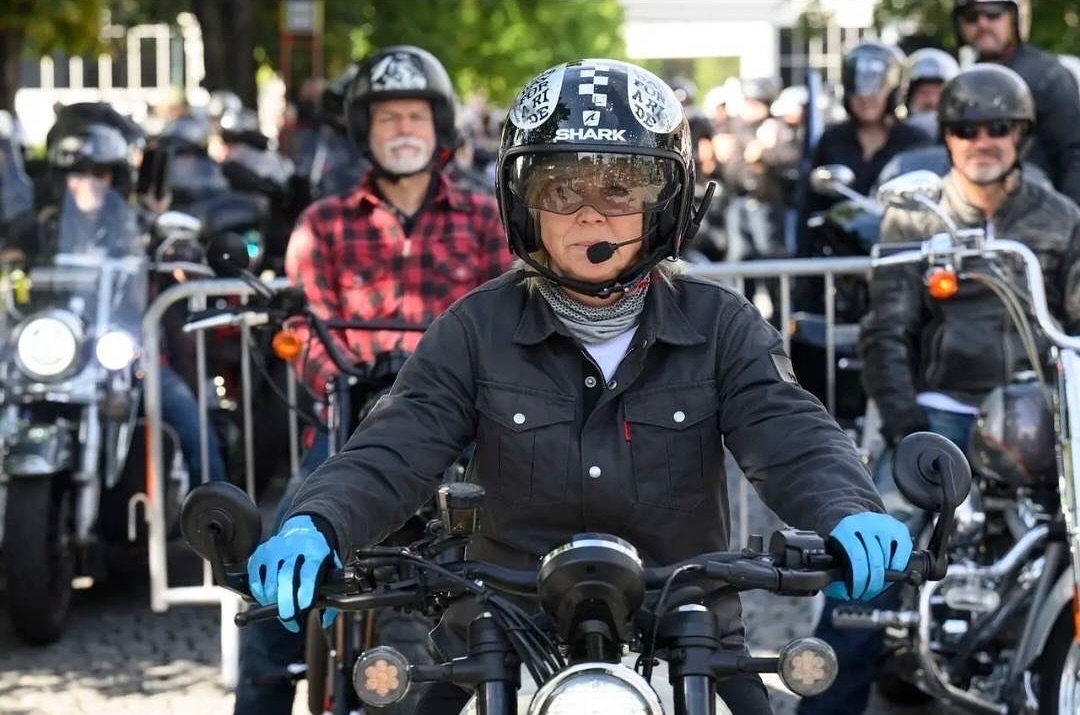
She received the rank of army lieutenant colonel and loves motorcycles.
Three years ago, Eva Pavlova moved to Prague Castle, the residence of the President of the Republic, with her husband Petr Pavel. In addition to her protocol duties, the First Lady remains a member of the local government in the village where their family cottage is located, works as a mediator, and engages in projects she calls "charitable diplomacy." "I didn’t want to remain in the background, I didn’t want to be just a mannequin for photographs during official visits," says Eva Pavlova.
-We are recording this interview shortly after your and the President's return from the Baltic states. You had your own program there: in Latvia, you met with members of the organization "Women for Security" and instructors of the "Women, Peace and Security" program. Now that the topic of security is on the agenda in the Czech Republic as well, what conclusions have you drawn from these meetings? Did you gain anything useful for the Czech Republic?
I believe that security as such is a major social issue that, as we see today, evokes a lot of emotions. In Latvia, I participated in a meeting of women involved in security issues. It was a very motivating meeting: there were women from the military, politics, and the non-profit sector, and they were all united by the understanding that security today is not only about technology and expenses but also about the resilience of society, the resilience of each individual, education, and how people communicate with each other.
This topic has been close to me for a long time. Many confuse mediation with meditation, although there is a huge difference. The distinction is that mediation and facilitation teach us proper communication – a third party is involved in this process, which always tries to find a compromise and a way to resolve disputes between two parties, organizations, or individuals.
-Is a mediator needed in Czech politics?
I don’t want to interfere too much in politics or evaluate it, but I think, yes – there should probably be some intermediary or personality, a leader, who would establish a dialogue between individuals and groups in a certain way, helping to find common solutions and paths that would be beneficial for our country and society.
It seems to me that in the daily hustle, people stop listening to each other. For example, mediation, especially the kind we are currently doing with children, the so-called peer mediation, gives me hope that the art of communication can be learned. And this can be learned from childhood. Conflict does not necessarily mean irreconcilability and the desire to insist on one’s own way at all costs – it can be an opportunity to understand something or someone, to change, to find a common path.
-You have been engaged in so-called peer mediation for a long time – you started this even before you became the First Lady, or rather, before your husband became the President of the Republic. Does this have even greater significance for you now? Is there hope that if children learn to communicate with each other, society, as you said at the beginning, will become, for example, more resilient?
Absolutely. At one time, I was very interested in this when I collaborated with a female mediator. I found it very intriguing: we tried to implement this in a private school in Roudnice. The children learned how to conduct a dialogue, how to name problems for what they are, how to give space to others, how to seek solutions, and understand that it is not about one winning and the other losing. These are skills that, it seems to me, can be useful throughout life – both in the family and at work and in society.
As a primary task, I saw this as a prevention of divorces. Just when I was working with that mediator, she was dealing with divorce topics. I had the opportunity to meet and communicate with many people, and I saw how sometimes it is difficult for two partners, parents, to agree in the interests of the child. This seemed incomprehensible to me. And here, if we transfer this to a broader scale, I think about how sometimes it is difficult to agree for the good of our republic, our people.
-Now your husband, President Petr Pavel, is trying to act as a mediator in society. Does he ever ask you for advice as an expert in mediation?
No. I think there are enough qualified people and advisors around him. This is rather my personal small sphere of support, my activity that I have been engaged in for a long time. I try to help him in other areas – where my husband may not have such a wide reach.
-Returning to the visit to Lithuania and Latvia: these countries border Belarus and Russia, which affects their approach to defense. You mentioned that, in addition to armaments, there is a lot of talk about developing individual resistance capabilities. When you observe the discussion about defense spending and strengthening resilience here in the Czech Republic, is it noticeable that we lack the experience of direct proximity to aggressor countries?
Latvia has a border with Russia, so people there are very sensitive to security issues. And I believe that it is also important for us to talk about defense openly and clearly. We need to remind everyone again and again that security is not something to be taken for granted. It is not only the army and certain structures, but all of us. It is not just money, but primarily our mindset.
Today we are talking about what is called cognitive warfare, that is, the battle for minds. This is a new form from which we must defend ourselves. These are attacks on people’s consciousness, on shaping opinions, spreading disinformation, and manipulating people. The goals are simple: to change the thinking and behavior of the population, to divide society, to weaken political will and defense capability – not only ours but that of all of Europe.
And the main thing we talked about with the women in Latvia is how quickly lies and disinformation are spreading today, how this radicalizes and polarizes society, how it undermines trust in state institutions. And, of course, that topics that are currently on everyone’s lips are being used for this: social networks and media.
The tools are precisely disinformation, propaganda, social networks, cyberattacks, and psychological operations. The only defense, which I have already mentioned, is to increase media literacy and strengthen psychological resilience, because today the battle for our minds is becoming the main battlefield of the future.
I posted these theses on social media. I hope that everyone will think about this a little, and from time to time we will arrange a "social detox," trying to live a normal, beautiful life, not burdening ourselves with that incomprehensible world for many that is happening precisely in social networks.