
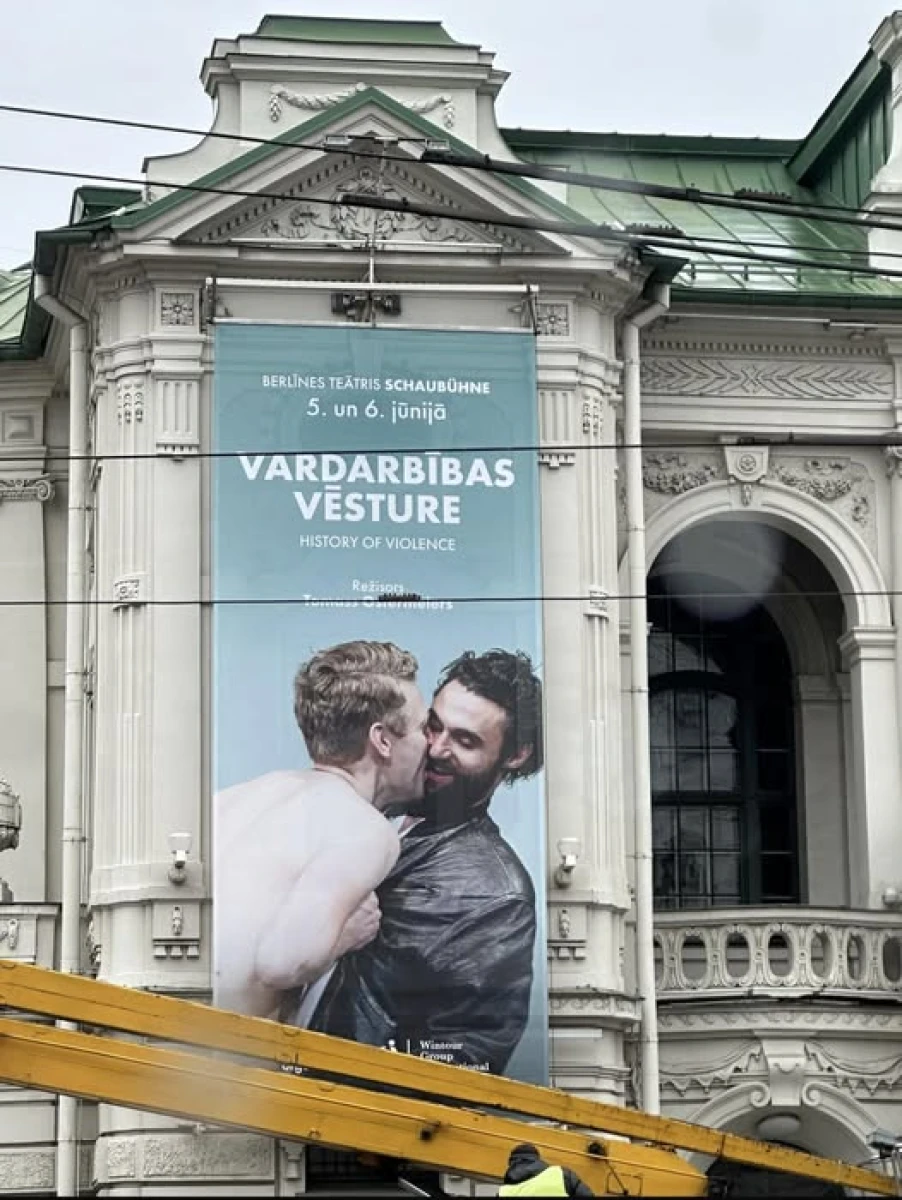
Widespread discussions on social media were triggered by the poster of the touring performance placed at the Latvian National Theater, which depicts two men seemingly about to kiss. Some users are outraged, while others believe there is nothing terrible about the poster.
The poster advertises the touring performance of the Berlin theater “Schaubühne” — “The Story of Violence,” which will be shown at the National Theater in June.
A heated debate quickly erupted in the comments. Some users called the poster “disgusting,” “a disgrace,” and “LGBT propaganda,” accusing the theater of placing such visual material on the facade of a national cultural institution.
“Latvian National Theater, ugh. Never again will I set foot in there. I’m already tired of this cheap provocative style of Latvian theaters, but this poster is completely off-putting. The goal of completely getting rid of a thinking audience has been achieved,” wrote one commenter.
Another user expressed similar outrage: “These European values are already stuck in my throat.” Yet another added: “A national disgrace, not a theater. They have fought long enough for this.”
Comments were particularly harsh regarding the fact that the poster is in a public place. “What the hell do children need to see this garbage for?” wrote one user. Another commenter noted that the poster is located near educational institutions: “I was there half an hour ago — looked at it, ugh. I wondered if it’s even allowed to place such images opposite the Riga State Technical School, where many minors study.”
Some commenters even called for financial punishment for the theater. “Cancel state subsidies and funding for this institution! And immediately remove this nightmare from the theater building,” wrote one user.
However, there were also opposing opinions. Some people pointed out that no one has seen the actual performance yet, and the scandal has erupted solely due to the poster.
“Wait, no one has seen the performance yet, so what are we discussing? The poster?” asked one commenter. Others supported him, noting that a work of art should be evaluated by its content, not just by the promotional image.
“I wonder how many of these extremely categorical people even tried to find out what the performance is about,” wrote one commenter.
Another user ironically noted that the noisy reaction only makes the performance more popular: “This is a tour, and the National Theater did not invite them — they are just renting the space. The poster is just a poster; there have been many like it and there will be more, no need to get so worked up.”
The discussion also included accusations against politicians for using the topic for their own interests. “Why do you need such comments and this post? There is already so little hatred in the world?” asked one user.
Others, on the contrary, defended the poster as an artistic and necessary provocation for society. “Well done — now we can look in the mirror with our heads held high. A tribute to European pop culture has been paid,” ironically wrote one commenter.
One thing is clear — even before the start of the tour, the poster has already achieved what provocative theatrical advertising usually aims for: it made society argue, get angry, defend its values, and question where art ends and political struggle begins.












Leave a comment