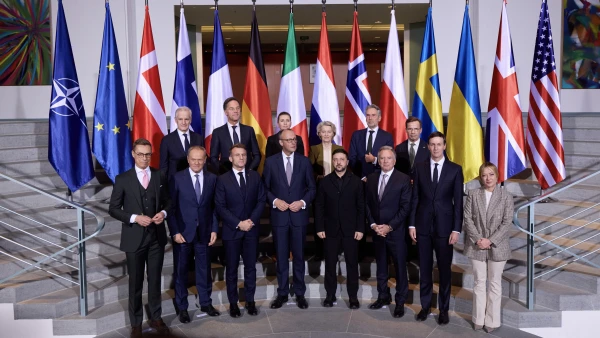
On Monday, European leaders made a joint statement supporting U.S. President Donald Trump's peace plan and the security of Ukraine.
The joint statement was signed by German Chancellor Friedrich Merz, Danish Prime Minister Mette Frederiksen, Finnish President Alexander Stubb, French President Emmanuel Macron, Italian Prime Minister Giorgia Meloni, Dutch Prime Minister Dick Schoof, Norwegian Prime Minister Jonas Gahr Støre, Polish Prime Minister Donald Tusk, Swedish Prime Minister Ulf Kristersson, British Prime Minister Keir Starmer, as well as European Council President Antonio Costa and European Commission President Ursula von der Leyen.
The statement remains open for other countries to join.
The heads of state welcomed the significant progress in President Trump's efforts to achieve a fair and lasting peace in Ukraine. They also welcomed the close cooperation between the teams of President Zelensky, President Trump, and European leaders in recent days and weeks.
The heads of state agreed to work with Trump and Zelensky to achieve a lasting peace that preserves Ukraine's sovereignty and the security of Europe. The leaders highly appreciated the high degree of alignment between the positions of the U.S., Ukraine, and Europe.
The heads of state agreed that ensuring the security, sovereignty, and well-being of Ukraine is an integral part of broader Euro-Atlantic security. A clear position was also expressed that Ukraine and its people deserve a prosperous, independent, and sovereign future, free from the fear of future Russian aggression.
The leaders of the U.S. and Europe committed to working together to provide Ukraine with reliable security guarantees and support measures for economic recovery as part of a peace agreement. This will include commitments, including providing Ukraine with ongoing and substantial support to restore its armed forces, which should number 800,000 in peacetime, capable of deterring adversaries and defending Ukrainian territory.
There are also plans to create international forces under European command, consisting of units from contributing countries within the "Coalition of the Willing," supported by the U.S. This will aid in the restoration of Ukrainian troops, ensure the security of Ukraine's airspace, and enhance maritime security.
It is also planned to establish a monitoring and control mechanism for the ceasefire under U.S. leadership with international participation for early warning of any future attacks, as well as for identifying and responding to violations. This will be complemented by a conflict prevention mechanism to develop measures to reduce mutual tensions, benefiting all parties.
Another goal is a legally binding commitment, subject to domestic procedures, to take measures to restore peace and security in the event of future armed attacks. These measures may include the use of military force, providing intelligence and logistical assistance, as well as economic and diplomatic actions.
Plans are in place to invest in the future well-being of Ukraine, including allocating significant resources for reconstruction and recovery. There are also plans for mutually beneficial trade agreements and consideration of the need for Russia to compensate for the damage caused. To this end, Russian state assets in the European Union have been frozen.
There are also plans to resolutely support Ukraine's accession to the European Union.
The leaders reiterated their support for President Zelensky and agreed to support any decisions that the head of the Ukrainian state ultimately makes on specific issues concerning Ukraine.
The heads of state also confirmed that state borders should not be changed by force. Decisions regarding territory should be made by the people of Ukraine after reliable security guarantees have been provided. European leaders agreed that some issues will need to be resolved at the final stage of negotiations. The leaders emphasized that they will support President Zelensky if he deems it necessary to consult with his people.
The leaders clearly stated that, as in any deal, "nothing is agreed until everything is agreed." All parties must work intensively towards a solution that ensures a definitive cessation of hostilities.
The heads of state also clearly stated that any agreement must protect the long-term security and unity of the Euro-Atlantic community, as well as NATO's role in ensuring strong deterrence. They reported that all elements concerning the European Union and the NATO military alliance will be discussed among the members of the respective organizations.
Now Russia is obliged to demonstrate a willingness to work towards a lasting peace, accept President Trump's peace plan, and prove its commitment to cease hostilities, including agreeing to a ceasefire. The leaders agreed to continue to increase pressure on Russia to compel Moscow to engage in serious negotiations.
All parties committed to working towards rapid progress in the coming days and weeks to jointly conclude and endorse an agreement for a lasting peace. They all reaffirmed their steadfast support for President Zelensky and the people of Ukraine in their struggle against Russia's illegal invasion and in achieving a fair and lasting peace.