
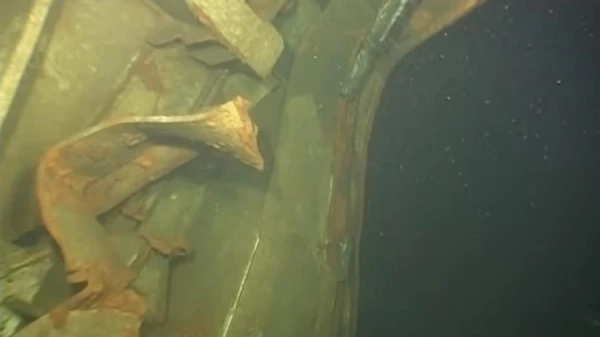
The new investigation into the causes of the sinking of the ferry 'Estonia', which sank on the night of September 28, 1994, found no confirmation of conspiracy theories regarding a hole in the vessel's hull that allegedly appeared before the disaster. The report notes that the damage to the starboard side of the vessel was caused by contact with the seabed.
"The Estonian Safety Investigation Centre (OJK), the Swedish Accident Investigation Authority (SHK), and the Finnish Safety Investigation Authority (OTKES) publish the final report of the preliminary assessment, concluding that there is no need to resume the safety investigation of the ferry 'Estonia' sinking conducted in 1997 by the joint Estonian-Finnish-Swedish commission (JAIC). The damage to the starboard side of the sunken vessel was caused by contact with the seabed. 'Our work also provides a comprehensive and up-to-date overview of the condition of the wreck, the sequence of events, and the broader systemic factors that led to the disaster,' said OJK director Märt Ots.
The report presents a number of conclusions based on marine studies, interviews with survivors, technical expertise, as well as scientific calculations and computer modeling.
'We collaborated with many experts from various fields and conducted six studies at the crash site. The seabed at the wreck location is very well documented. The central part of the vessel rests on a 1.8 billion-year-old gneiss outcrop—a solid bedrock that runs almost diagonally beneath the wreckage. The fact that the wreckage lies on a slope explains its significant displacement over the years,' said SHK investigation leader Jonas Bäckstrand.
The wreckage of the vessel is severely damaged and has significantly shifted on the seabed over the decades. The shape of the damage to the starboard side closely matches the shape of the bedrock exposure nearby. The condition of the wreck is deteriorating over time, which makes the emergence of new deformations possible.
'Although the work to cover the wreckage conducted in the mid-1990s was sharply criticized, the archival documents from these studies turned out to be valuable evidence for the preliminary assessment. Based on these documents, we were able to reconstruct changes in the location and position of the wreckage on the seabed. This explains why previously unknown damage to the starboard side was not visible in the 1990s but became exposed later due to the displacement of the wreckage,' said OJK lead investigator Tauri Roosipuu.
There are no indications of a collision with another vessel or object while the ferry was afloat, nor are there signs of an explosion in the area of the starboard side or the bow.
The investigation of the bow ramp raised from the seabed and computer modeling of the bow structure's failure are consistent with the JAIC's findings from 1997: the bow visor failed under wave load, causing the bow ramp to open and water to begin flooding the car deck.
Updated computer modeling confirms the previous scenario: the rapid influx of water through the bow ramp led to the capsizing of the vessel. Alternative scenarios, including water entering through a hole in the starboard side, are inconsistent with calculations, witness testimonies, and other collected evidence.
According to the joint assessment by OJK and SHK, the ferry 'Estonia' was not seaworthy, as the vessel had unverified and therefore undetected design flaws, as well as exemptions from regulations not reflected in the certificates.
'The vessel had hidden design defects throughout its service life, and technically it was not safe for operation on this route. The relevant parties—neither onboard nor onshore—were aware of this,' added Bäckstrand.
During the additional investigation, testimonies from 68 survivors were collected. 'Interviews indicate that a certain amount of water entered the cabins located below from the car deck. They also confirm that military equipment was not loaded onto the vessel. Many witnesses expressed opposition to the idea of covering the wreckage and did not understand why the bodies of the deceased were not raised to the surface,' said SHK lead investigator Jörgen Zachau.
'The final report emphasizes that the sinking of the ferry 'Estonia' was not caused by a single main reason or specific actions of the crew. It was a complex systemic failure in the shipping industry, involving multiple deficiencies. Unfortunately, this disaster served as a wake-up call for the entire industry, as incidents related to bow visors had occurred before it, but information about them was not widely disseminated,' emphasized Roosipuu.
The chain of errors, starting with an imperfect regulatory framework, continuing through the design and construction process of the vessel, exacerbated by insufficient oversight and deviations in certification, as well as operational practices and safety culture in the maritime sector, created a situation in which it was practically impossible to prevent the disaster after the first deficiencies manifested.
The final report notes that public discussion often focused on individual factors, such as the speed of the vessel or the quality of maintenance. Based on the preliminary assessment, it is clarified that these factors alone are insufficient to explain the sinking of the vessel; the disaster was the result of an accumulation of systemic errors and inadequate risk management throughout the industry.
Although the disaster of the ferry 'Estonia' was extremely tragic, it led to the development and implementation of new unified regulations, primarily concerning bow structures and vessel stability, strengthening the structures of existing vessels, and the development of rescue equipment. Nearly three decades of safe ferry operations in the Northern and Baltic Sea region after the disaster have shown that valuable lessons were learned from the tragedy that improved safety at sea.
Considering all available evidence, it can be concluded that the ferry 'Estonia' sank due to the failure of the bow structure, and new damage to the starboard side occurred as a result of contact with the seabed. Therefore, there is no need to resume the investigation into the circumstances of the sinking of the ferry 'Estonia'.









Leave a comment