
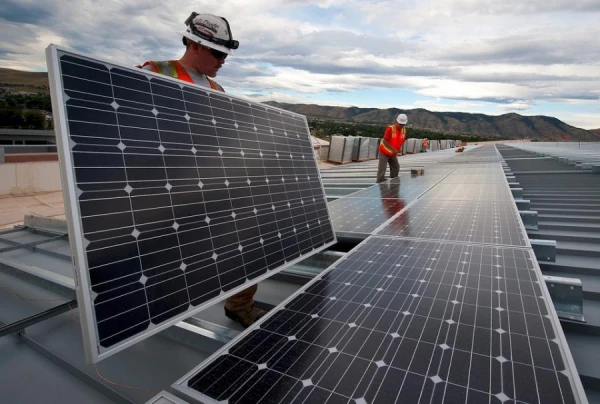
Interest in solar panels is declining worldwide. Next year, the volume of installations will decrease for the first time since the industry emerged in the global market over 20 years ago.
Bloomberg reports that, according to the BNEF Global PV Market Outlook, 649 gigawatts of solar power capacity will be added worldwide in 2026, which is less than in 2025. The growth this year is the weakest in the last seven years, and the decline next year will be the first since 2000.
The reason for the decline is changes in the policies of China and the United States, which have led to a decrease in demand. Other markets will not be able to compensate for the significant shortfall caused by the two largest economies in the world.
This is bad news for Chinese solar manufacturers, who are already struggling with overproduction and losses. The market pricing policy for renewable energy introduced in June caused a surge in installations at the beginning of the year, followed by a sharp slowdown. BNEF has lowered its installation forecast for China in 2025 by 9% to 372 gigawatts and by 14% for 2026.
At the same time, the U.S. market is also expected to slow down at a similar pace due to President Donald Trump's efforts to limit the adoption of renewable energy and return to fossil fuels.
Other markets, such as Spain and Brazil, are also slowing down. They experienced rapid capacity growth in solar energy, which led to falling electricity prices and created uncertainty that is holding back investments.
Meanwhile, it is expected that by 2027, the volume of solar installations will show "moderate" growth as China and the U.S. adapt to new demand and supply conditions, and new markets expand. According to BNEF, the total volume of installations this year will be 688 gigawatts.
Solar Energy - Latest News
A huge secondary market for solar panels has emerged worldwide. Experts explain that people are mass dismantling and selling solar panels because this technology has reached its limit.
In addition, floating solar panels are rapidly gaining popularity as a promising direction for "green" energy, but new studies raise questions about their environmental safety. Modeling conducted by U.S. scientists showed that covering reservoirs with panels reduces water temperature and affects ecosystems.














Leave a comment