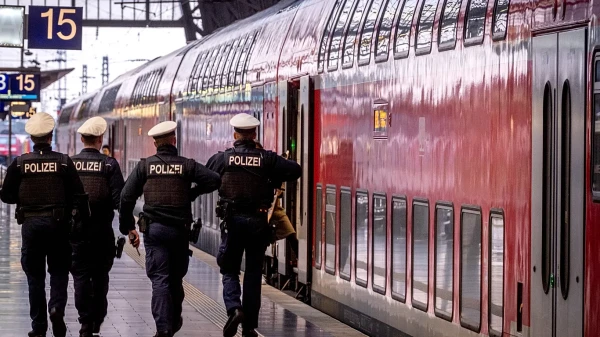
Violence at train stations in Germany has risen again. This is stated in the annual report of the Federal Police for 2024. Compared to the previous year, the number of violent crimes increased by 6%, and compared to 2019 - by 51%. A total of 27,160 violent crimes were registered at train stations and on trains. Police are increasingly having to keep a close eye not only on large cities but also on small and rural stations.
The increase has also been noted in the area of sexual offenses. In 2024, the Federal Police recorded 19.2% more cases of exhibitionism, harassment, rape, and other sexual offenses. A total of 381,894 crimes were registered at train stations and on trains - a decrease of 10.1% compared to 2023.
"The report is alarming," said Manuel Ostermann, Vice Chairman of the Federal Police Union, in an interview with Euronews. "The overall number of crimes has decreased, but in key areas - violent and sexual crimes, as well as violations of the Weapons Act - the situation remains complex."
As with train stations, the total number of offenses has decreased by 18.8% compared to the previous year, to approximately 640,000 registered cases. This is largely due to a decrease in violations related to the Residence Act.
At the same time, the report notes an increase in violent and sexual crimes across Germany - by 6.6% and 13% respectively. The data only pertains to registered cases and does not reflect the number of initiated cases or convictions.
According to Manuel Ostermann, the increase in registered acts of violence may be linked to social problems: more people are left without support from infrastructure such as social workers and educators.
Typical Profile of an Offender
The profile of the offender, according to the report: predominantly men, often under the influence of alcohol or drugs, and frequently without German citizenship.
"Extremists know how to attract young people," notes Manuel Ostermann, "In fact, many problems start at home."
He also points to migration as a risk factor:
"The profile of offenders is predominantly male, and, secondly, in relation to the overall population, these are men from major asylum countries."
According to the report, about 79% of offenders are men. Almost half (49%) were under the influence of alcohol or drugs at the time of the crime, and just over half (53%) did not have German citizenship.
The Federal Police and Deutsche Bahn are trying to combat crime at railway stations by increasing the presence of staff, conducting checks, creating weapon-free zones, and installing over 11,000 surveillance cameras.
Ostermann calls for greater responsibility from Deutsche Bahn AG:
"It also needs to protect its own stations by increasing the number of security personnel. Stations need to be modernized more quickly."
According to him, well-lit and well-maintained stations can enhance the feeling of safety and possibly lead to a reduction in crime.
Violence Against Police Officers Remains a Serious Problem
Federal police officers are also increasingly becoming victims of attacks. In 2024, the number of such cases reached 2,967 - slightly less than in 2023 (2,979), but it remains the second-highest figure since statistics were introduced in 2001.
"Every attack on the physical integrity of our public servants is an attack on society as a whole and on our peaceful coexistence," stated the Minister of the Interior of Germany, Alexander Dobrindt (CSU), in his report.
Last year, 804 Federal Police officers were injured, most of them men.
"Attacks almost always involved physical violence: kicks and punches, spitting, biting, blows to the head and body. In every eighth case, objects were used - most often bottles, stones, and household items," the police report states.
Vice Chairman of the Federal Police Union Manuel Ostermann, a member of the CDU, positively assesses the work of Minister of the Interior Alexander Dobrindt but notes that much has been overlooked in the last ten years.
"We will consider these years as dark in terms of security. More cameras are good, but with a lack of technology, legal framework, and personnel, problems arise. This is hardly thought about. We are still far from effective cooperation between the federal government and the states. If you look, for example, at schools, they have not been renovated for decades. Restoration will be both a sprint and a marathon," Ostermann said in an interview with Euronews.
In the end, the report sends a clear signal: despite positive changes in certain areas, the situation is deteriorating where it is most sensitive.