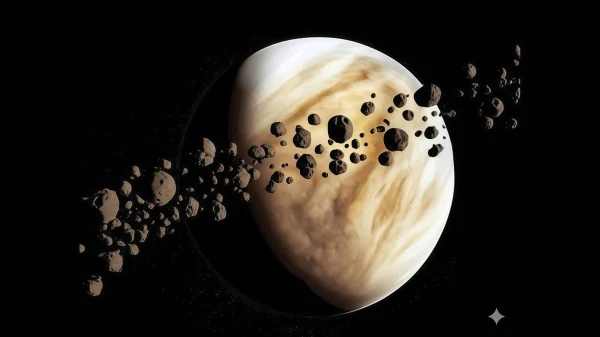
This will require six gravitational maneuvers at Venus.
According to calculations by a Russian space mission design specialist, there is a real possibility of examining five potentially hazardous near-Earth asteroids up close in just 3.5 years using the same probe. He assured that fuel costs would be relatively negligible: instead of engines for acceleration and redirecting the spacecraft, the gravity of a neighboring planet can and should be utilized.
The famous probe "Voyager 2" flew past four gas giants in just 10 years — from 1979 to 1989 — whose orbits are separated by hundreds of millions or even more than a billion kilometers: Jupiter, Saturn, Uranus, and Neptune. It accomplished this with the help of the planets themselves: it approached each of them at the right angle and received tremendous acceleration from their gravity. Without such acceleration, a similar journey would have taken about 30-40 years.
This is the most striking illustration of the grand possibilities of the indispensable trick for interplanetary missions called a gravitational maneuver. It is constantly used in astronautics: for example, thanks to Jupiter's gravity, the New Horizons probe reached Pluto several years faster, while MESSENGER was accelerated near Venus for its flight to Mercury.
Recently, the Institute of Space Research of the Russian Academy of Sciences proposed using the second planet from the Sun for another interesting, and possibly vital, purpose for humanity — studying potentially hazardous asteroids flying in the vicinity of Earth. These are celestial bodies ranging from 100-150 meters in size that approach our planet at a distance of seven and a half million kilometers or less. There are several thousand of them.
Astrodynamics specialist, gravitational maneuvers expert, and researcher of Venus and small bodies of the Solar System Vladislav Zubko recently decided to focus his calculations on the very tip of this iceberg: 139 asteroids that are at most about the distance of the Moon from us. For reference, this is an average of 384 thousand kilometers.
In a paper published on the arXiv.org preprint server, the scientist outlined a whole list of realistic schemes for flying past several such objects in the coming years using Venus. The main advantage of this concept is that the same probe can "examine" up to eight asteroids in a short time with minimal fuel expenditure. Essentially, during the maneuvers, fuel will only be needed for "fine-tuning" the orbit, while gravity will do most of the work.
One of these schemes involves launching a spacecraft on October 1, 2029, and flying past five potentially hazardous asteroids over the next three and a half years. This will require six gravitational maneuvers at Venus.
Among the mission's targets is 1997 XF11, which caused a significant stir after its discovery: initial trajectory calculations indicated a high risk of it hitting Earth on October 26, 2028. Its diameter is estimated to be about 1.4 kilometers. According to current data, on that day, the object will pass at a distance of 930 thousand kilometers from Earth — more than twice the distance to the Moon.
Nevertheless, the researcher is convinced that it would be quite beneficial to clarify the asteroid's trajectory, size, mass, shape, structure (how porous it is), and rotation speed. The same applies to all other asteroids on the list of potentially hazardous ones.
After all, the very term "potentially hazardous" implies that it is not entirely safe to observe their wandering in the vicinity of Earth. And most importantly, such a mission could be considered a "dress rehearsal" in case there is a need to urgently investigate an object that truly threatens humanity.