
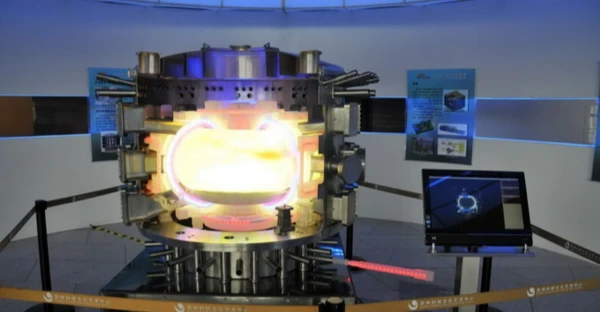
The young Shanghai company Energy Singularity has announced a significant breakthrough in the development of nuclear fusion energy.
The HH70 tokamak, developed in-house using high-temperature superconductors (HTS), has set a world record among commercial nuclear fusion reactors by maintaining a stable plasma current for a continuous cycle lasting 1337 seconds (over 22 minutes).
The HH70 installation was commissioned in June 2024. It can be considered a next-generation tokamak, as all its magnets rely on high-temperature superconductivity. The ITER project, for example, uses superconducting magnets that require deeper cooling — low-temperature superconductivity. The higher the temperature of the magnetic system, the cheaper and more convenient it is to operate, which is what the developers at Energy Singularity aim to achieve.
Since the launch of HH70, 5755 experiments have already been conducted. Importantly, this breakthrough was made possible by the continuous optimization of the plasma control system based on artificial intelligence. AI and high-temperature superconductivity are the two ingredients for the project's success, the company claims.
The material gathered during the experimental operation of HH70 has allowed for the design of the next experimental reactor — HH170. According to previous plans, it is expected to be commissioned in 2027, so that by 2030 the company can move on to the creation of a prototype nuclear fusion power plant using high-temperature superconductors. The HH170 reactor is expected to demonstrate a positive energy output with a Q factor of 10. In other words, the reactor should produce 10 times more energy than is used to heat the plasma.













Leave a comment