
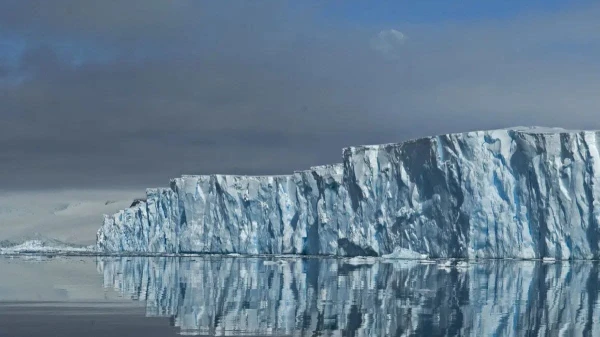
Unfortunately, this structure will not stop climate change.
The Thwaites Glacier in West Antarctica is melting significantly faster than scientists expected, and now a group of engineers and climatologists is proposing a radical solution — to physically block warm ocean water that accelerates its destruction.
The project involves the construction of a large barrier anchored to the seabed, which is intended to slow down ice loss at the glacier, often referred to as the 'Doomsday Glacier.' Today, Thwaites is responsible for about four percent of annual global sea level rise. Its area is over 190,000 square kilometers, and the volume of ice is such that, if it were to collapse completely, global sea levels could rise by about 65 centimeters. Each additional centimeter of water rise puts approximately six million people worldwide at risk of coastal flooding.
The idea belongs to the Seabed Anchored Curtain Project initiative — a collaborative project of scientists, engineers, and policy experts who believe that mere emission reductions may not be enough to stabilize the glacier.
Instead, they propose to install a flexible underwater 'curtain' designed to block warm ocean currents that erode the glacier from below. This structure will not stop climate change. Its purpose is to slow down the melting rate, buying time until global emission reduction measures start to take effect.
The proposed structure will be just under 150 meters high and will stretch approximately 80 kilometers along key sections of the seabed in front of the Thwaites Glacier. Anchored to the ocean floor, the curtain will act as a physical barrier, limiting the inflow of warm seawater that erodes the ice shelf from below.
Teams from the University of Cambridge, the University of Chicago, New York University, Dartmouth College, the Alfred Wegener Institute, the Norwegian Institute for Water Research, Aker Solutions, and the Arctic Center of the University of Lapland are involved in the project.
The project's roadmap includes a three-year research phase focused on material selection, development of anchoring systems, and prototype testing.














Leave a comment