
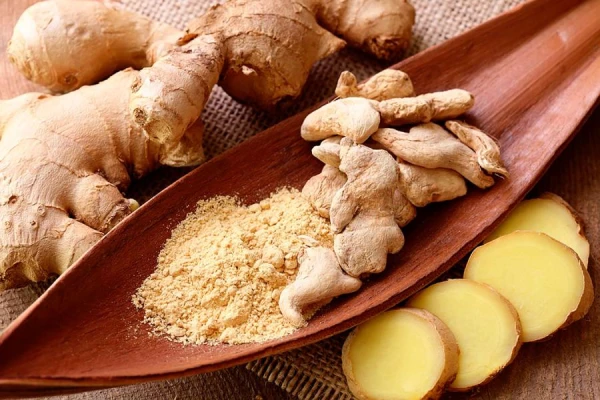
Ground ginger has almost the same health benefits as fresh ginger. Let's consider the nuances of choosing, using, and preparing ground ginger.
What Ground Ginger Is
Ground ginger is a popular spice widely used in Eastern cuisine, especially in Indian, Chinese, Japanese, and Thai dishes. However, ginger has also gained popularity in our regions: its main advantage is that it pairs well with meat, chicken, and fish, as well as with vegetables, especially when sautéed in ghee. Moreover, ground ginger often turns out to be more aromatic and spicy than fresh ginger, as it is a concentrate, especially if prepared well.
Another advantage of ground ginger is the ability to quickly prepare a healthy drink based on it. We will explain how to do this below.
Ground Ginger: Store-Bought or Homemade?
Experienced cooks agree: spice prepared by oneself significantly surpasses store-bought. Firstly, it is fresh: even well-packaged spices lose their aroma and flavor over time. Secondly, when it comes to bulk spices, the storage conditions are not always obvious — who knows what might have settled on the bright piles while gourmets approached them.
With homemade preparations, everything is much clearer: yes, it will take time to prepare the product, properly dry it, and grind it into powder, but you will be confident in the final result. And, most likely, you will appreciate the richness of flavor and aroma. Time or quality — the choice is yours. If you decide to buy ground ginger, choose trusted brands and packaging that is easy to open and close, secured with a clip.
How to Prepare Ground Ginger at Home
To obtain spicy ground ginger, you first need to acquire a regular root. In supermarkets, it is available in the fruits and vegetables section — either loose or on a tray wrapped in plastic. Choose a few of the highest quality roots — they should show no signs of rot or mold. If possible, break a piece of ginger and check if it has a bright, juicy, and aromatic fracture. This guarantees that the root is indeed spicy.
At home, wash the ginger, dry it, and peel it. This can be done with a vegetable peeler or a small knife — these tools make it easier to navigate the side branches and hard-to-reach spots. Then, slice the ginger into thin pieces. Next, it needs to be thoroughly dried.
Vegetables can be dried in several ways — it all depends on your kitchen equipment. For example, using an oven. Line a baking sheet (or several, if available) with parchment paper and spread the ginger slices in a single layer. Preheat the oven to 90-100 degrees Celsius and place the ginger in it for several hours. It is better to leave the door slightly ajar and occasionally turn the slices.
A dehydrator (or electric vegetable dryer) will require less of your involvement. Arrange the ginger on the trays and turn it on for about 8 hours. Check periodically for readiness. The root should be completely dry. The exact drying time depends on the juiciness of the root and the thickness of the slices.
Checking for readiness is easy: try bending a slice. If it is brittle and breaks, the ginger is ready for the next stage.
The dried ginger should be cooled to room temperature; otherwise, excess moisture will remain in it. This can take from two to four hours. Then, place the ginger in a blender (it should be capable of grinding to a very fine state) or a coffee grinder and grind it. The finished ground ginger should be stored in an airtight jar — preferably one with a tightly sealing lid with a rubber gasket.
Where to Add Ground Ginger
Here, you can trust your imagination: ginger as a spice is suitable for many dishes. For example, just a pinch will give roasted meat a piquant Eastern flavor. You can prepare a sauce for chicken or make a marinade for pork with ginger. Additionally, it pairs wonderfully with other spices: turmeric, garlic, chili pepper.
It is worth noting separately the baking with ginger. The first thing that comes to mind is gingerbread cookies. Now is the most suitable season for them, considering the weather outside: they will go perfectly with tea and honey on any autumn day. For the dough volume for 25 aromatic cookies, you will need two teaspoons of ground ginger. It is best to use homemade ginger.
A pinch of ginger can be added to regular pancakes — along with a bit of nutmeg and cinnamon. This way, the familiar snack will acquire the flavor of a gingerbread house. Or add spices to an apple charlotte with sour cream. You will be surprised how the simple combination of ginger and cinnamon transforms classic baking.
How to Brew Ground Ginger
Ground ginger, like fresh ginger, is suitable for preparing warming and toning drinks. This spicy root strengthens the immune system, speeds up metabolism (by the way, it helps with weight loss), has antipyretic effects, and possesses antibacterial properties. This means it can be consumed both during illness and for prevention. It also helps reduce the risks of arthritis and cardiovascular diseases.
Just one teaspoon of ground ginger can be added to regular tea brewing — for health benefits and flavor. The spice should be poured into the teapot before pouring in hot water.
Another option is a ginger drink without tea. For this, you will need a quarter teaspoon of ground ginger for one cup of hot water. Steep and stir thoroughly. For variety, you can add a slice of lemon and a teaspoon of your favorite honey. This drink is excellent for consumption in the morning or evening — right after breakfast.
By the way, we recently published a recipe for an amazing healing drink for anxiety and headaches — it also contains ginger, along with several other interesting spices. Be sure to try it.








Leave a comment