Mayonnaise has become such a discussed topic in cooking that writing about it seems inappropriate. However, the clumsy use of this wonderful gastronomic idea does not diminish its value.
The history of this wonderful idea remains uncertain, although many sources link the appearance of mayonnaise to a banquet held in honor of the capture of the Spanish Mahón in Minorca by Duke Richelieu in 1756. However, Marie-Antoine Carême had a completely different opinion on the matter.
But that is not so important; let’s move on to the preparation of the mayonnaise itself. There are several methods, and each has its advantages. Let’s start with the classic one, which is the most traditional.
Hand Method of Making Mayonnaise
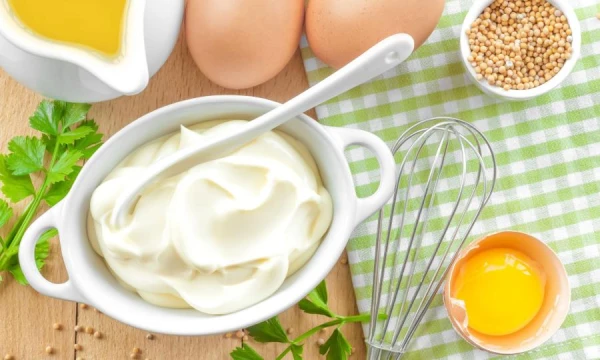
1. Take a bowl, preferably metal and with a round bottom. Place the egg yolk in the bowl. Add a teaspoon of mustard, a pinch of salt, and a little pepper.
2. Use a whisk or fork and thoroughly beat the mixture until it becomes homogeneous. Add a few drops of lemon juice.
3. Now take a container of olive oil in your other hand and start to drip (do not pour!) the oil into the bowl while whisking the mixture with the other hand.
If all goes well, a white emulsion will begin to form. The process will be noticeable — white threads will appear in the initially homogeneous mixture, which will gather into a layer, and soon the entire mass will become white and thick. It resembles a trick or a miracle, without a doubt. It is important to drip first the lemon juice and then the oil, not the other way around.
Once the emulsion starts to form, you can add the oil in a stream, and it will immediately bind with the mass.
If the oil refuses to emulsify, you may have added too much too quickly. Don’t despair. In another bowl, start over: place the yolk, add the mustard, drip some lemon juice, whisk, and then add not the oil, but your failed mixture from the first bowl drop by drop. The chances of success are quite high.
Although this method is traditional, as Zhvanetsky says, “for connoisseurs.” Let’s consider more reliable methods.
Machine Method of Making Mayonnaise at Home
If you have a powerful stationary blender with a large jar, the task becomes easier. Place one whole egg, one yolk, a tablespoon of mustard or the juice of half a lemon, half a teaspoon of salt and pepper in the jar, blend for 5 seconds, and pour in a cup of olive oil through the top opening. Thanks to the high speed and blade design, the mayonnaise will easily turn out.
Using an immersion blender is a bit more complicated. It usually comes with a tall narrow cup. In this cup, again place one whole egg, one yolk, mustard, salt, and pepper, carefully cover the yolks with the blender attachment, placing it at the bottom. Then pour a cup of oil on top, turn the blender on high speed, and wait for white streams of emulsion to start appearing from underneath. Usually, 10–15 seconds is enough. Now you can slowly lift the blender, capturing the upper layers of oil until it is fully emulsified. In 30 seconds, you will have homemade mayonnaise.
How to Store Homemade Mayonnaise
If you plan to store homemade mayonnaise for a while, it needs to be stabilized. Add a tablespoon of boiling water, stir, and it will stabilize. If the mayonnaise turns out too thick, it can be thinned with lemon juice, water, cream, or sour cream. Lemon juice is preferred.
If you do not like the strong taste of olive oil or it is too expensive, use a couple of tablespoons for flavor, and fill the rest with sunflower oil. Instead of lemon juice, vinegar can be used, especially aromatic vinegar.