
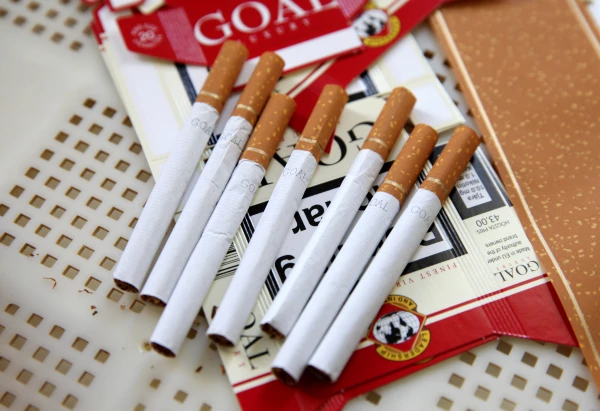
The problem discussed below was raised within the walls of the Latvian Lawyers' Association. It was addressed by the head of an agency whose activities include providing various services to companies that hold rights to cigarette brands, at the initiative and invitation of the association's leadership.
In case signs of illegal activity in the tobacco product trade are detected, this detective agency takes measures to involve law enforcement in verifying the information.
There are more than ten companies providing such services in EU countries; over the course of a year, thanks to joint efforts, law enforcement agencies uncover dozens of illegal productions and seize hundreds of millions of illegal cigarettes.
However, the fight against the "shadow" continues, and it is clearly far from over. What factors, in the opinion of the interviewee, hinder it? This is discussed below.
When Good Quality Is Bad
– First of all, I would like to note that recently the quality of illegal cigarettes has significantly increased and sometimes even rivals legal products produced according to all standards. And in our case, this is not advertising, but a statement of a very alarming fact indicating the presence of a serious problem — that there is a free circulation of equipment. In other words, someone with a certain amount of money can purchase a full-cycle production line and start producing cigarettes.
However, if you want to produce them legally, you must meet certain very strict conditions. In particular, you need to obtain a license, and for that, approvals from various authorities are required. And this incurs costs — both time and financial. And, of course, even before you start production, at the stage of equipment debugging and testing, you need to pay excise tax for each produced and then necessarily destroyed cigarette.
Now let’s estimate: if even under such conditions the production of tobacco products remains very profitable — how much more profitable is such a business when it is illegal!
As I mentioned, the quality of illegal cigarettes — especially in the cheap segment — has recently been almost on par with legal ones; they — unlike illegal alcohol, the consumption of which poses a huge risk of death or serious harm to health — generally do not carry significant risks. That is, the harm from them is approximately the same as from regular cigarettes produced legally.
Many consumers, especially those who are poorer and not very picky, frankly do not care whether the cigarettes are produced legally or not — it’s even better for them if the cigarettes cost less. And here the "illegals" win the competition, as they say, by a landslide, because the production cost of a pack of cigarettes is relatively low, with the main "markup" coming from various taxes. As a result, a pack costing, say, 1 euro at the kiosk will sell for 4-5 euros (and in Central and especially Western European countries, even more — it can cost up to 15 euros). The "illegals," on the other hand, due to "savings" on taxes, will sell their products much cheaper.
And here we have two problems at once:
- First, illegal products become more competitive due to their low cost,
- Second, illegal cigarette productions objectively do not evoke as much rejection in society as, for example, "roll-your-own" producers or, even more so, drug dealers.
Accordingly, there is not much desire in society to uncover illegal "points" in the tobacco product market.
Of course, there are people who would never touch products produced in unclear conditions. But let’s be realistic: when incomes are low and the desire to smoke literally makes your mouth water, there’s no room for whims... And I’m not just talking about Latvia.
Illegal — But Oh-So-Tempting...
– The illegal cigarette business, as mentioned above, is incredibly profitable. However, it also requires certain investments: purchasing production facilities, sourcing raw materials and packaging, delivery to a specific location, finding dealers...
Importantly, this business carries significant risks — in particular, the risk of losing one’s freedom for a considerable period. Nevertheless, there seems to be no shortage of personnel in this field, as far as we can tell. The reason is simple: compared to average incomes in a given country, people involved in this business earn quite substantial amounts. Therefore, it is easy to involve less wealthy individuals, both locals and newcomers — refugees, guest workers, illegal migrants (for example, in Scandinavia, this sector is tightly controlled by people from the Middle and Near East).
Let me give you an example. The minimum price for a box of cigarettes on the black market is around 700 euros (including transportation). The truck driver, who is transporting, say, a thousand boxes, receives 50 euros per box. Yes, if he is caught with this cargo, he faces a serious prison sentence. But 50,000 euros — that’s an amount for which many would be willing to take the risk. The same can be said for other workers involved in this field: they take risks — but they also earn, by the standards of their country, quite well. So the temptation is enormous.
Of course, no one transports illegal cigarettes openly; a whole system has been developed, which includes forging accompanying documents, organizing escorts to avoid "unwanted" checks on the roads, and so on (I won’t go into details for obvious reasons). All this greatly complicates the fight against this illegal business.
From Latvia — With "Love"?
It should be noted that Western and Southern European countries are a very important and profitable market, as the cost of cigarettes there is several times higher than in Latvia. And despite the high-profile arrests and seizures of illegal cigarettes recently, according to estimates from companies holding rights to tobacco brands, the flow of illegal cigarettes coming from Latvia to Europe has not decreased.
This indicates that, despite millions of seized cigarettes in Latvia, it is clearly not yet time to rest on our laurels. There are still plenty of illegal productions in our country, both large and small: they compete with each other and sometimes unite, investing in some common "projects."
When talking about Latvian leaders in the illegal cigarette market, I would highlight two of the largest groups; at the same time, law enforcement agencies seem to pay close attention to one of them, while for some reason overlooking the other. We see this, but I cannot answer why this is the case. I hope it is due to some operational considerations.
Moreover, I repeat — the flow of illegal cigarettes coming from Latvia to Europe has not decreased after all these seizures. Therefore, it would still be desirable for law enforcement agencies to pay attention to the other groups, the existence and activities of which — I am sure — they are also well aware of.
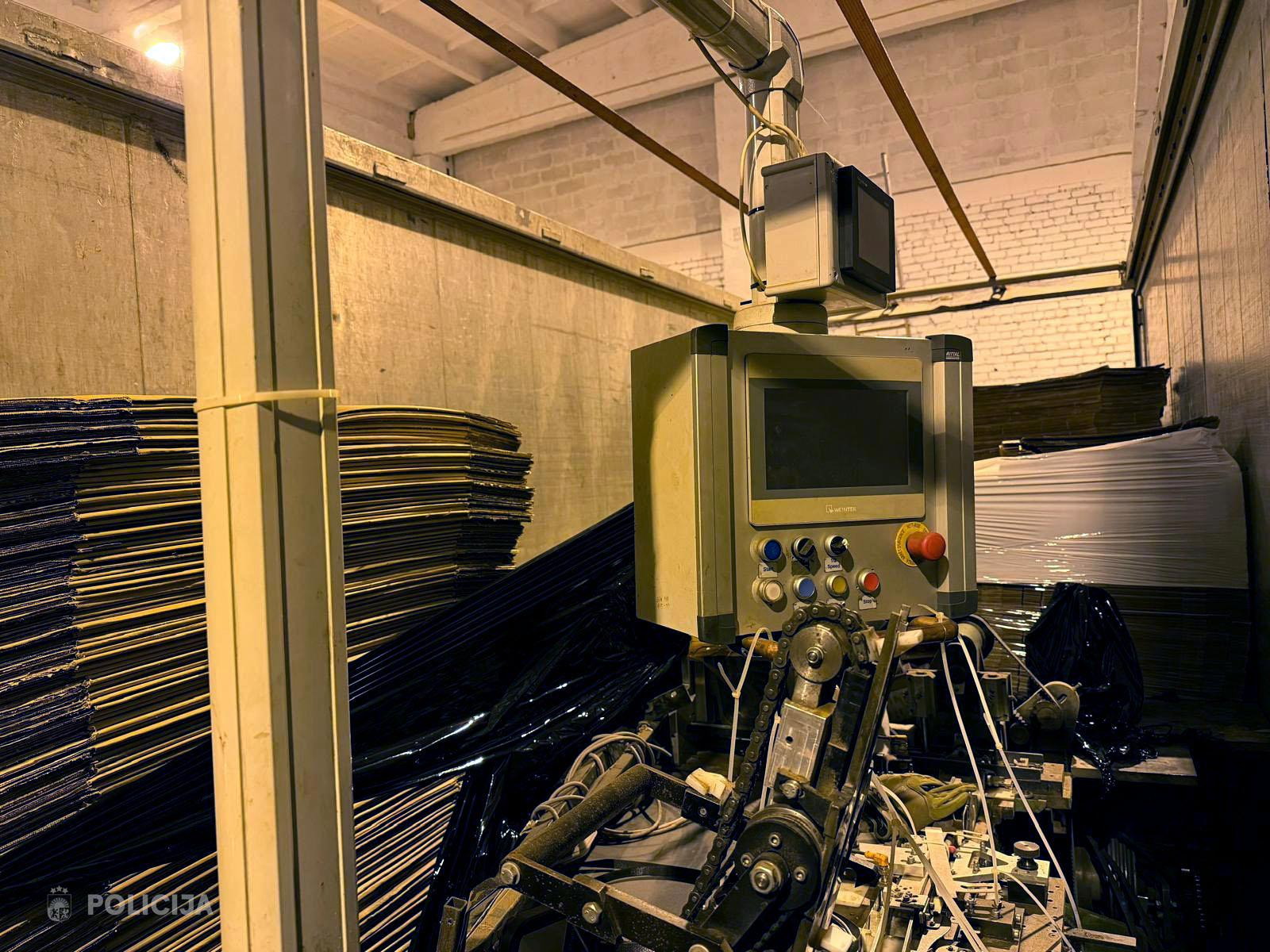
Photo: Valsts policija
"Belarusian" Cigarettes Made in Latvia
– If earlier illegal cigarettes were firmly associated with both counterfeiting and smuggling, primarily from Belarus, now there has been an interesting metamorphosis with these cigarettes: counterfeit (that is, illegally produced products) are now being faked by Latvian "craftsmen" ... as smuggling!
In simpler terms, not only cigarettes counterfeited to well-known global brands are produced in Latvia, but also those imitating Belarusian products. Moreover, they are counterfeiting Belarusian excise stamps! All of this is then directed to local and European markets, where, it must be admitted, this product is quite highly valued, primarily due to the price/quality ratio.
Just a couple of years ago, no one even thought of counterfeiting Belarusian cigarettes. Now this is happening in large quantities.
Increasing Excise Tax — More Profit for the "Shadow"?
– When a state faces financial problems (and such problems arise regularly), one common way to improve the situation is to raise the excise tax on goods that are inherently recognized as harmful. This usually provokes protests from producers of legal excise products, but, as a rule, the increase still occurs.
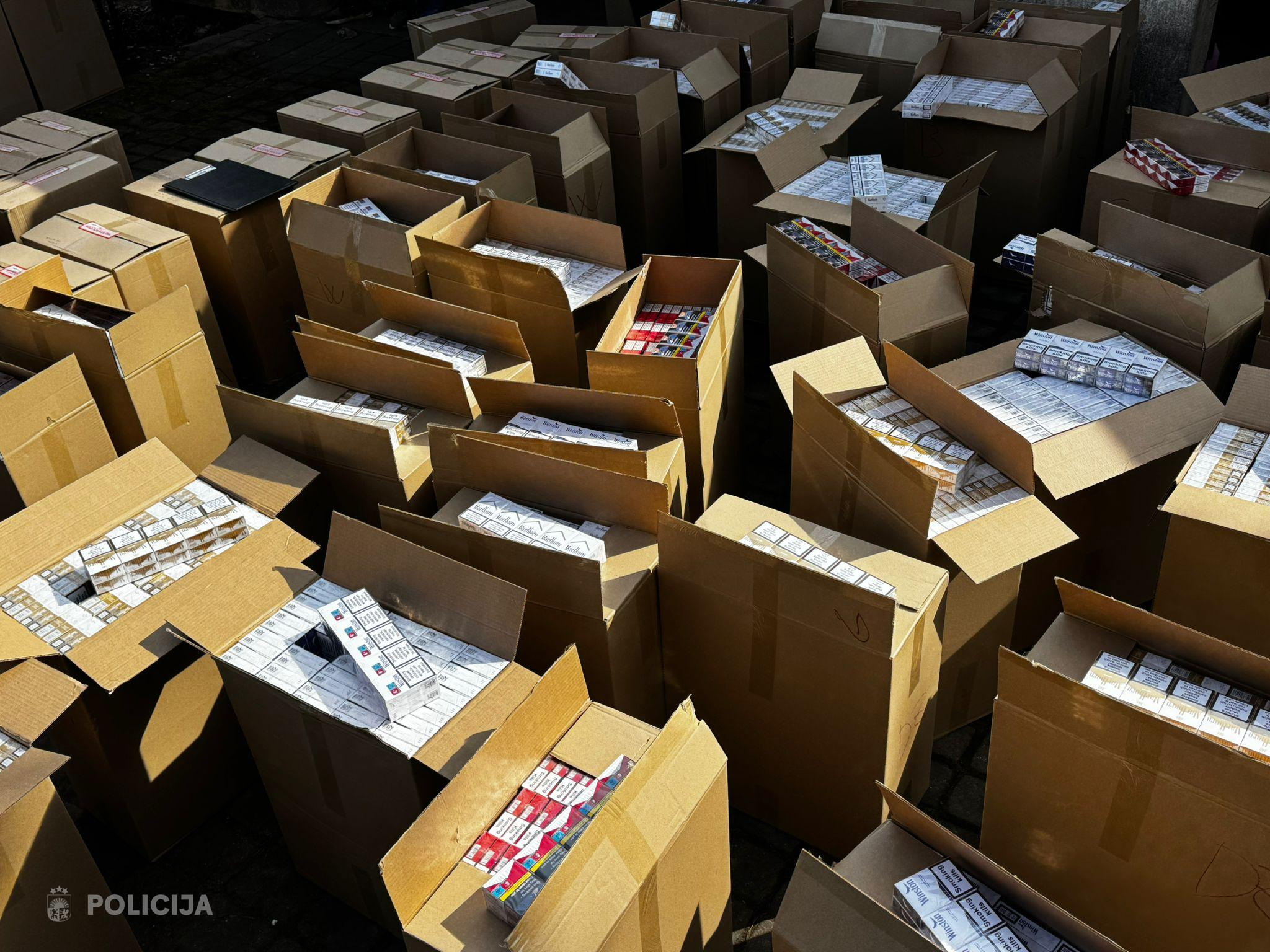
Photo: Valsts policija
However, let’s look at the side effect of such decisions.
We have official statistics (I am currently speaking exclusively about cigarettes). And it shows: the tax has increased — the number of packs of cigarettes sold in legal sales locations has decreased. But does this mean that society has suddenly become healthier and there are fewer smokers? Not at all: it simply means that the amount of counterfeit sold has increased, which, of course, does not appear in the official statistics.
What gives me the basis to assert this? There are auditing companies, one of whose tasks is monitoring: what is the ratio of legal and illegal cigarettes in a specific city/country. The agency hires workers who collect discarded cigarette packs — from bins at bus stops and other places where smokers usually throw these packs away. Then it is analyzed how many were "legal" packs and how many "illegal." So, when the excise tax increases once again, the number of the latter immediately skyrockets. So on paper everything seems wonderful, but in reality — alas.
Japanese Experience
– The shadow business is always evil. First, even if producers of illegal cigarettes try to "maintain their brand," controlling compliance with all the established sanitary and other norms in such production is impossible. Therefore, there is always a chance that something will go wrong — consequently, there is always a risk to the health and even lives of consumers.
Secondly, this leads to huge losses for the state, which means that it affects all residents in one way or another.
Finally, the "shadow" always brings along other crimes — massive corruption in all government structures, "settling scores" for markets and other criminal activities.
How to solve the problem of the illegal cigarette market? This is within the competence of our legislators and government. I can, however, tell how this issue was once resolved in Japan.
For a long time, there was a black market there, where both counterfeits and smuggled goods were sold in huge quantities. This was quite understandable: a country with one of the highest standards of living (and corresponding prices for cigarettes), and nearby — countries in Southeast Asia with very poor populations. I believe that the poor but enterprising neighbors of the Japanese were ready to deliver both counterfeits and smuggled goods to Japan even on junks and rafts!
The solution the authorities found was very elegant. They simply introduced a gradation — branded cigarettes and non-branded cigarettes. With branded cigarettes, everything remained the same. However, with NON-branded ones (let’s conditionally call them "white packs"), there were changes. They had minimal printing on the packs and were produced only in state-owned factories.
That is, they were produced legally and, importantly, went through certain quality control. And most importantly — their cost compared to branded ones was quite low, as they were not subject to excise tax or all the additional taxes. The ultimate goal was to release cheap cigarettes onto the legal market, alongside branded ones, comparable in price to smuggled and counterfeit cigarettes.
As a result, if prestige is important to the buyer and he can afford it, he goes to a large retail chain store and buys well-known brand cigarettes (others are not sold there). And cheap "white packs" are available in small shops, although branded ones can also be purchased there.
For smokers who are satisfied with counterfeits or smuggled goods, it’s essentially all the same — they are usually only interested in the price. Often, they are not even able to distinguish one from the other. And if a "legal" cigarette is quite competitive in price with an "illegal" one, why buy a product made who knows where and from what paper, glue, filter, and other raw materials? It’s better to buy a "white pack!"
Advantages of such a solution:
- People get a guarantee of quality at a competitive price for the product;
- Workers in such productions receive legal incomes and social benefits;
- There is less ground for serious corruption in the state;
- The criminal environment loses a significant portion of its financial "support."
And what do we have? The problem of the illegal tobacco market in Latvia, as well as possible ways to solve it, has long been known to both politicians and officials. But no one has yet taken real action...







Leave a comment