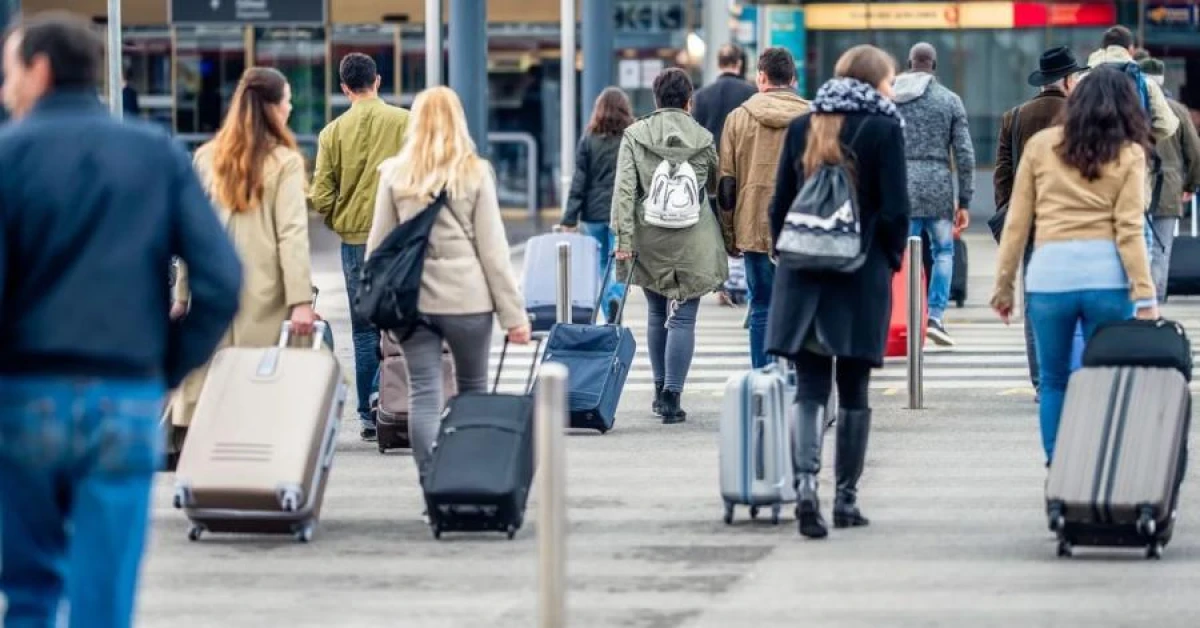
On Monday evening, representatives of the European Parliament and the EU Council reached an agreement on updating the rights of air passengers, which have been in effect since 2004.
The aim of the agreement is to protect passengers from disruptions during their travels, including delays and cancellations of flights. Although the EU Council intended to relax some existing rules, the Parliament strongly opposed this and ultimately achieved its goal.
Thus, airlines will still be required to compensate for delays of three hours or more, with payments to be made within 30 days. An adult traveling with a child must receive a seat next to them for free, and ticket prices must be transparent.
"The European Parliament has always advocated for reliable protection of air passengers, and today’s agreement provides them with even stronger positions than before. The new rules will enhance transparency and predictability for both passengers and airlines. At the same time, they will not create excessive bureaucracy. Processes will become simpler, and the treatment of passengers will be fairer," said European Parliament President Roberta Metsola.
If a flight is delayed by more than three hours, canceled less than 14 days before departure, or if a passenger is denied boarding, they retain the right to a refund, rerouting, and compensation.
The amount of compensation for delayed or canceled flights depends on the distance of the flight: €250 for flights up to 1500 kilometers, €400 for flights from 1500 to 3500 kilometers, and €600 for longer flights. However, for the longest flights, compensation may be reduced by half if passengers are offered rerouting after a disruption or if they arrive at their final destination with a delay of up to four hours.
If a flight is delayed or canceled due to circumstances beyond the airline's control, it is not obliged to compensate passengers. This exception applies to cases such as natural disasters, war, extreme weather conditions, strikes at the airport or air traffic control center, as well as situations caused by problematic passengers.
However, the airline is still required to take care of passengers whose flights are delayed or canceled. Specifically, it must offer drinks every two hours of waiting, food after three hours, and in the case of longer delays, provide accommodation in a hotel for up to three nights.
Airlines must provide clear instructions for passengers of delayed or canceled flights on how to apply for compensation within four days after the trip. This should not require creating an account or downloading any application. Passengers will have nine months to submit their claims, and the airline must pay compensation or justify a refusal within 30 days.
The new rules stipulate that an adult traveling with a child under 14 years old must be able to sit next to them without paying extra for seat selection. This same rule applies to companions of passengers with disabilities or reduced mobility, as well as pregnant women.
Passengers with disabilities and reduced mobility who miss their flight due to the airport not providing timely assistance on their way to the boarding gate also have the right to compensation from the airline, rebooking on another flight, and assistance.
The new rules establish that a passenger can take one so-called "personal item" on board for free — a bag or small backpack that fits under the seat in front of them. For larger carry-on luggage, the airline may charge an additional fee; however, for transparency, all airlines and search portals will be required to automatically show the passenger the ticket price that already includes carry-on luggage first. After that, a passenger wishing to opt out of larger carry-on luggage will be able to select a corresponding cheaper ticket.
The airline will no longer be able to charge passengers an additional fee for correcting a typo in the name or for printing a boarding pass for a registered passenger. The airline will also be required to accept a printed digital boarding pass created at home. Furthermore, the new rules clarify that a passenger must be able to obtain a digital boarding pass without the need to create an account or download the airline's app.
Vice-Chair of the Transport and Tourism Committee Virginijus Sinkevičius (Lithuania) stated that today is a good day for air passengers: after more than a decade of stagnation, Europe has finally agreed on updating their rights. "This means for passengers not only the preservation of existing rights but also greater clarity and additional protection."
Rapporteur Andrey Novakov (Bulgaria) added that the European Parliament promised not to cut air passenger rights. "And we kept our promise. We fought for people, not for statistics. Behind every delay and cancellation of a flight are real lives. The new rules will simplify life for both passengers with children and people with reduced mobility, as well as for the aviation sector. This is a balanced solution that we can be proud of."
Now the Parliament and the EU Council have six weeks to approve the preliminary agreement reached in the conciliation committee. The European Parliament will vote on the agreement in a plenary session in July.