
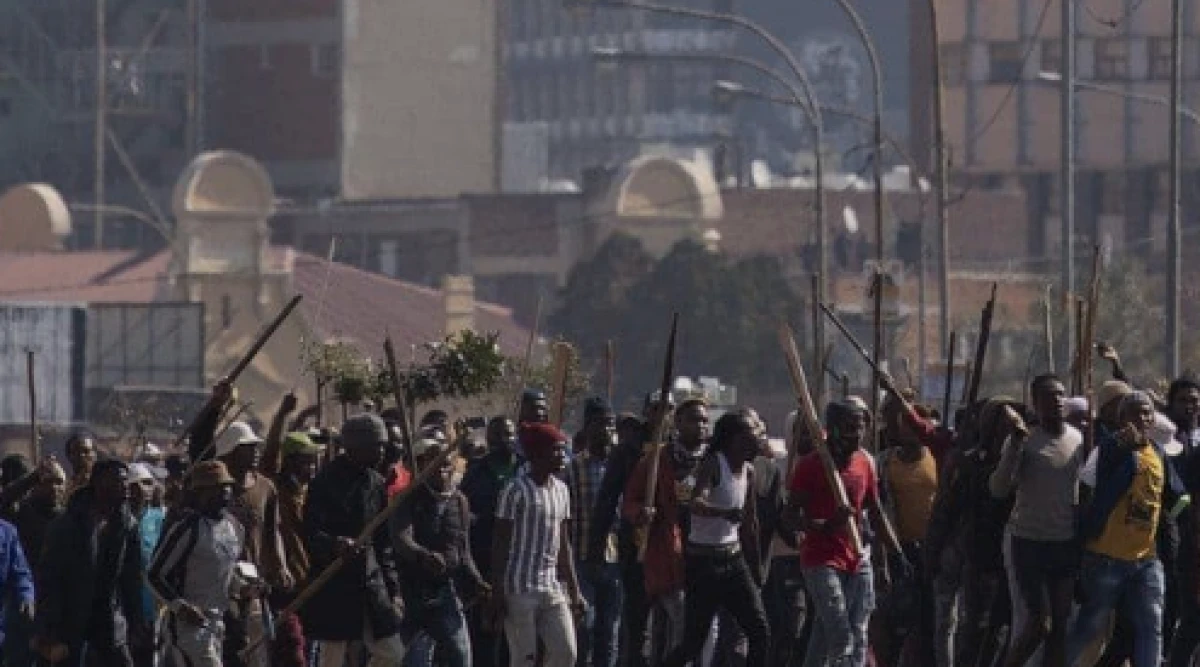
Business owners are required to find replacements for all foreign workers by June 30.
A wave of xenophobic unrest has swept across South Africa. Crowds of angry people are invading the homes of foreigners, robbing them and threatening violence if they do not leave the country. Many migrants, fearing for their lives, are hiding in forests and mountains, waiting for their governments to organize repatriation. Hundreds of foreigners have already been evacuated. There are reports of fatalities.
The country's authorities have already responded, acknowledging the existence of a migration problem and proposing a series of measures to address the situation. However, they have warned South Africans against vigilante justice.
This, however, has not stopped the protesters. Aggressive marches continue, and social media is filled with posts and videos in which activists demand that migrants leave the country by June 30. Some social media users threaten "bloodshed" if foreigners do not leave by this date.
South Africa is already facing accusations from foreign ministries of other African countries. They criticize the country's authorities for not responding strongly enough to xenophobia and the aggressive behavior of its citizens.
A few days ago, Mozambican immigrant Lado Amido, living in Kleinmond, opened the door of his home to find an angry crowd declaring that "foreigners like him must leave." "People came to my house, knocked on the door, and then took all my belongings," said the 49-year-old Amido, who arrived in South Africa in February in search of work.
Fearing for his life, Amido left his home and spent two nights hiding in the mountains. He is now sheltering in the local town hall, along with more than 100 migrants from Malawi and Mozambique who worked in the Western Cape province of South Africa. Many of them were also forced to leave their homes due to the actions of anti-immigrant groups in several coastal towns of the country. Some hope to take advantage of voluntary repatriation programs organized by their governments.
Thirty-one-year-old Michael Markson from Malawi told Reuters that he spent a night in the mountains after being forced to flee from a settlement where he had lived for about a year.
"My landlord came and said I needed to leave because if we were found – we would be killed," Markson said.
Now he is also waiting for help to return home, as he cannot afford the journey himself.
Xenophobia remains a long-standing issue in South Africa, the publication notes. Migrants are often blamed for rising unemployment and crime. There is no convincing evidence for this, but many politicians readily play on anti-immigrant sentiments, especially in the lead-up to elections.
In recent months, groups demanding that the authorities tighten immigration policy have become noticeably more active in South Africa, reports the South African publication Mail & Guardian.
According to the participants in the actions, illegal migrants exacerbate the unemployment problem and create additional pressure on already overloaded schools and medical facilities.
The authorities have already reacted to the rising tensions. South African President Cyril Ramaphosa acknowledged the existence of the problems pointed out by the protesters. "Many South Africans are asking difficult but entirely justified questions," Ramaphosa said in his Sunday address to the nation on television. "These concerns are real. They deserve to be heard and addressed."
At the same time, Ramaphosa urged not to blame illegal immigration for all the country's woes. "Illegal immigration is not the cause of all our economic problems," he stated. According to the president, in the long term, the country needs to accelerate economic growth, attract investment, develop industry, and create jobs.
Additionally, the president stated that employers hiring undocumented workers and often paying them lower wages will now face not only fines but also imprisonment. The country will also create special courts to expedite the deportation of illegal migrants. Another measure will be a new registry with biometric data of "every resident of the country."
Ramaphosa also urged not to succumb to xenophobic sentiments and emphasized that the authorities will not tolerate vigilante justice, reports Associated Press.
"Only authorized state bodies can take action against violators of our laws," the president stated. He also warned that some groups are deliberately inflaming tensions.
South Africa, the publication notes, remains the largest economy in the region and has attracted migrants from neighboring Zimbabwe, Mozambique, and Lesotho, as well as from Nigeria, Ghana, Malawi, and Ethiopia for decades.
There are no exact figures on the number of illegal migrants in the country. Estimates suggest that between 2 to 5 million undocumented individuals may be in South Africa, with a total population of about 62 million.
The coalition government of South Africa, formed in 2024, is paying special attention to immigration policy. Over the past two years, more than 100,000 illegal migrants have been deported from the country. According to Ramaphosa, about 450,000 people attempting to enter South Africa without documents were apprehended at the border in just the last year.
However, xenophobic violence remains a long-standing problem for the country. In 2008, more than 62 people were killed in attacks on foreigners, including 21 South Africans, and over 150,000 people were forced to flee their homes.
However, Ramaphosa's speech did not calm the protesters. The very next day, anti-immigrant groups marched through East Rand – an industrial area east of Johannesburg. They demanded that local companies dismiss all foreign nationals by June 30, including those who are in the country legally, reports the South African online publication Daily Maverick.
The action was attended by supporters of the anti-immigrant movement "March and March," as well as representatives of the "All Truck Drivers Forum and Allied South Africa" (ATDF-ASA).
Participants moved along the main industrial highway of the city of Benoni (one of the largest industrial centers in East Rand east of Johannesburg) and entered the businesses located along the road, where they spoke with company owners, the publication reports. Many protesters carried golf clubs, wooden sticks, and sjamboks – heavy whips commonly used in South Africa.
According to the organizers, business owners must find replacements for all foreign workers by June 30, regardless of their legal status. Initially, this deadline was set by anti-immigrant groups only for those foreigners who are in the country illegally. What will happen after June 30, the participants of the actions do not specify.
Several protesters told Daily Maverick that they would like to see all foreign nationals leave, not just those without documents. "They can come to visit, but not work here," said one participant in the march.
"We are witnessing a real invasion of migrants into our country. Its own citizens feel like refugees in their homeland," said Jacinta Ngobese-Zuma, leader of the anti-immigrant movement "March and March," in an interview with the British newspaper The Guardian. She advocates for the mass deportation of foreigners, claiming that the number of illegal migrants in South Africa is between 15 to 30 million.
Legal status does not always protect migrants from violence, notes The Guardian.
"Every day, almost everyone I meet experiences fear, intense fear," said an Ethiopian entrepreneur who moved to South Africa in 2000, married a local woman, and is raising a 19-year-old daughter with her. "The saddest thing is that it is not about the lack of documents. No legal documents will protect you from violence," he added.
What is happening is already affecting South Africa's relations with other countries on the continent. Relations with Nigeria have particularly soured. Nigerian Foreign Minister Bianca Odumegwu-Ojukwu accused South African authorities of not responding decisively enough to violence against Nigerians. According to her, this has undermined relations between the two countries, even though Nigeria supported South Africa during its struggle against apartheid, reports Al Jazeera.
At least two Nigerians were killed in April during another wave of violence. Moreover, as the minister noted, those who are in the country legally are also subjected to attacks.
"Nigerians are being targeted despite having legal grounds to be in the country, and the police refuse to do anything," Odumegwu-Ojukwu stated.
"Nigeria is unhappy with what is happening because it once did a lot to liberate South Africa. People of my generation protested with placards, demonstrated at South African sites, and sometimes even got arrested," the minister added.
This week, the Nigerian authorities planned to evacuate about 1,000 of their citizens from South Africa. However, the number of those wishing to leave continues to grow.
Other countries have also begun to repatriate their citizens. Mozambique has repatriated more than 700 people from the Western Cape province of South Africa. Thousands of citizens of the country have returned home on their own. Mozambican authorities stated that five of their citizens died directly as a result of xenophobic attacks. Two others died in a car accident while trying to reach their country.
At the end of May, Ghana also began to evacuate its citizens. According to the government, at least 1,000 people have returned home. Over one weekend alone, according to the South African Border Management Agency, 663 Ghanaian citizens were repatriated. They are currently receiving psychological support.






Leave a comment