
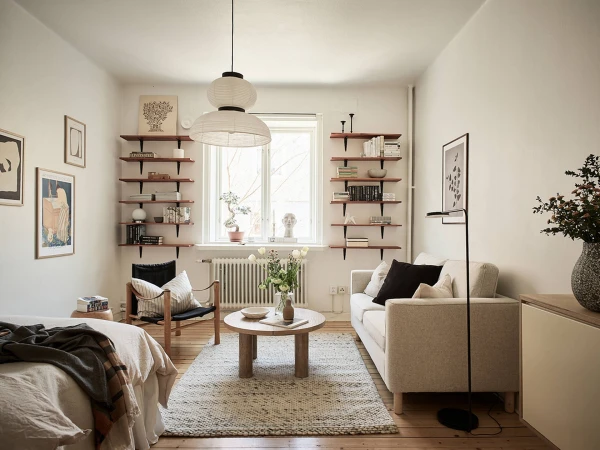
Even if the area of the apartment leaves much to be desired, it does not mean that one has to put up with a feeling of tightness. Modern design approaches allow for a significant change in the perception of space without major renovations. Through the smart use of color, light, furniture, and decorative elements, even a small living space can appear more spacious, bright, and comfortable for living.
One of the basic and most effective tools remains color scheme. Light shades — white, cream, light gray, pastel tones — reflect more light and visually "push" the walls apart. This does not mean that the interior must be completely monochromatic: accents are allowed, but it is important that they do not overload the space. Bright details are better used sparingly — for example, in textiles, cushions, decor, or small pieces of furniture.
No less important is lighting. The more natural light that enters a room, the more open and airy it seems. Therefore, designers recommend abandoning heavy curtains in favor of light fabrics or leaving windows as open as possible. Additionally, it is worth considering multi-level artificial lighting — a combination of ceiling fixtures, wall sconces, floor lamps, and furniture lighting helps create depth and volume.
Mirrors are another proven way to visually enlarge space. They reflect light and the surrounding environment, creating an effect of additional depth. Mirror surfaces placed opposite windows or light sources work particularly well. Glossy furniture facades and glass elements provide a similar effect.
Special attention should be paid to furniture. In small apartments, it is important to avoid overcrowding: bulky items "eat up" space. It is much more effective to use compact and multifunctional solutions — beds with storage drawers, folding tables, modular sofas. Such elements allow for functionality without weighing down the interior.
Minimalism in design is another important principle. The fewer unnecessary details, the "freer" the space feels. This applies not only to furniture but also to decor: an excess of accessories creates a sense of chaos and visual noise.
Geometry also plays a role. Vertical lines in the interior — for example, tall cabinets, elongated panels, or vertical patterns on wallpaper — visually increase ceiling height. Horizontal elements, on the contrary, can "expand" the room. The correct combination of these techniques helps to adjust the proportions of the room.
Floor coverings also matter. If a single covering is used without sharp transitions between zones, the space will be perceived as more cohesive and spacious. A large pattern or large tiles further enhance this effect.
Another technique is to abandon traditional hinged doors in favor of sliding structures. They save space and make movement around the apartment more convenient. In some cases, designers recommend completely eliminating doors between zones if it does not disrupt functionality.
Textiles in a small space should be light and airy. Heavy dense fabrics weigh down the interior and visually "compress" it. Light curtains, sheer drapes, and neutral fabrics help maintain a sense of space.
Finally, a well-thought-out storage system is important. When each item has its place, the apartment looks neater and more spacious. Closed storage systems help avoid visual clutter, which is especially noticeable in small spaces.
In conclusion, designers agree: even a compact apartment can be made visually more spacious without radical changes. A thoughtful combination of light, color, furniture, and details allows for a feeling of freedom and comfort without resorting to complex and expensive solutions.













Leave a comment