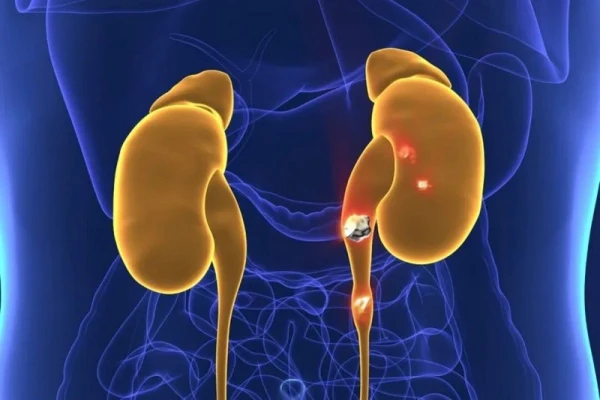
Between 7% and 28% of people with kidney stones also have a urinary tract infection.
A recent study conducted by the University of California, Los Angeles (UCLA) has revealed the presence of bacteria hidden within the most common type of kidney stones.
This unexpected discovery calls into question decades of scientific thinking about how these painful stones form.
"This breakthrough challenges the long-held hypothesis that these stones form solely as a result of chemical and physical processes, and instead shows that bacteria can be present inside the stones and actively contribute to their formation," said Dr. Kimora Scotland, a co-author of the study and an associate professor of urology, in a press release.
She emphasized that this "opens the door" to new therapeutic strategies aimed at the microbial environment of kidney stones.
Bacteria are not only present in the stones but are also an integral part of their structure. Using electron and fluorescent microscopes, Dr. Scotland and her colleagues discovered live bacteria and bacterial layers, known as biofilms, embedded within the crystals.
Kidney stones begin to form when urine becomes concentrated, leading to the growth of crystals in the urine. These crystals turn into stones when they reach a size sufficient to not be expelled from the body with urine. Until now, only one rare type of stone containing bacteria was known.
Calcium oxalate stones, which account for about 80% of kidney stone cases, had not been considered to contain bacteria. When researchers stained common kidney stones to detect DNA, they observed fluorescent bands glowing in even stripes, revealing bacterial layers.
The researchers suggest that bacteria may contribute to the growth of these stones. Instead of kidney stones forming solely as a result of spontaneous crystallization of crystals, bacteria may facilitate the accumulation of successive layers.
"We have discovered a new mechanism of stone formation that may explain why they occur so frequently," Dr. Scotland said. These findings may also help explain the connection between recurrent urinary tract infections and the recurrence of kidney stones, as well as provide clues for future treatments for these conditions.
Between 7% and 28% of people with kidney stones also have a urinary tract infection.
The clinical implications are still not entirely clear, but this discovery supports a new prevention strategy aimed at reducing the formation and growth of stones, explained Dr. Michael Zell, a urologist not involved in the study, to the Epoch Times.
"It has been thought that most stones form according to the so-called supersaturation model, leading to crystallization and aggregation," he said. "This study suggests that some stones contain an as-yet unrecognized bacterial component that may be a focus of infection contributing to their formation."
In his opinion, this discovery also indicates that influencing the local microbiome of the kidneys may be a viable approach to reducing the formation and growth of stones.
How to Reduce Risk
The incidence of kidney stones has increased worldwide; the latest data suggests that one in eleven people will have a kidney stone in their lifetime.
Risk factors include heredity, metabolic syndrome, particularly prediabetes, and insufficient fluid intake.
According to Dr. George Ellis, a urologic surgeon from Florida who was not involved in the study, there are five main types of kidney stones:
- Calcium oxalate stones, the most common.
- Calcium phosphate stones.
- Struvite stones, associated with infections.
- Uric acid stones, forming in urine.
- Cystine stones, which are less common.
"Several types of stones can develop simultaneously or appear throughout life," Dr. Ellis said in an interview with the Epoch Times. "Treatment depends on their chemical composition. Some can be treated with medications, while others require surgical intervention."
Preventive measures already exist, including drinking more water, taking antibiotics (in the case of struvite stones), or using medications that target the underlying cause of stone formation, Dr. Ellis noted. Citrate is commonly used to treat calcium oxalate stones, preventing calcium from binding with oxalate in the urine.
However, recent research findings point to a possible additional treatment option: prescribing antibiotics, "similar to the treatment of struvite stones," he noted.
Dr. Scotland and her colleagues plan to conduct further research to better understand how bacteria interact with calcium stones and why some patients are more prone to recurrences.
"Our multi-institutional team is currently conducting studies to determine how bacteria and calcium stones interact with each other," Dr. Scotland said. "We want to understand exactly what makes some patients particularly vulnerable to recurrences and what it is about certain types of bacteria that allows them to form these stones."