
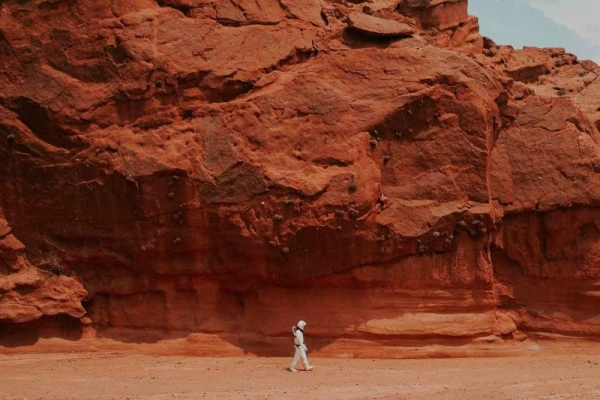
An important aspect is access to energy sources, with a greater emphasis placed on nuclear.
A new study shows how data scientists are considering the colonization of the Red Planet. According to their findings, only 22 people are needed to create a functional life on Mars—provided they have the "right qualities."
What is needed to create a functional colony on Mars and sustain promising life? These questions have arisen for researchers and astronomy enthusiasts since the idea of colonizing Mars first emerged.
Many scientists already believe it is proven that the Red Planet is ideally suited for life away from Earth. Mars has large reserves of water ice, as well as a thin atmosphere that provides limited protection from solar and cosmic radiation. Additionally, a Martian day lasts about 24 hours, 39 minutes, and 35 seconds (on Earth, it is 23 hours, 56 minutes, and 4 seconds), and, due to its axial tilt, seasons occur—though they are nearly twice as long.
But how should food and electricity be supplied, who can be brought to live on Mars, and what should the goal be? These questions were addressed in a study led by Edgar Argüello, a data scientist at George Mason University (USA). To do this, the researchers specifically used what is known as agent-based modeling (ABM).
Thus, the researchers model a habitable environment for humans on Mars, with the primary activity being the extraction of minerals and sending them back to Earth.
Infrastructure and Power Supply
"Creating a human colony on Mars is an extremely complex technical problem," the researchers state in their study. The modeling plan begins at the moment when the Martian colony with appropriate residential and economic buildings has already been constructed. The exact appearance of these structures is not specified by the researchers.
Such considerations have already been expressed by scientists at the University of Bremen as part of their research project "Humans on Mars." They developed a concept for a space station consisting of several cylindrical modules containing spaces for sleeping, working, and resting, as well as airlocks.
Another important aspect is access to energy sources, with a greater emphasis placed on nuclear energy than on solar. "Solar energy is limited by the number of daylight hours, seasonal fluctuations, and dust accumulation on solar panels. We decided to model our colony based on a nuclear generator that NASA deployed in 2011 for the Perseverance rover," the researchers explain.
Thus, this generator is expected to provide a constant and vital power supply for the Martian population. The total operational lifespan is planned to be at least 14 years—seven times longer than that of the Perseverance rover. According to NASA, small lightweight fission reactors can provide up to 10 kilowatts of electricity, which is sufficient to simultaneously power several households. By the end of the 2020s, NASA plans to deliver one of these systems, operating on low-enriched uranium, to the Moon for testing.
Sectors of life such as waste disposal or recycling have so far remained outside this study and will need to be examined in more detail in future work. The actual construction of the Martian station was also not the subject of this study.
Air, Water, and Food
Edgar Argüello and his colleagues believe that another important condition for the functioning of society is the ability of residents to produce air and water on-site. "The inhospitable Martian environment requires that each settlement be largely self-sufficient. Except for the extraction of some basic minerals and water, colonists will depend on supplies from Earth and replenishing stocks using technical means," the researchers explain.
The resources and capabilities necessary for humans in space are illustrated by the experience of the International Space Station (ISS). NASA indicates that one ISS resident consumes 5.88 kilograms of air, 28 liters of water, and 10.5 kilograms of food per week. Since there is currently no convincing way to produce food in microgravity, the researchers assume that Mars inhabitants will initially depend on food supplies from Earth.
Preliminary estimates suggest that external food supplies could be made on average every six months. This frequency may vary, as may the volume or scale of supplies, if food cultivation on Mars is successful. These calculations include reserves in case the supply does not reach its destination.
Character Determines Success
Researchers led by Edgar Argüello also pondered what types of personalities would have the greatest chances of survival in the isolated and hostile environment of Mars. To do this, they considered studies of groups of people, such as soldiers or Arctic explorers, who often work and live in extreme conditions. "The technical expertise required for long-term survival during underwater missions, combined with isolation and its risks, makes these organizations good models," the researchers write.
But mental attitude also seems to be an important factor. "Traits such as strong motivation for results and interpersonal orientation have been associated with better mission management. In another study, optimism and humor were key crew adaptation strategies," argue Edgar Argüello and his colleagues.
The researchers then examined what type of character has the best chances of survival. The result was clear: in all trials, only friendly individuals survived throughout the testing period, which lasted over 28 years, due to their adaptability and positive nature. In contrast, neurotic individuals fared much worse.
22 People Are Enough
The scientists also calculated how many people are necessary for the functioning of a colony on Mars. An important factor is that residents work together and have at least two skills. The researchers do not specify what exact skills are necessary.
Assuming that all personality types are represented roughly evenly, 22 people are sufficient to support the colony. Of course, the population may temporarily drop to fewer than ten individuals, but this should not happen repeatedly within 1.5 years.
According to the scientists, future studies could consider how the initial situation and success rate would change if the population consisted solely of friendly and communicative individuals.
Criticism of this calculation was voiced by French space researcher Jean-Marc Salotti in an interview with Live Science: "22 people are not enough to create and sustain a full-fledged and autonomous colony on Mars." According to Salotti, at least 110 people are needed, which is five times more. "To build and maintain an autonomous colony on Mars, more people with a broader range of knowledge and skills are needed to solve complex tasks," explains Jean-Marc Salotti.
While the idea of considering personality types is very good, a simple dispute or conflict in the colony could already lead to disaster. Furthermore, if a long-term population is to be established on Mars, the colony needs a much broader genetic reserve. Otherwise, close kinship could lead to diseases or physical and mental defects, further weakening the Martian population.













Leave a comment