
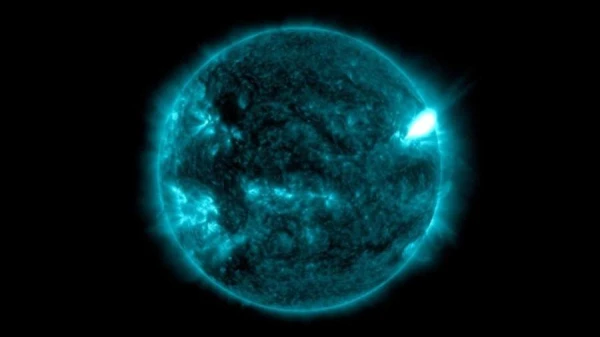
A powerful X1.4-class solar flare has been recorded on the Sun, causing communication issues on Earth. NASA is monitoring solar activity, which could pose a problem for the launch of the Artemis-2 mission.
On the evening of April 1, 2026, four astronauts—three Americans and one Canadian—are set to embark on a historic journey around the Moon for the first time in 54 years from a launch site in Florida. The Artemis-2 mission plans for the astronauts to spend 10 days in space as they orbit the Moon aboard the Orion spacecraft and return to Earth. However, early on March 30, a powerful X1.4-class solar flare occurred, causing communication issues on Earth. Along with it, a coronal mass ejection was directed toward the planet. NASA is monitoring solar activity, as it could hinder the Artemis mission launch, although the U.S. space agency remains optimistic, reports Focus.
The colossal X1.4 flare caused significant disruptions in radio communications over parts of Asia and Australia. Along with the flare, a coronal mass ejection erupted from the Sun, which is a flow of plasma and magnetic fields directed toward the Sun. The flare occurred in the sunspot region AR 4405.
Solar flares, which are bursts of powerful radiation and energy, along with coronal mass ejections, can pose serious dangers to astronauts and satellites in space. Moreover, X-class flares are the most powerful on the Sun. Currently, the AR 4405 region is facing Earth and could produce another powerful solar flare.
When coronal mass ejections reach Earth, they can trigger geomagnetic storms. According to NASA protocols, such a storm could disrupt communication with a spacecraft that has been placed in low Earth orbit. For now, NASA scientists are monitoring solar activity, but the latest data indicates that the Artemis-2 mission, barring any unforeseen events, is scheduled to launch on April 1 (which will be close to midnight in Kyiv).
According to the latest NASA report, there is an 80% chance that weather conditions will be favorable for the launch of this historic mission. Scientists also do not expect that the coronal mass ejection from the Sun will cause any problems for the spacecraft or the astronauts.
It is worth noting that the Artemis-2 mission represents the first crewed flight around the Moon since the Apollo 17 mission in 1972. Additionally, the astronauts will be flying aboard the Orion spacecraft for the first time, which will be launched into space by the powerful Space Launch System rocket. Previously, the spacecraft flew to the Moon uncrewed. Astronauts Reid Wiseman, Victor Glover, Christina Koch from NASA, and Jeremy Hansen from the Canadian Space Agency will embark on a 10-day journey around the Moon and back.
This will be a test mission before NASA sends astronauts to the Moon's surface in 2028, where humans have not been since December 1972.













Leave a comment