
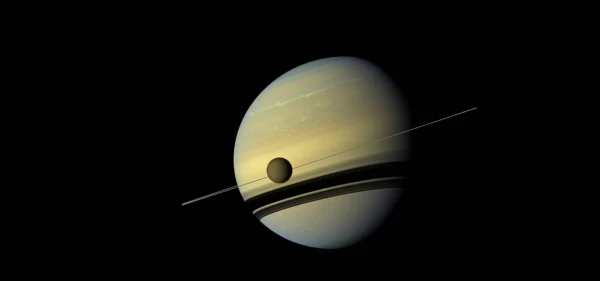
The results of the study explain several unresolved questions.
A new computer model has shown that around 400-500 million years ago, a massive gravitational catastrophe occurred in Saturn's system, resulting in one of its ancient moons possibly colliding with Titan, and from the debris, Hyperion was formed. A chain of subsequent disturbances likely led to the destruction of the inner moons and the formation of the current rings.
Saturn is one of the most unusual planets in the Solar System. This gas giant is surrounded by bright and massive rings that extend for hundreds of thousands of kilometers and are composed of 95% water ice. However, their age remains a subject of debate: according to data from the Cassini mission, it is only a few hundred million years, not billions as was believed for most of the 20th century.
Among the numerous moons of the sixth planet from the Sun — from small irregular objects to large regular satellites — Titan, Hyperion, Rhea, and Iapetus are of particular interest. Unlike the small moons captured by Saturn's gravity, these bodies move in relatively orderly, nearly circular orbits and actively interact with one another. Researchers believe that their orbital dynamics hold traces of past rearrangements of the system: Titan's tidal migration could have triggered a chain of resonant interactions and gravitational disturbances.
Now, scientists from the Paris Observatory (France), the Southwest Research Institute, and the California Institute of Technology (both in the USA) have calculated numerical integrations of the orbits using computer modeling. This approach allowed them to trace the evolution of Saturn's moon system over hundreds of millions of years, taking into account the gravitational interactions of the bodies and tidal effects.
The authors of the scientific paper presented on the Cornell University preprint server focused on the Titan-Hyperion pair. The fact is that these moons are in a stable orbital resonance that protects them from close encounters. However, calculations showed that such a resonance could not have existed since the formation of our star system: the rapid tidal migration of Titan away from Saturn suggested that Hyperion entered the resonance relatively recently — about 400-500 million years ago.
Understanding the situation was aided by a new computer model that included another, now-extinct moon — the so-called proto-Hyperion, located between Titan and Iapetus. In most scenarios, the orbital instability led to a collision between the proto-moon and Titan. In this process, some material was ejected into the surrounding space, which over time could have formed the modern Hyperion — a porous celestial body of irregular shape.
This catastrophe, according to scientists, could have displaced Saturn from the spin-orbit resonance that previously shaped the tilt of its axis and destabilized the orbits of other satellites. After the collision, Titan began to move in a more elongated orbit and to "rock" the other moons more strongly. Over time, this could have led to their destruction and the formation of new satellites and rings.
The results of the study explain several unresolved questions — the origin of Hyperion, the unusual dynamics of the moons, and the formation of the rings — as a recent gravitational restructuring of the gas giant's system. Although the new model requires refinements, it aligns well with the data from Cassini and current understandings of the tidal evolution of Saturn's large moons.






Leave a comment