
While China and the USA actively invest in the development of autonomous transport, Europe still hesitates and is slow to adopt such technologies.
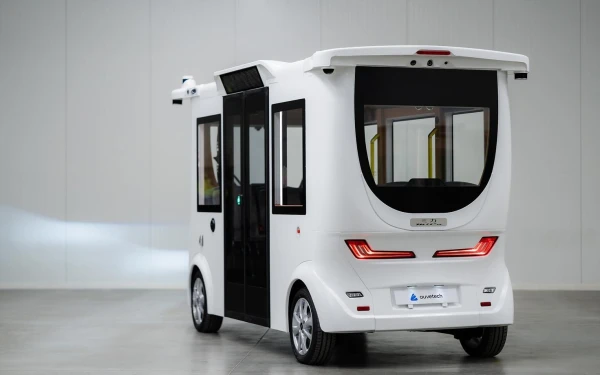
An autonomous shuttle bus, fully designed and manufactured in the European Union, finds its largest markets in Japan, the Middle East, and the United States, rather than in Europe.
MiCa, designed for eight passengers and capable of operating autonomously for up to 20 hours a day at speeds of up to 25 km/h, embodies the paradox: European technology thrives anywhere but on its own continent.
The bus is packed with modern technology: sensors, lidars, cameras, and, recently, improved software that allows the artificial intelligence-based system to dynamically respond to objects, recognizing overtaking or side-moving vehicles.
"When the vehicle understands what is happening around it, it can determine where the road is, where potential objects are moving, where the pedestrian crossing is, where the intersection is," explained the product manager of AuVe Tech OÜ, Kristjan Vilipild, an Estonian company that developed this shuttle.
Level 4 autonomous vehicles could appear in Europe next year, Nvidia stated. "Based on this information and the next stop the bus is heading to, the system plots a path for the route," he added.
Last month, for the first time in Europe, developers received permission to conduct tests at Tallinn Airport.
According to managers, such transport can operate around the clock, transporting technical personnel between hangars, reducing costs and environmental impact. During the tests, autonomous prototypes traveled 2,150 km and transported 215 passengers across the airport's runways.
The company was founded in 2018 in collaboration with Tallinn University of Technology.
Lack of Funding and Strategy
Its autonomous vehicles have already operated in 17 countries, including several European states, as well as in Japan, the USA, Israel, Saudi Arabia, and the United Arab Emirates.
However, the most advanced projects are currently being implemented not in Europe, but in the Middle East and Asia, primarily in Japan.
Managers primarily attribute this to a lack of government funding for autonomous transport and the absence of an overall EU strategy in this area.
"In Japan, for example, there is a very clear goal of where autonomous vehicles should operate: say, 50–60 locations by 2027. Serious investments are being made in China. In Europe, we have been a bit more conservative," said Johannes Mossov, a board member of AuVe Tech.
Waymo Hires People to Close Robotaxi Doors to Prevent Idle Time
According to Mossov, there are already cities in Japan where autonomous buses have become the only public transport, and the government actively supports this approach.
Developers say that European autonomous driving technologies are ready for further development and widespread implementation, but recently there has been a clear lack of investment.
"The biggest problem in Europe is indeed the lack of investment in technology, both from the private and public sectors, especially compared to what is happening in the USA or China," Mossov said.
This is compounded by the "regulatory situation," developers note.
"Theoretically, we have one European Union, but when it comes to the autonomous transport sector, in practice, we have twenty-seven different sets of rules," explained the chairman of the supervisory board of the company, Taavi Rõivas.
"In some places, regulators are very open to innovation, while in others, they are extremely cautious. In some countries, strict requirements apply even to the vehicles themselves, not just their autonomy."
Without urgent changes, the EU risks falling behind and "cutting the wings" of an industry that could stimulate innovation and create jobs, developers warn.
They cite their own company as an example: their transport is entirely produced in Estonia, one of Europe’s digital hubs.
Europe Faces a Driver Shortage
One shuttle can be assembled in a week. According to executives, avoiding outsourcing production helps ensure quality, control all processes, and manage manufacturing risks.
The situation indeed requires urgent action, developers insist. Europe is facing a severe driver shortage, which autonomous shuttles could help address — but only if the continent starts acting now.
"We are demonstrating not just beautiful technology. This is a practical solution. Soon there simply won’t be enough drivers in Europe," says Rõivas, referring to data indicating that autonomous shuttles are already safer than most human drivers — a reality that Japan, Middle Eastern countries, and the USA have already accepted, while Europe continues to hesitate.
However, without harmonizing regulations and increasing investments, the advantage of the "made in Europe" label may evaporate. Due to the current fragmentation, companies have to spend resources navigating 27 different regulatory systems instead of improving the technology itself.
"The bulk of investments should be directed towards the technologies themselves, not towards working with regulators just to get transport on the road," Mossov noted.
This is not just about one company: regulatory paralysis and funding shortages could cost the EU jobs, manufacturing capacity, and competitive advantages in an industry on the brink of explosive growth.
According to Rõivas, this is a matter of European sovereignty: "Perhaps Europe really should implement strategic autonomy and prioritize European solutions. As a person proud to be European, I believe we cannot afford to be late in this race."
It seems this message is beginning to resonate. At a recent European Parliament event dedicated to autonomous transport, a warning was issued that 2026 will be a "turning point" for the development of European autonomous driving technologies, "before the gap with the USA and China becomes insurmountable," according to a statement from the EU-funded platform Connected and Automated Driving.












Leave a comment