
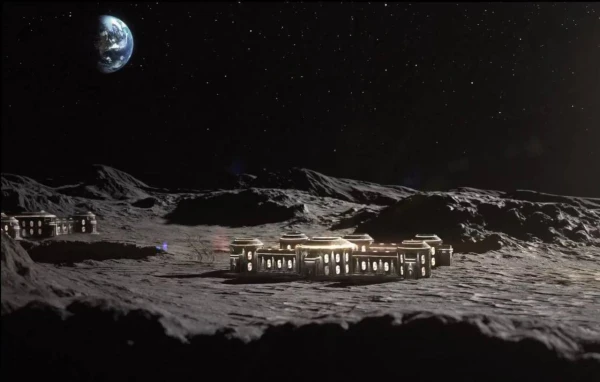
Applicants for rooms are urged to pay a million dollars.
By 2032, the first hotel may appear on the Moon. The American space startup Galactic Resource Utilization Space (GRU Space) has announced the start of accepting applications for reservations for a project it calls "the first ever permanently operating extraterrestrial facility." According to the company, selected candidates will be offered to make a preliminary payment – either $250,000 or $1 million depending on the chosen participation format. It is also specified that the final cost has not yet been determined, but it is expected that the price of one stay will exceed $10 million.
To have their reservation application considered, potential guests must also pay a non-refundable registration fee of $1,000. According to the company's materials, the structure in the form of an inflatable module is initially planned to be manufactured on Earth, after which it will be delivered to the Moon and deployed directly on its surface. GRU Space reports that the facility is designed for a maximum of four guests. The expected lifespan of the structure is about ten years, and the total payload mass required for delivering the equipment is estimated at approximately 9,070 kilograms.
The first tests of the module on the Moon are scheduled for 2031 – a year before the possible start of the first crewed flights. So far, the project exists mainly as a concept: similar structures have never been built on the Moon, and the feasibility of long-term human presence in such conditions has not yet been confirmed in practice. Nevertheless, the company is already actively promoting this idea among wealthy tourists, people who have previously been to space, and couples looking for an unusual honeymoon destination.
Additionally, GRU Space has announced plans to eventually expand the facility into a full-fledged lunar hotel designed for ten guests, as well as plans to build a similar hotel on Mars. These statements came against the backdrop of U.S. President Donald Trump's promises to plant the American flag on Mars by 2028, as well as the efforts of technology billionaires to involve private business in space exploration beyond low Earth orbit.
Meanwhile, experts point out that human life on the Moon is fraught with extreme dangers due to the lack of atmosphere, extreme temperatures (from +100 to -150 °C), high levels of radiation, low gravity (16.5% of Earth's), and hazardous lunar dust. The main risks include radiation sickness, cardiovascular diseases, muscle atrophy, depressive disorders, and lung damage from inhaling dust. Key dangers include: High radiation: The Moon lacks a magnetic field and atmosphere to protect against solar flares and galactic cosmic rays. The radiation dose is about 1.4 millisieverts per day, which limits safe stays on the Moon to 60 days. Lunar dust (regolith): The dust consists of sharp, microscopic particles that do not erode like on Earth. It clogs mechanisms, damages spacesuits, and when inhaled, causes irritation of the nasopharynx and eyes, and can lead to "lunar hay fever" and serious lung damage.
Extreme temperatures: require complex thermal regulation for life support.
Low gravity: Staying in conditions where gravity is 6 times weaker than Earth's leads to calcium leaching from bones, muscle atrophy, and cardiovascular problems.
Psychological factors and physiology: Studies show a risk of decreased cognitive abilities, memory impairment, and depressive disorders due to radiation and confined space.
Technical threats: Landing and operating the base require high precision due to the lack of atmosphere for braking, and any breach of a spacesuit or module is fatal.
To minimize these risks, radiation protection (building bases underground), using airlocks to clean spacesuits from dust, and creating artificial gravity are necessary.
















Leave a comment