
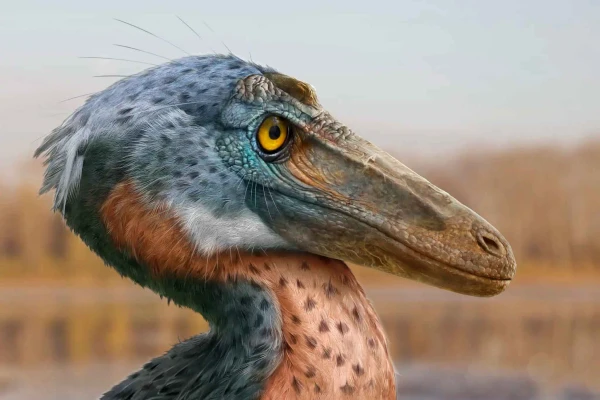
He quickly calmed all adversaries with a mighty blow.
An international team of paleontologists has described a new species of dinosaur the size of a large modern bird. It had a dense bony growth on its head, which these animals may have used for intraspecific disputes. The finding shows that even small predators of the Cretaceous period could resolve conflicts not only with claws and teeth but also with headbutts.
At the end of the Cretaceous period, the world of dinosaurs resembled an overcrowded market. Many species emerged, competing with each other for the best place in the sun: food, territory, and mates.
Evolution experimented with forms, especially when it came to defense and displays of strength. At that time, large pachycephalosaurs (Pachycephalosaurus) roamed the Earth, sporting a large bony dome on their skulls that could be up to 25 centimeters thick. The exact role of these domes remains a subject of scientific debate, but it is believed that they served as a "battle hammer" during collisions between individuals of the same species.
Pachycephalosaurs were accompanied by ceratopsians (Ceratopsia) — herbivorous dinosaurs with massive horns and bony frills. Nearby, groups of fast theropods (Theropoda) — the ancestors of birds — roamed, relying on speed, intelligence, and sharp claws.
Until recently, paleontologists believed that head-on collisions in the dinosaur world were the domain of only the heavyweights. A discovery in Mexico showed that scientists might have been mistaken.
In 2000, paleontologist Martha Aguillón-Martinez was conducting routine research in the Cerro del Pueblo formation in northeastern Mexico. Her attention was drawn to a bone protruding from the ground. It turned out to be a fossilized skull of a dinosaur, but its shape did not match any known species.
Subsequent analyses revealed that the finding was 73 million years old. During the Cretaceous period, this area was a swampy habitat where some species of duck-billed dinosaurs (Hadrosauridae), long-legged tyrannosaurs (Tyrannosaurus), and Coahuilaceratops, whose horns reached over a meter in length, lived.
A team of paleontologists led by Hector Rivera-Sylva from the Mexican Museum of the Desert in Saltillo took on the study of this unique find. The scientists determined that the skull belonged to a small dinosaur from the troodontid group (Troodontidae) — feathered, bird-like theropods. These creatures were known for their relatively large brains, forward-facing eyes, and omnivorous diets.
However, the structure of this particular skull puzzled the scientists. The front part featured a massive bump — a thickened dome in the area of the frontal and parietal bones, and the surface of the skull above the dome had a bumpy, rough texture. In other words, the finding combined features that were atypical for small theropods. It was a true evolutionary puzzle.
To understand the structure of the skull, paleontologists conducted a CT scan of the fossil. The scan showed that the seams between the skull bones were tightly interlocked and formed distinct zigzag patterns. This indicated a strong connection between the individual bones forming the dinosaur's dome.
Inside the bones was a spongy structure that apparently served to cushion impacts. According to the researchers, such skull anatomy was unlikely to give dinosaurs an advantage during hunting. Most likely, it was suited for one purpose only — cushioning during impacts.
Rivera-Sylva and his colleagues classified the skull bearer as a new species and named it Xenovenator espinosai, meaning "strange hunter of Espinosa." The scientists concluded that the bony bump on the dinosaur's head served as a kind of weapon for intraspecific conflicts.













Leave a comment