
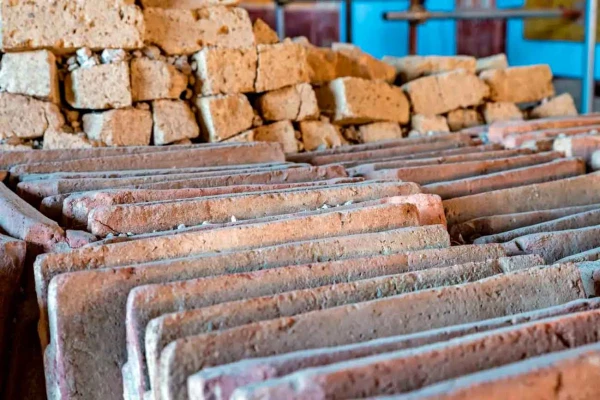
All materials, tools, and even notes on the walls with work schedules and calculations of necessary materials were well preserved.
The city of Pompeii, buried under the scorching ash of Vesuvius in 79 AD, has served as an invaluable window into the daily life of the Roman Empire for archaeologists for several centuries. First, the city was covered with sediment from pumice and lapilli, then it was engulfed by fast-moving hot pyroclastic flows that buried and 'cemented' the streets, houses, and household items. This allowed Pompeii to be preserved in the state in which the fleeing inhabitants left it.
For the convenience of archaeological excavations, scientists divided Pompeii into nine geographical areas, called regions. In the 1880s, researchers began excavating in Region IX, but then the work was suspended for a long time.
Excavations resumed only in 2023, when an international team of archaeologists led by Admir Masic from the Massachusetts Institute of Technology in the USA organized a new large expedition. The specialists did not expect to find under the layer of earth not just another building, but a kind of full-fledged concrete factory from the 1st century.
Masic and his colleagues discovered a construction workshop where workers prepared concrete mixtures. Ash covered the facility in the midst of work, so all materials, tools, and even notes on the walls with work schedules and calculations of necessary materials were well preserved.
In particular, the scientists found masonry tools, piles of volcanic sand, fragments of recycled tiles, and, most importantly, neat mounds of white powder — quicklime. Such an opportunity to study Roman technologies in their 'pristine' state is extremely rare.
The workshop provided an opportunity to understand a technology that had not been fully replicated even in the best laboratories in the world. The discovery showed that the Romans made concrete differently than described in ancient texts.
In these texts, the authors claimed that builders used slaked lime — calcium hydroxide — to make concrete. According to the records, the material for construction work was obtained as follows: the Romans took lime, added water, waited for a reaction, and then mixed this slaked lime with volcanic ash and other concrete components.
However, chemical analysis of the dry mixtures from the Pompeian workshop proved the opposite. Ancient builders employed a method known as hot mixing using quicklime — calcium oxide.















Leave a comment