
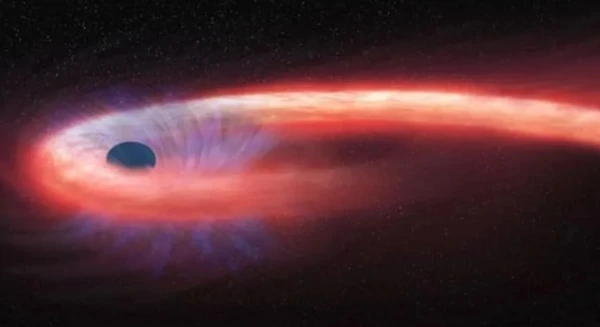
The strange X-ray signal may be the result of an attack by two black holes on an unfortunate star, reports Focus.
Astronomers believe that about 3 billion years ago, an unfortunate star was destroyed by two black holes, and now a faint X-ray emission can be seen coming from this event. If the scientists' hypothesis is confirmed, it will be the most distant known tidal disruption event involving two black holes. A study dedicated to years of observations of the strange X-ray outburst that occurred 3 billion light-years away from us has been published in the journal The Innovation, reports Live Science.
Astronomers first detected the source of the X-ray emission, named XID 925, in 1999 using the Chandra space telescope. Since then, astronomers have studied the X-ray emission and observed it gradually weakening. Over 25 years, the emission has decreased by about 40 times from its initial value.
The bright X-ray outburst and the prolonged period of decay of this emission are what astronomers expect to see during a tidal disruption event. It occurs when a star approaches too closely to a supermassive black hole at the center of a galaxy. The black hole tears the star apart with its immense gravity and transforms its material into something resembling spaghetti. Therefore, this process is called spaghettification.
However, before the star's material falls into the black hole, it spirals around it in the form of an accretion disk. It heats up and emits powerful X-ray radiation. As the star's material falls into the black hole, the emission weakens.
The X-ray source XID 925 is one of the most distant cases of tidal disruption of a star. But in 1999, astronomers discovered something unusual. Over several months, the brightness of XID 925 suddenly and unexpectedly increased by 27 times. Then the brightness quickly decreased, and the emission began to weaken.
The authors of the study believe they have found the reason for the strange increase in brightness of XID 925. They concluded that it was a tidal disruption event involving not one, but two black holes.
Astronomers believe that the unfortunate star was under the gravitational influence of the central supermassive black hole and a smaller black hole that is a companion to the first.
The larger black hole tore the star apart and turned it into an accretion disk. But then the second black hole approached the disk or even broke through it, leading to a sharp release of energy and X-ray emission. Once the smaller black hole moved away, the system returned to a normal state.
Although astronomers say this theory does not perfectly explain all the data, they assert that it is the most convincing scenario, given what is known about black holes and tidal disruption events.
If this theory is confirmed, it will be the most distant known tidal disruption event involving two black holes. This event could provide more information about the complex relationships between stars and black holes in the cores of galaxies.














Leave a comment