

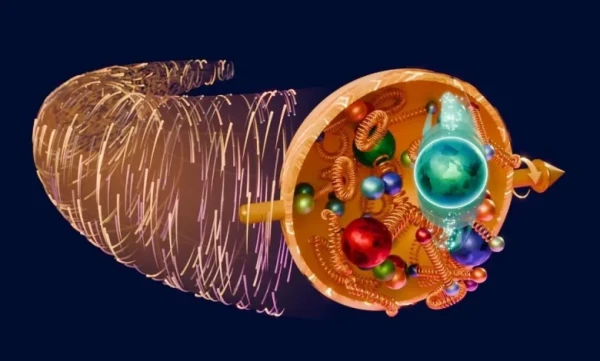
The technology underlying the project involves magnetic confinement of plasma using superconducting magnets and special fuel spheres.
According to information from CCTV News, in the Chinese city of Hefei, the fusion reactor known as the 'Artificial Sun' is completing the final stage of its construction. The level of localization of equipment at this stage is 93.4%.
It is important to note that among the components of the installation, there are more than 660 unique devices that have no analogs in the world. As part of the 15th Five-Year Plan, which covers the period from 2026 to 2030, it is planned to increase the share of domestic production to 100%. After all construction work is completed, the installation will need to demonstrate its ability to operate stably and sustainably in long pulse mode, and then transition to the process of energy generation using nuclear fusion.
According to developers' forecasts, by 2030, the device will be able to 'light a lamp' for the first time thanks to the energy of controlled nuclear fusion. The technology underlying the project involves magnetic confinement of plasma using superconducting magnets and special fuel spheres that can withstand temperatures up to 1620 °C.
'The fusion device must operate stably with high efficiency for thousands of seconds to ensure self-sustaining plasma circulation, which is crucial for continuous energy production in future fusion installations,' stated Sun Yuntao, director of the Plasma Physics Institute responsible for the fusion project at the Chinese Academy of Sciences, to Chinese state media.
In this reactor, plasma is heated and confined within a donut-shaped reactor chamber — the so-called tokamak — using powerful magnetic fields.













Leave a comment