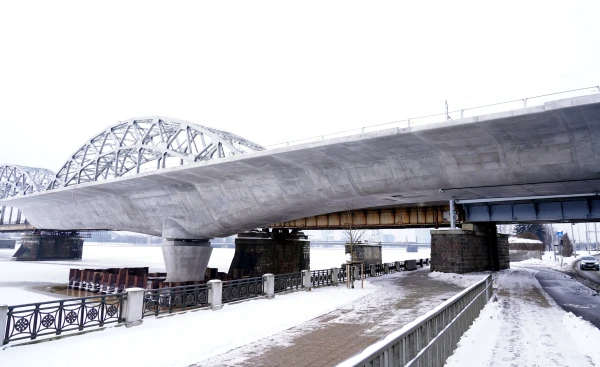
The State Audit Office, together with the supreme audit institutions of Estonia and Lithuania, has begun an audit of the feasibility of implementing the Rail Baltica railway project, the State Audit Office reported to the LETA agency.
The audit is being conducted to assess the feasibility of the project implementation and the timely achievement of its goals. Special attention during the audit will be paid to procurement management and construction contracts to ensure cost-effectiveness.
Martin Abolins, a member of the State Audit Office, emphasized that "Rail Baltica" is one of the key infrastructure projects in the Baltic region, the implementation of which is still associated with significant challenges regarding costs, timelines, and management.
"That is why in this audit, collaborating for the third time with the supreme audit institutions of Estonia and Lithuania, we aim to provide an independent assessment of whether the project is progressing towards its goals effectively and in the public interest, as well as whether previously identified issues are being addressed," Abolins stated.
The audit will focus on the effectiveness of the procurement organization and the contracts concluded for the first phase of "Rail Baltica," as well as the management of related risks.
The financing of the first phase and the resolution of issues identified in the joint audit of 2019 and the combined situation study of 2024 will be analyzed.
The audit will cover RB Rail AS as the joint implementer of the project, as well as at the national level: the Ministry of Transport, the Ministry of Finance, European Railway Lines LLC, and Latvijas dzelzceļš State Joint Stock Company.
The audit covers the period from 2022 to mid-2026, with results expected in early 2027.
As reported, according to the information from the Baltic States joint venture RB Rail, the costs for the construction of the first phase of Rail Baltica in the Baltics could amount to €14.3 billion, of which €5.5 billion is in Latvia; however, potential savings of up to €400 million are possible as a result of optimizing technical solutions, as well as reducing other costs.
The total costs for the construction of the railway corridor in the Baltics could reach €23.8 billion. In 2017, the project implementation costs were planned to be €5.8 billion.