
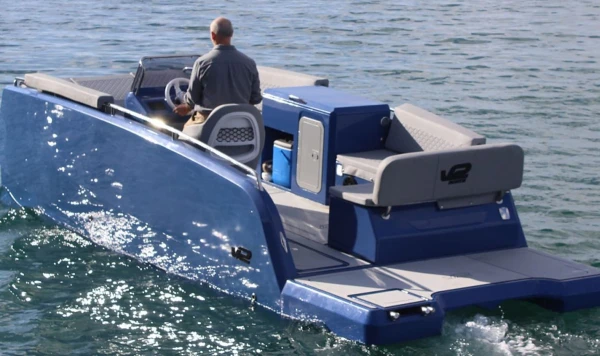
The developers emphasize that their object was created not as a prototype, but as a fully functional vessel.
V2 Group (Spain) and Caracol AM (Italy) have created the world's first six-meter catamaran entirely 3D printed as a monolithic structure. The vessel, designed for open sea navigation, is the result of a deep rethinking of the entire production cycle — from material selection to printing and design, initial testing, and post-processing — with an eye towards future industrial production.
Unlike traditional shipbuilding, where fiberglass hulls require the creation of complex molds, manual layering of materials, and numerous assembly operations, robotic large-format extrusion was used here. The composite material is applied layer by layer directly according to a digital model, allowing for the creation of a solid geometry without joints and adhesive seams, reducing the number of potential weak points and speeding up production. This approach also provides customization freedom: changes to the design can be made quickly and without reworking expensive tooling.
The developers emphasize that the catamaran was created not as a prototype, but as a fully functional vessel capable of withstanding real open sea conditions. Special attention was paid to buoyancy, structural rigidity, and resistance to dynamic loads. At the same time, engineers optimized printing time and minimized material waste to scale the technology for mass production of both small vessels and large marine components in the future.
The project lays the groundwork for a "new era in boat manufacturing," where additive technologies can complement or partially replace traditional composite methods. Digital processes allow for the integration of structural reinforcement directly into the printing geometry, reducing the number of parts and assemblies. If material costs and production speed remain competitive, robotic 3D printing has the potential to change the approach to creating small and medium-tonnage fleets, making them more environmentally friendly and economical.











Leave a comment