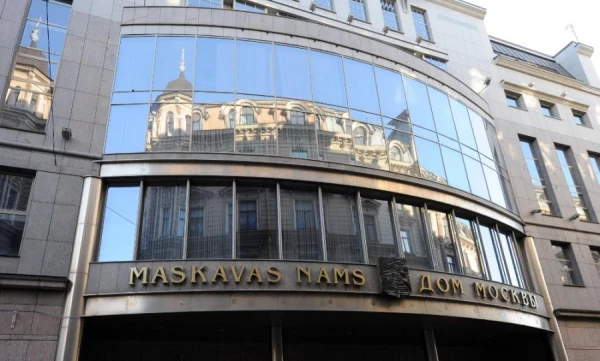
The prosecutor's office has submitted a criminal case against the former head of the 'House of Moscow' Eduard Tsekhovalov, accused of violating sanctions imposed by the European Union (EU), while another former head of the institution — Svetlana Zaitseva — has been declared wanted, reports LETA.
As noted by the prosecutor's office, from 2016 to 2024, the 'House of Moscow' was managed by the 'Moscow Center for International Cooperation', which was owned by the city of Moscow and was under the management and actual control of the mayor of Moscow and the president of Russia, both of whom are included in the sanctions list.
According to the prosecutor's office, the accused, being a representative of the 'Moscow Center for International Cooperation', was aware that the institution was associated with individuals subject to sanctions, and therefore restrictive measures of the EU applied to it. As a result, one of the institution's accounts in a Latvian financial institution was frozen, and in April 2022, a prohibition on the alienation of real estate on Marias Street or its encumbrance with other rights was introduced.
The accused, acting out of selfish motives, ignored the EU's restrictive measures against Russia and, knowing that EU sanctions prohibit the use of economic resources, rented out 'frozen' real estate, assuming legal obligations with the aim of obtaining cash and ensuring the functioning of the property and the representation.
"Thus, he intentionally and systematically violated the prohibition on the use of frozen economic resources controlled by sanctioned individuals, obtaining funds and ensuring the receipt of services," the indictment states. It emphasizes that such actions by the accused violated the EU sanctions against Russia imposed in connection with its invasion of Ukraine.
Earlier, the prosecutor's office brought charges in this case against Zaitseva as well, but a separate criminal case has been initiated against her, which is currently suspended as she is outside Latvia and has been declared wanted.
As previously reported, before the case was handed over to the prosecutor's office, the State Security Service (SSS) was conducting the investigation. The criminal process regarding the violation of EU sanctions was initiated by the SSS on November 23, 2023.
The current EU regulatory framework provides for the obligation to freeze all funds and economic resources owned, disposed of, or managed by individuals included in the sanctions list. Such resources include the premises of the 'House of Moscow', the use of which is prohibited if it leads to the receipt of funds, goods, or services, meaning that renting out premises subject to sanctions is prohibited.
On January 11, 2024, the Saeima adopted in the final reading the law 'On Actions with Real Estate Necessary to Eliminate Threats to National Security', which provided for the transfer of the so-called 'House of Moscow' to state ownership. The aim of the law is to ensure the security of Latvia, including preventing and timely addressing threats to the democratic state system.
On March 26, 2024, the government decided to transfer the 'House of Moscow', which is under the Ministry of Transport's jurisdiction, to the ownership of the Ministry of Finance.
It is expected that the funds obtained from the sale of the property at auction will be credited to the state budget and then directed to support the residents of Ukraine. So far, the property has not been sold.