
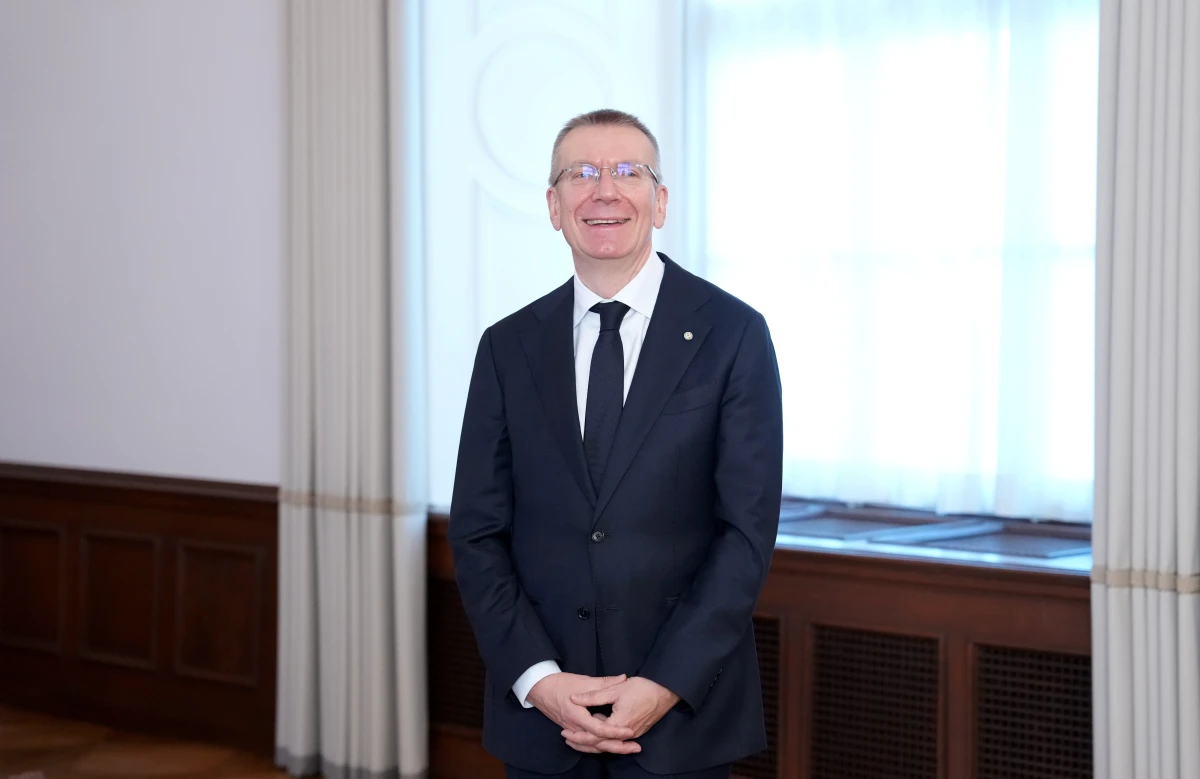
The president will determine the fate of the new "temporary" government.
So, the "not boring" meetings with all parliamentary parties continue at the presidential palace. Edgars Rinkēvičs faces a complex task - to decide who to entrust with the formation of a government that must work for almost 5 months until the elections and then for some time until the new Saeima approves the next government. On the one hand, the head of state has no reason to rush: while a new government has not been formed, the Silinie government, that is, the outgoing Cabinet of Ministers, continues to work. And this can be dragged out until the elections, especially since the Saeima will go on summer vacation in a month and will not return until September, while the elections to the Saeima are already on October 3. If a "temporary" government cannot be formed during May to early June, it will lose all meaning.
On the other hand, Edgars Rinkēvičs, being a highly experienced politician, constantly keeps in mind that he needs to try to get elected for a second term in just a year, and delaying the formation of a "temporary" government is not in his interest - he could very much anger both the National Alliance and the United List, which will surely be represented in the next parliament.
This means that the president will likely not delay long in proposing a candidate for the post of prime minister. However, the task is not easy. The "core" of the possible government - the National Alliance, the United List, and the Union of Greens and Farmers - has not managed to agree on a single candidate, thus complicating the president's task. This means Rinkēvičs needs to choose from three possible candidates or... propose some "own" candidate from outside. The latter option is quite risky, as it is unlikely that the parties will agree to work under the leadership of some neutral prime minister. Therefore, he needs to choose someone from the three. Namely: either the current Minister of Economics Viktors Valainis, or Saeima deputy, former Minister of Economics Ilze Indriksone, or Saeima deputy Andris Kulbergs. The latter candidate has two significant drawbacks. He has no experience in public administration at all and in government in particular, and there is no time to gain experience either. Moreover, Kulbergs still needs to obtain access to state secrets. The other two candidates do not have such problems. Logic suggests that the president should initially entrust the formation of the government to either Indriksone (National Alliance) or Valainis (Union of Greens and Farmers). However, Kulbergs does have one advantage, or rather the United List does - this political force has not drawn red lines and has not rejected cooperation with either the "Progressives" or "Latvia First," and therefore Kulbergs will find it easier to negotiate with the possible opposition to ensure that it... at least does not hinder the approval of the government, ensuring the necessary quorum.
Hypothetically, the government can also function as a minority government - if the Saeima approves it. There are rumors that representatives of the "core" of the future government are actively communicating with individual deputies of "New Unity," trying to "split them off" and negotiate support for the new government, but without including "New Unity" in the government. However, in this case, it is necessary to "split off" at least 8 votes to have at least a minimal majority in the Saeima - 51 votes.
In any case, this trio of political forces does not have much time for a long government formation - a maximum of three weeks.





Leave a comment