
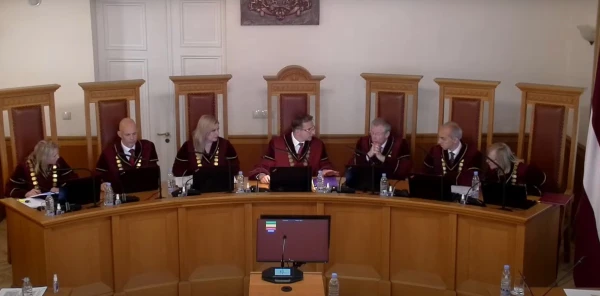
The Constitutional Court of Latvia (CC) on Wednesday recognized that the regulation concerning the payment for legal land use and the procedure for assessing the cadastral value of land in legal use, which provides for a limitation of the rent charged to 4% of the cadastral value, does not comply with the Satversme, LETA reports citing the court.
Three similar cases have been consolidated into one proceeding. The applicants were 21 private individuals — landowners of plots where buildings owned by other parties are located. The case challenged the constitutionality of the provisions of three regulatory acts governing the payment for legal land use and the principles of its calculation.
The applicants contested the norms establishing that the amount of payment for legal use is 4% of the cadastral value of the land per year, as well as provisions limiting the increase of this payment for owners of residential houses from January 1, 2025, to December 31, 2028.
The Constitutional Court concluded that a fair balance between the rights of each landowner to compensation, which serves a compensatory function, and the protection of the rights of building owners has still not been achieved. Legal regulation that places one party in a relationship in a deliberately more unfavorable position compared to the other cannot ensure either social peace or the protection of the public good.
The court acknowledged that the legislator has taken measures to eliminate the shortcomings of legal regulation indicated in the Constitutional Court's decision of May 2, 2023, including the updating of cadastral land values. Two types of cadastral value have been introduced — universal and fiscal.
The universal cadastral value is close to market value and is not used for tax calculations and other public payments. The fiscal cadastral value, which has not been updated, is used for tax calculations. The universal cadastral value can be either higher or lower than the fiscal value, or coincide with it.
The Constitutional Court noted that there are landowners, including some applicants, for whom the payment for legal use will decrease from January 1, 2025, as the universal cadastral value of their land is lower than the fiscal one. This means that after paying the property tax, they receive less compensation than before. This situation is also influenced by the application of standard area and correction coefficients when calculating the universal cadastral value of land under apartment buildings.
If the payment for use does not cover the property tax or is equal to it, or if the remaining compensation after its payment is disproportionately small, then such payment does not fulfill the function of compensation. Consequently, in a number of cases, a fair balance between the rights of landowners and the rights of building owners is still lacking. Such regulation cannot ensure social peace either.
The Constitutional Court also indicated that for landowners whose universal cadastral value has increased, the amount of payment for use is limited in some cases to a maximum increase of 30% compared to the previous year — for owners of residential houses. By adopting such a norm, the legislator did not always proportionately balance the rights of residential building owners and landowners.
The legislator assumed that owners of residential houses are socially less protected than landowners; however, the Constitutional Court found this general assumption unfounded. The mentioned norm also applies to legal entities, which cannot be classified as socially unprotected. Situations where residential building owners face difficulties in paying the use fee can be resolved in other ways, the court emphasized.
To give the legislator time to regulate legal relations in such a way that all landowners receive compensation that fulfills a compensatory function while simultaneously respecting the rights of building owners, the Constitutional Court declared the contested norms regarding legal land use relations invalid as of January 1, 2027.
At the same time, the Constitutional Court ruled that by June 1, 2026, the legislator must adopt regulations that ensure the right of landowners to appropriate compensation in cases where the payment for use does not cover the property tax, is equal to it, or the remaining compensation is disproportionately small.
Such compensation must be provided for the period from January 1, 2025, until the new regulations come into force. Otherwise, landowners may seek compensation from the state through the courts.
The Constitutional Court's decision is final, not subject to appeal, and comes into force upon announcement.
It was previously reported that in 2023, the Constitutional Court recognized the regulation established by the Saeima regarding land rental in cases of forcibly divided property as compliant with the Satversme, but the limitation of rent was deemed contradictory to the Constitution.
The contested norms of 2023, which established rent at 4% of the cadastral value of the land, were recognized by the court as contradictory to the Satversme, as the establishment of this payment at 2.5% did not take into account expenses that reduce the owner's income from the land transferred for use.
After years of discussions about solving the problem of forcibly divided property, where the land belongs to one owner and the buildings to another, the so-called payment for legal land use — 4% of the cadastral value — came into effect on January 1, 2022. If 4% per year amounts to less than 50 euros, a minimum fee of 50 euros per year applies. This amount is not divided among co-owners of the building or land.
Rights to legal use were introduced gradually depending on the situation. From January 1, 2022 — for all cases of divided property not regulated by a contract or court decision. From January 1, 2023 — for cases where a contract or court decision was in effect by 2022. From January 1, 2024 — for cases where private buildings are located on land owned by a public entity.















Leave a comment