
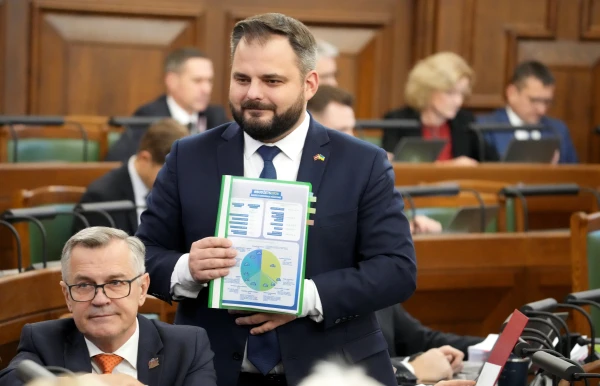
Thus, the country has a budget for the next year, which is already a good thing. It should be noted that this was the last budget formed by the Siliņa government — the 2027 budget will already be created and adopted by a new government and Saeima.
They Gathered and Adopted. For Three
As predicted, the three ruling parties managed to, in the words of the president, "gather," temporarily forget their disagreements and grievances, and vote for the budget — and moreover, vote in accordance with the agreements reached in the corridors of power. They even supported as many as 4 proposals from the opposition.
It took two working days to discuss the budget and the budget package — considering breaks, the deputies spent about 18 hours in debates! At the same time, all parliamentarians knew in advance that the debates, no matter how heated, would not affect the voting results.
Life on Credit Continues
One way or another, the main financial law has been adopted, and we can draw 5 main conclusions about this budget. The first conclusion is that the budget deficit exceeded the maximum allowable 3% of GDP set by Brussels, but the European Union still gave this budget the green light, as the excess was largely due to an increase in military spending. The second conclusion: increasing allocations for the main priority of the Siliņa government — external and internal security — was mainly achieved through borrowing, and thus the national debt will continue to grow rapidly, reaching 55% of GDP by 2028. This is a lot! And the most unpleasant thing is that with each new borrowing, the amount of debt servicing increases. In 2029, we will spend over 1 billion euros just on debt servicing!
Can’t We Be More Modest?
The third conclusion: the ruling parties "dared" to cut only the expenses on cash prizes and bonuses, which means that salaries in budgetary institutions will rise under the pretext of inflation. It has already been reported that the established ceiling for growth in rewards in the public sector — within 2.6% — was "violated," and on average — by three times! The government allowed a number of state enterprises, including Latvenergo and university clinics, to disregard the imposed restrictions... It is unlikely that next year the ruling parties will allow themselves to offend clerks, as they are a significant part of the electorate.
However, in one thing the politicians are right — inflation will continue to rise, as the minimum wage will increase next year, and consequently, other salaries, primarily in the public sector, will also rise. Additionally, heating, water, and electricity tariffs will continue to increase... It should not be forgotten that next year excise taxes on alcohol and tobacco will also rise, and vignettes, that is, additional payments for commercial transport, will be introduced. All of this will push inflation up.
The fourth conclusion: for the first time in the last 14 years, child birth and child care benefits for the first year and a half of life will be increased. Funds have also been allocated to improve medical care for children. At least something!
They Will Patch the Holes Next Year
The fifth conclusion: many sectors were clearly deprived of funding, especially healthcare. Miracles do not happen: by the middle to late summer of 2026, that is, on the eve of the elections, it will become clear that the money for treatment and diagnostics under the quotas has run out, and it will be necessary to urgently allocate funds for medical services from the contingency fund and through the redistribution (appropriation) of budgetary funds.
Of course, the prime minister and the finance minister, in assessing the budget, follow the familiar scheme: if you don’t praise yourself, no one will praise you. They have already rushed to call the 2026 budget the best of all possible. It is very difficult to agree with this conclusion, considering the dangerous trend of living on credit and the rather modest reduction in administrative expenses.






Leave a comment