
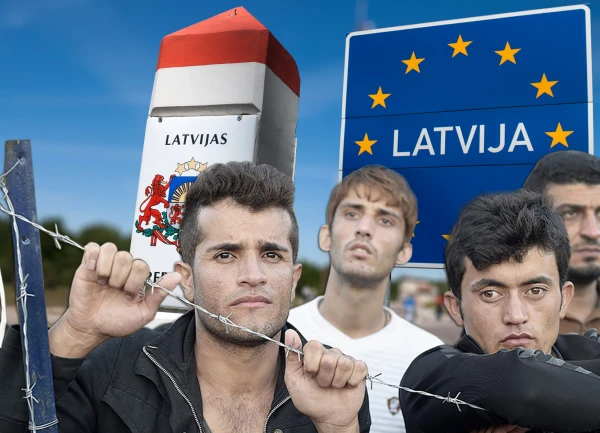
On Wednesday, December 10, the parliamentary investigative commission will hold its first working meeting to investigate the reasons for the increase in heating tariffs by the company "Rīgas siltums." To begin with, the deputies will hear from representatives of "Latvenergo." Next week, the leadership of the new parliamentary investigative commission — to investigate the reasons for the mass influx of citizens from third countries and to study the possibilities for tightening immigration policy — will be elected.
A Lot of Investigative Commissions
But before we move on to the goals, tasks, and possible outcomes of this "migration investigation," let's recall the history of parliamentary investigations in Latvia. Throughout the history of parliamentarism in our country, a total of 38 investigative commissions have been established in the Saeima, of which 8 were during the first republic and 30 in modern times. Notably, after the restoration of independence, 8 out of 30 parliamentary investigations were related to... banking activities — deputies tried to understand the causes and consequences of the collapse of certain commercial banks. Despite the fact that in recent years, after the adoption of the relevant law on parliamentary investigations, deputies working in such commissions have gained more rights and opportunities (for example, to involve a prosecutor in the commission's work), the effectiveness of the commissions has not increased as a result. Yes, often, following the work of such investigative commissions, the Saeima adopts various legislative amendments that improve the legal situation, but deputies fail to achieve anything more significant.
The work of the parliamentary investigative commission into the circumstances of the terrible tragedy in Zolitūde (the commission operated from late 2014 to late 2015) can be considered relatively effective — as a result, a number of changes were adopted that tightened control in the construction sector. However, the government and the Saeima are now "playing back" - canceling a number of articles in regulatory acts governing the construction sector under the pretext of combating excessive bureaucracy.
To Remind About Themselves
Recent history of parliamentarism shows that such investigative commissions are often created... closer to the upcoming elections — it is clear that deputies see the work of such commissions as yet another opportunity for free political advertising! Most likely, the desire for additional publicity motivated the initiators of the establishment of the jubilee investigative commission — on migration. Opponents or rather — critics of this initiative to create an investigative commission likely have grounds to believe that migration issues could have been discussed in a regular mode — in the commission on defense and internal affairs, which, by the way, is controlled by a representative of the opposition, and in the profile commission — on citizenship, migration, and social cohesion.
If we talk about the overall EU migration policy, then the deputies of the Saeima have virtually no opportunity to influence this overall migration policy. As for Latvian legislation, a new Immigration Law is currently being considered in the Saeima.
In any case, the necessary 34 deputy signatures have been collected, and the commission can begin its work. The initiators of the parliamentary investigation note that "since 2015, the number of citizens from third countries residing in Latvia with temporary or permanent residence permits has significantly increased — over 105,000. In addition, there are also an indefinite number of individuals using visas and travel documents issued in other EU countries."
They’ve Arrived Here!
Interestingly, at the moment this material was being prepared for publication, news came from Brussels: EU countries supported tightening immigration policy, which also includes the establishment of "return centers" outside the territory of the bloc for rejected asylum seekers.
At the meeting of the interior ministers of EU countries in Brussels, the corresponding package of measures was approved. It is clear that in many "old world" countries, dissatisfaction with the influx of migrants is growing, contributing to the rise in popularity of right-wing politicians, and Brussels is forced to respond to the increasing pressure from right-wing forces. The dissatisfaction of local residents is easily understandable — migrants often live solely on benefits, that is, at the expense of taxpayers in the host countries, and they are already starting to dictate their own rules, creating their own ethnically-religious enclaves. Due to the disproportionately high influx of migrants, the crime situation is also deteriorating...
One prominent figure from the National Alliance, Jānis Dombrava, warned that if the number of migrants continues to grow in Latvia at the current pace, then, considering the low birth rate, "immigrants may simply replace Latvians."
Tasks of the Commission
So what exactly does the parliamentary investigative commission on migration intend to do? Firstly, the deputies will try to find out if there are any abuses or unjustified leniencies in the issuance of visas and/or residence permits to citizens of third countries. Secondly, the parliamentarians intend to thoroughly study the system of inviting and issuing student residence permits to students from third countries. The deputies will gather information about the academic performance of such students, their attendance discipline, and whether foreign students primarily use the student visa to work here, leaving their studies as a secondary concern. Thirdly, of course, the people's representatives will propose options for tightening control over foreign students and guest workers — including in light of the new Immigration Law currently under consideration.
To be fair, Latvia is not currently among the countries particularly attractive to migrants. But it is evident that the situation may change over time. It is clear that immigrants from third countries are becoming "cramped" in wealthy EU countries, which will be forced, as Germany is already doing, to tighten their immigration policies. In Latvia, the shortage of labor — including or even primarily — unskilled labor will only increase. The niche of food delivery services like Bolt and Wolt has been occupied by citizens from Asian countries not because of extremely high incomes, but because there are very few locals willing to do this work.
In any case, the parliamentary investigative commission has been established, and the deputies have another opportunity to loudly remind voters of their presence.













Leave a comment