
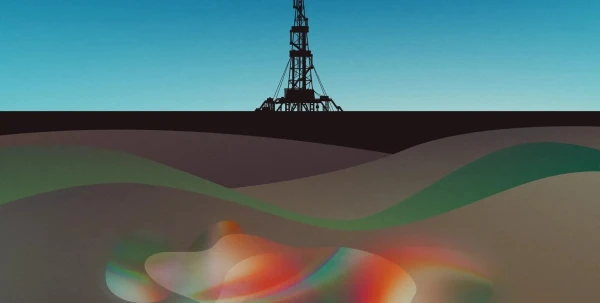
Researchers believe that an incredible amount of "golden" hydrogen is hidden in the Earth's crust. It is assumed that these reserves will be enough to provide humanity with energy for the next tens of thousands of years, writes Focus.
Hydrogen reserves that form naturally in the Earth's crust could assist humanity in decarbonization. The main challenge is that humanity needs to locate these accumulations and determine the best ways to extract them, writes Live Science.
In 1987, a worker lit a cigarette near a new well located not far from the village of Burakebugu in Mali — at that moment, an explosion occurred. Years later, it became clear what had actually happened: unnoticed clouds of flammable hydrogen, rising from a gas reservoir beneath the well, exploded.
The well was abandoned at that time, but in 2011, the oil and gas company Petroma reactivated the well to explore the possibility of extracting hydrogen for profit. By 2012, the company had developed the well to generate electricity for Burakebugu, and the village still uses this hydrogen as a source of energy.
It is worth noting that the well in Burakebugu is the first and only productive hydrogen well in the world. Hydrogen, mixed with oxygen, is the smallest and simplest molecule in the world; however, it can generate electricity without greenhouse gas emissions, producing only heat and water as byproducts.
This makes hydrogen a clean energy source. Moreover, scientists expect that by 2050, the demand for hydrogen for microelectronics production, industrial supply, and powering vehicles and buildings will increase fivefold.
Hydrogen is lighter than air and highly reactive, so scientists long believed that it does not accumulate in the Earth's crust like fossil fuels. However, we now know for certain that this is not the case. Today, resource exploration companies are rushing to find deposits of natural hydrogen, also known as "golden" hydrogen. Scientists are also contributing by identifying the key "ingredients" necessary for the formation of such deposits. According to geochemist Jeffrey Ellis from the U.S. Geological Survey, the more scientists search, the more they learn.
Sources of "Golden" Hydrogen
The discovery in Mali initiated a global hunt for hydrogen reservoirs. However, before geologists embark on costly exploration projects, it is essential to understand how much hydrogen may actually be hidden beneath the Earth's surface.
New estimates suggest that an incredible amount of hydrogen may be concealed in the depths of our planet. For instance, according to a recent study, the continental crust of the Earth has produced enough hydrogen over the last 1 billion years to meet current energy needs for humanity for 170,000 years. It is noted that other estimates double this figure.
However, much of this hydrogen has escaped into the Earth's atmosphere. In a new study, scientists focused on calculating how much of this hydrogen remains in the Earth's crust. Last year, researchers estimated that the Earth contains 6.2 trillion tons of hydrogen, which is about 26 times the amount of oil remaining in the ground. The location of these hydrogen reserves is largely unknown, but most of them are likely too deep or too far offshore to access, and some deposits may be too small to be economically viable. On the other hand, it is believed that only 2% of the total reserves on the planet could actually replace current fossil fuels for 200 years.
Treasure Map
At the beginning of this year, scientists published a map showing where hydrogen reserves may exist in the continental United States. To do this, scientists used data from gravitational and magnetic signals to assess the composition of rocks throughout the Earth's crust and identify the locations of hydrogen migration underground.
According to Oliver Worrall, an associate professor of geochemistry at the University of Ottawa, the best sources of hydrogen are iron-rich rocks that generate hydrogen through a "hydration reaction," in which water reacts with the rocks. Other good sources of hydrogen are uranium- and thorium-rich rocks that produce alpha particles during the decay of radioactive elements.
Scientists also found that temperature is a prerequisite for hydrogen sources — the rocks must be hot, between 250 and 300 degrees Celsius, to ensure a high reaction rate. Additionally, other good sources of hydrogen are uranium- and thorium-rich rocks that produce alpha particles during the decay of radioactive elements.
The fifth criterion for the formation of a hydrogen reservoir is an impermeable "seal" that keeps the gas inside the reservoir. The sixth and final condition is minimal microbial activity at the site of hydrogen formation and accumulation, as microorganisms consume hydrogen.














Leave a comment