
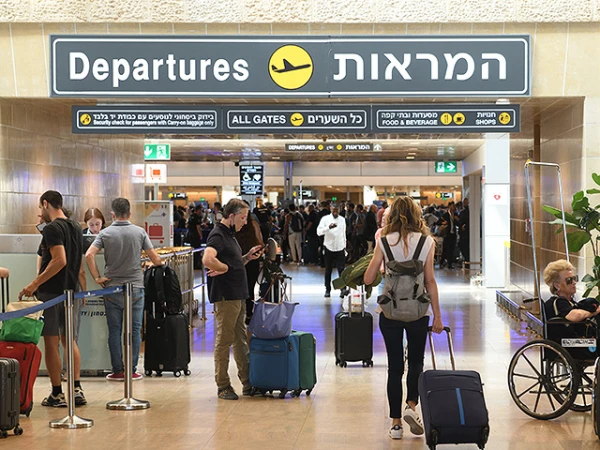
The main factors influencing people's decision to leave the country are security, economic, and religious aspects.
The Knesset's parliamentary committee on immigration, absorption, and diaspora once again discussed the issue of the increasing number of "yordim" – Israeli citizens who have moved to other countries for permanent residence. During the meeting, it was noted that there is no dedicated ministry in Israel responsible for preventing emigration, and the Ministry of Aliyah and Integration, which invests resources in promoting repatriation, is forced to deal with the opposite problem – the phenomenon of "yordim."
At the previous committee meeting, held in October, the following data was presented: since 2022, 125,200 citizens have left Israel.
According to the National Insurance Institute ("Bituach Leumi"), in 2024, there were 8,400 cases of initiated renunciation of residency – significantly higher than in previous years, when an average of 2,500 people per year renounced their status as residents of Israel.
The Director General of the Ministry of Aliyah and Integration, Avichai Kahana, emphasized that many emigrants do not publicly announce their departure; they reconsider their next steps each year – whether to return to Israel or stay abroad. He added that the ministry has opened so-called "Houses of Israel" in various countries around the world to help Israelis living abroad maintain their connection with their homeland and support their return.
Interestingly, among the list of 10 "Houses of Israel" currently operating, three are located in Europe – in Berlin, London, and Paris, and seven are in North America – in New York, Washington, Boston, Miami, San Francisco, Los Angeles, and Toronto. The Ministry of Aliyah and Integration plans to open an "Israeli House" in Australia as well. There seems to be no plan for the ministry to work in Ukraine, Russia, Belarus, Kazakhstan, the Baltic States, or other countries where Russian-speaking citizens who have left Israel reside.
However, the Director General of the ministry spoke about preparing a program to encourage the return of "yordim," which the ministry plans to launch in 2026 and for which it will request the appropriate budgets.
According to the Israel Democracy Institute, a negative migration balance has been observed in Israel since 2023, with secular individuals being more likely to consider emigration – twice as often as traditionalists ("masoritim") and 30 times more often than ultra-religious individuals. Young people aged 18-34 are twice as likely to consider leaving Israel compared to those aged 35-54 and five times more likely than those aged 55 and older. High-income individuals are 1.8 times more likely to consider leaving than those with lower incomes. Holders of foreign citizenship leave the country 1.7 times more often than those with only Israeli citizenship.
Marina Shpes, head of the Aliyah and Migration Department at the Central Bureau of Statistics, reported at the meeting that 65% of those who left Israel in 2024 were new immigrants who arrived in Israel in the last five years. About 60% of the immigrants who left Israel in 2023 had a bachelor's degree, and more than 25% held a master's degree or higher. She noted that in 2025, there was a slight decrease in the number of Israelis choosing to leave the country.
In response, Avichai Kahana, the Director General of the Ministry of Aliyah and Integration, stated that the data from years when Europe is experiencing a major war is inaccurate and incorrect. However, Ayal Eliyahu, a representative of the Knesset Research Department, noted that since 2022, both the number of Israelis deciding to move abroad for permanent residence and the number of repatriates arriving in Israel have increased.
Deputy Director General of "Bituach Leumi" Dani Zaken reported that after five years of an Israeli citizen's absence from the country, the ministry initiates the revocation of residency (status as a resident of Israel). "In 2024, we observed a significant increase in requests initiated by departing citizens to renounce residency – even before the five years of their absence from Israel had elapsed," he noted.
Deputy Evgeny Sova ("Our Home Israel") pointed out that the main factors influencing people's decision to leave Israel are security, economic, and religious aspects. "Too many coalition deputies are urging citizens to leave the country; this is sad," he reproached. "I believe the Prime Minister should announce that his government is fighting to prevent Israelis from leaving."
Committee Chairman Gilad Kariv, summarizing the meeting, stated that the next discussion will focus on "brain drain," and the committee will delve more deeply into the academic sphere. He emphasized that "brain drain" is not being addressed in Israel, and it is a deeply painful issue for Israeli society.












Leave a comment