
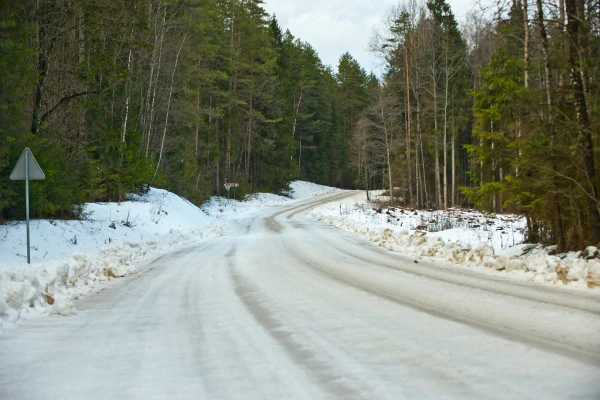
A map of Europe, where countries are highlighted in different colors based on highway density, does not foster a sense of patriotism. Our republic is pale yellow on it, compared to the deep red of Germany and France. The number of highways and byways in Latvia is roughly comparable to that in... Serbia.
On Tuesday, the Cabinet of Ministers took decisive action, reviewing the Strategy for the Development of State Roads until 2040.
Fifty-Fifty
According to data presented by Minister of Transport Aitis Švinka ("Progressives"), the total length of Latvia's state roads is 19,897 km, of which 50% are asphalted and 50% are gravel. The average density of the state road network is 0.308 km per 1 sq. km.
The main state roads total 1,660 km, all of which are asphalted. Among regional roads, which total 5,485 km, the overwhelming majority—4,789 km—are asphalted. However, among local roads, which are still state roads, out of 12,660 km, 9,246 km are already gravel.
Accordingly, the percentage of roads in "good and very good" condition is 74%, 57.8%, and 37.7%, depending on their classification. In "poor and very poor" condition, the percentages are 7.9%, 19.5%, and 27.3%. Overall, in the last five years, Latvia has managed to reduce the number of poor-quality roads requiring urgent repairs from 25.1% to 20.2%.
There are significant nuances in road construction: "Asphalt concrete, built according to the designed load, should last from 8 to 10 years; however, during this time, residual deformations accumulate on the surface, wear occurs, cracks and surface debris appear, and the surface ages. It is economically feasible to restore asphalt concrete surfaces in a timely manner when defects have not become widespread and unpredictable, and the average lifespan of these surfaces does not exceed 12 years. Then the costs of restoration... are the lowest."
Restoration: No Need to Rush?
In the Ministry of Transport, however, they did not hastily rush to asphalt everything and anything. To start with, they established 40 permanent and 239 temporary traffic control points. The automated installation, powered by autonomous electricity, transmits data to the state AS Latvijas valsts ceļi. And it turns out that repairing roads... is not profitable!
Yes, there is no doubt—due to poor roads, vehicles wear out, travel times increase, and excess CO2 is released into the atmosphere, resulting in a total loss of 728 million euros per year. However, if everything is repaired, it will cost 2.9 billion euros. Whether this is a lot or a little can be determined by comparing it to the military budget for 2026—over 2 billion (2,157,907,137) euros. That is, conditionally speaking—one and a half years without defense spending, and all roads in Latvia would be in perfect condition.
Where Are We Going?
According to the Ministry of Transport, data on the traffic load of Latvia's state road network show that two-thirds (66.9%) of vehicles for daily trips use only 10% of the country's road sections. The highest traffic intensity is noted on the roads in the Riga planning region. The intensity of freight traffic is one of the most important indicators to consider when planning road surface wear. 70.4% of freight vehicles for daily trips use only 10% of the country's road sections. The highest traffic intensity is noted on the roads in the Riga planning region.
Several European corridors of roads cross Latvia, facilitating transit traffic. The busiest route in Latvia is the South-North direction, or the main state road A1 – Riga (Baltezers)-Estonian border (Ainaži), the Ainaži-Grenc'tāle route, A4 – Riga ring road (Baltezers-Saulkalne), A5 – Riga ring road (Salaspils-Babite), and route A7 – Riga-Bauska-Lithuanian border (Grenc'tāle), or the so-called VIA Baltica corridor, where the intensity of freight traffic averages 3,100 vehicles per day.
Where Do Our Taxes Go?
Wait a second—but road repairs and construction are financed by all drivers. The Ministry of A. Švinka agrees with this—according to Article 12 of the Law on Roads, the funding for roads according to the tax collection plan for 2025-2027 is expected to be between 817 and 863 million euros.
Here’s how they plan to collect money from Latvians actively using motor vehicles in 2026:
- Vehicle operation tax – 124.51 million.
- Road usage fee – 58.78 million.
- Excise tax on petroleum products – 691.49 million.
"However, from the state budget, funding for the management, maintenance, and restoration of both municipal and state roads is allocated annually (including funding from EU funds) or is planned to be allocated 306-362 million EUR, or an average of 45.81%." The remaining 54.19% will go to other necessary expenditure items—primarily defense and the maintenance of the state apparatus.
For People and for Moose
Building or repairing a road is only half the job. It is necessary to create road infrastructure. Thus, it is planned to build bus stops—isolated from the roadway. The passenger flow of public transport across the roadway should be provided for by a multi-level crossing.
Roads will be equipped with animal deterrent fences and animal crossings, as well as noise-reducing elements. In cooperation with municipalities, it is necessary to create appropriate micromobility infrastructure (for pedestrians and cyclists) and communication corridors intended for placing various communication cables in one place and digitizing traffic, including creating 5G infrastructure.
All of the above applies only to the main state roads. If we consider local roads, then, as they say, there hasn't been a horse in sight—repairs have been carried out only on 17.5% in the last decade. Indeed—why bother?
The only motivation for the authorities to do something will be the notorious "military mobility." So, the presence of a NATO training ground, say, in the same Selija, means a chance for residents of Aizkraukle and Jēkabpils to at least drive a few minutes on a quality highway...







Leave a comment