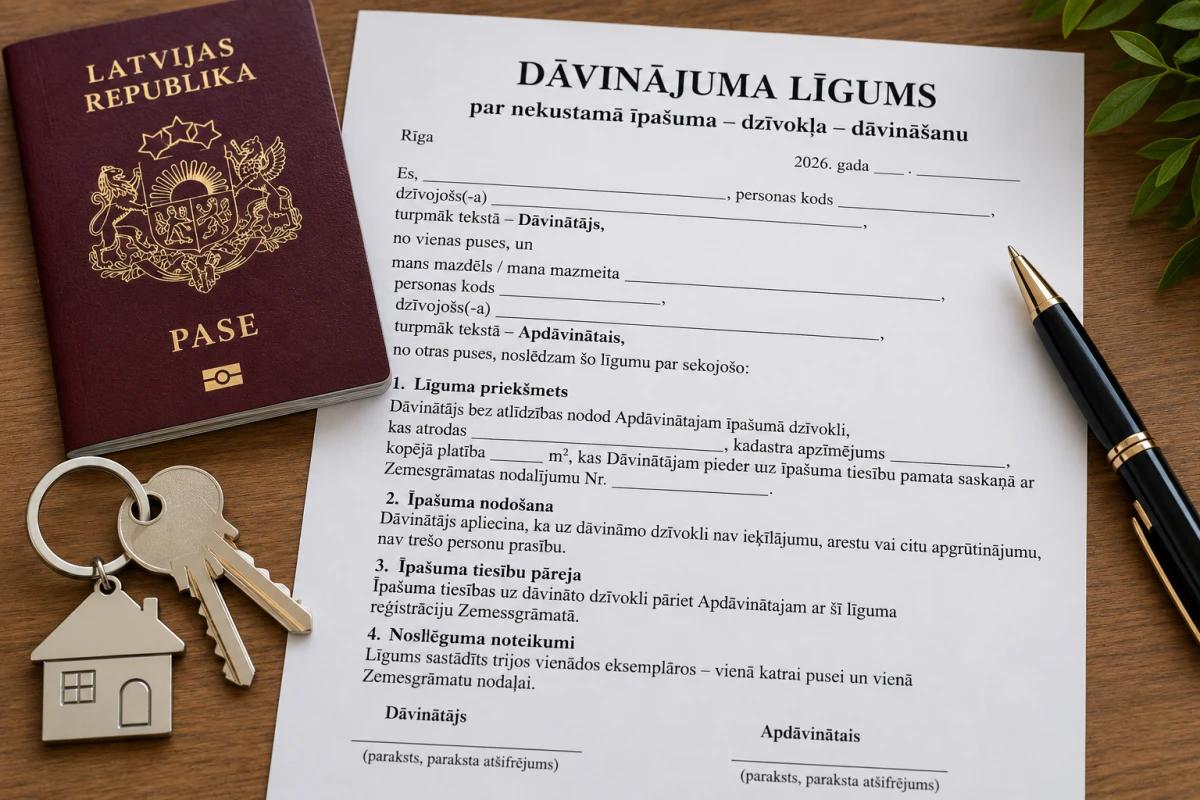
"I am a pensioner and want to formalize a gift deed for my apartment to my grandson, but I am very afraid of ending up on the street (I know that such cases have occurred). I heard that it is possible to conclude some kind of combined contract that can protect my rights to reside. Could you tell us more about this and explain how it works in practice?"
And also: is it possible to foresee in the contract the possibility of cancellation if, for example, he stops helping me in my old age? Reader of the portal bb.lv.
Answers by sworn notary of the Riga District Court Santa TEREKHINA:
– In the legislation of Latvia, there is no concept of a "combined contract."
All gift agreements come into effect upon signing; in other words, as soon as the contract is signed, the recipient becomes the owner of the gifted item (that is, the one to whom it is gifted).
There are two types of gift agreements.
A simple agreement implies that the recipient receives all rights to the gifted item – can sell, re-gift to someone else, pledge, rent, etc. However, in the overwhelming majority of cases, people prefer to conclude another type of gift agreement – with restrictions.
For example, when it comes to real estate, the donor understands that the recipient becomes the new owner and that this property will now be registered in the Land Register in the name of the new owner. However, there are two encumbrances – firstly, that the donor retains the right to live in this property (at a specific address), and secondly, that the recipient does not have the right to dispose of the gifted item without the donor's consent.
Next: termination of the gift agreement. There are two possibilities here. Firstly, by mutual consent. Secondly, the donor can terminate the gift agreement for acts of gross ingratitude.
However, it is important to understand what the law means by the concept of "gross ingratitude." Some local quarrel, offense, disagreements, etc., cannot be considered sufficient grounds for terminating the agreement; in turn, the cancellation of the gift is possible in cases where the recipient, for example, committed an offense that endangered the life/health of the donor and/or members of his family, intentionally caused bodily harm to the donor, morally pressured the donor with the aim of driving him to a nervous breakdown (and possibly even to suicide), etc.
However, it should be noted that if the donor wishes to terminate the gift agreement for the aforementioned or other serious reasons, he will need to convincingly prove in court, with substantial evidence, that the recipient indeed committed all those acts that prompted the donor to wish to revoke his gift.
And finally, is it possible to foresee in the contract the possibility of cancellation if the recipient stops helping the donor in old age? Here, one should not confuse two types of contracts – gift and life maintenance. A gift implies a gratuitous transfer of the gifted item to another person. But if a person wants to be cared for until the end of their life, they need to conclude a life maintenance agreement.
Although there are similar clauses (in particular, from the moment of its signing, the legal owner becomes the one who agrees to care for the previous owner, and that the new owner does not have the right to dispose of the object without the consent of the previous owner) – this is already a completely different type of agreement.
Unlike a gift agreement, a life maintenance agreement must clearly specify the conditions under which this transaction is concluded – that is, the obligations of the person who takes on the function of providing the previous owner with everything necessary – for example, bringing food (possibly also cooking), paying utility bills, ensuring access to hygiene and medical services, etc.