
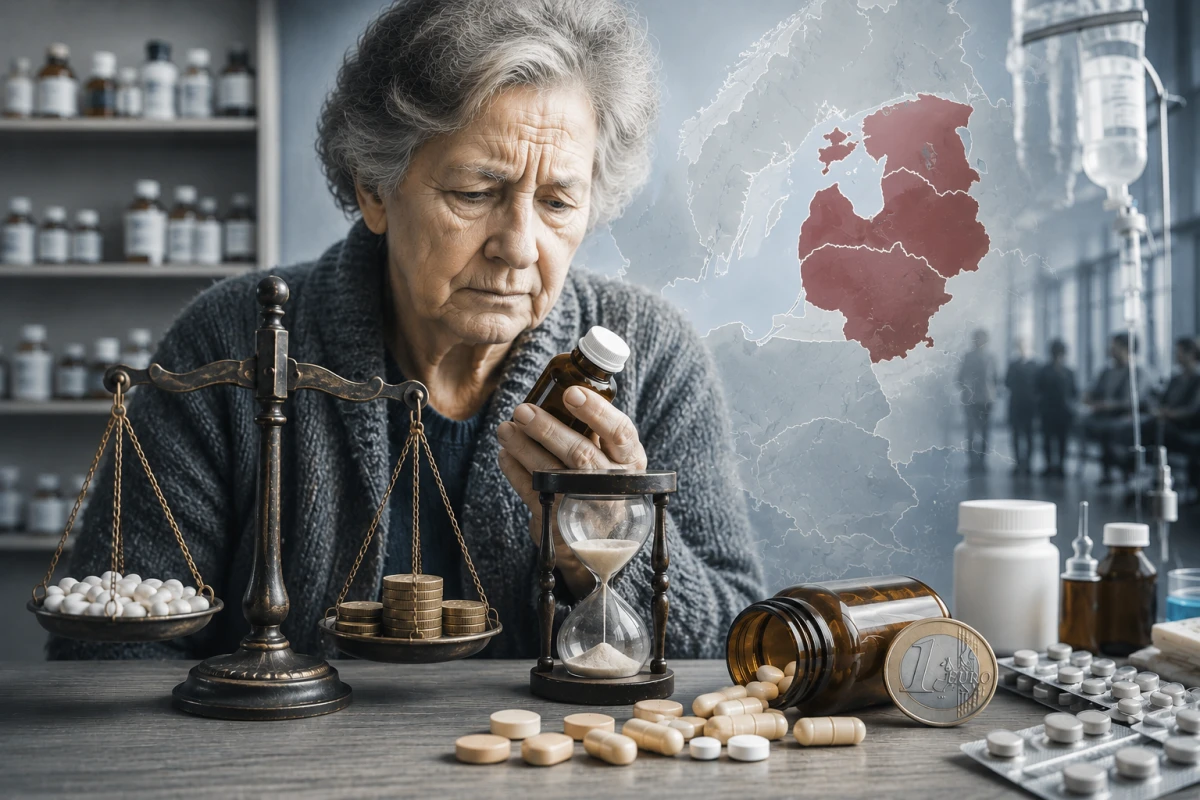
Compared to the pre-pandemic period, the situation in Latvia's medicine has worsened, such a sad conclusion can be drawn from the information presented in parliament. Since 2019, a huge number of new drugs for various diseases have been introduced in the European Union, but very few are imported into our country. Unlike, for example, Lithuania...
Results of Abu Meri's "Reforms"
It would seem that the concept of "medication shortage" is far in the past. Pay, and everything will be yours! But no. Director of the International Association of Innovative Pharmaceutical Firms (SIFFA) operating in our country, Vladislava Marane, reported in the Saeima that Latvia ranks second to last in the European Union in terms of the number of advanced medications available to patients, only ahead of Malta.
Moreover, only 40% of medications in the country are fully accessible to buyers; the rest are available only for specific indications or as individual compensation.
The most distressing remains Latvia's ranking in the field of oncology – last in the EU, with significantly lower survival rates. While Germany has 51 innovative medications for malignant tumors, the average across the EU is 28, in Latvia there are only 5. How much is health worth?
As for rare diseases, Latvian patients can access only 14% of the medications registered in Europe.
Furthermore, even when considering older generation drug therapies, comparing data from 2014, Latvia ranks second to last in the EU. For comparison, Germany has implemented 397 types, while we have only 144. As Ms. Marane explained, innovative medications, if properly utilized, would ensure a full return of patients to the labor market. It seems impossible to assess human life – but if one were to calculate the potential aggregate GDP from these individuals, it would amount to 1.1 billion euros, or 2.8% of the national economy per year.
"The only reason for the inaccessibility of medications in Latvia is the lack of state funding," summarized SIFFA.
What the Ministry of Health Says
Zinta Rugāja, Deputy Director of the Department of Medicines and Medical Equipment, stated at the Saeima's subcommittee on public health that in 2025, 320.65 million euros from the budget were spent on reimbursable medications and products. The forecast for 2026 is 360.65 million.
The list of reimbursable medications consists of 1,877 items, with payments ranging from 25 to 100 percent. Elderly patients receive the largest number of reimbursable medications – the largest cohort, those aged 80 and over, amounts to about 100,000 individuals.
Alongside this, the Ministry of Health disagrees that Latvia is lagging behind its neighbors in terms of reimbursable medications. For instance, in terms of spending per patient, we actually spend a little more than Estonia – 174 and 172 euros, respectively. In Lithuania, however, it’s a full 237! A key difference between Latvia and its neighbors is that reimbursable medications are subject to a 12% tax here, while in Estonia it’s 9%, and in Lithuania, it’s only 5%.
The Ministry of Health takes credit for including 12 new active substances in the list of reimbursable medications in 2025. Among them, three belong to oncology medications – drugs for breast cancer, myeloleukemia (a malignant disease of the blood and bone marrow), and intestinal tract tumors.
The conditions for reimbursement for 14 medications have been revised, and access has been eased for another 27 medications. Family doctors have been given the opportunity to prescribe reimbursable anticoagulants (blood-thinning medications) for cardiovascular patients; nephrologists – medications for chronic kidney failure; pediatric neurologists – medications for sclerosis.
In total, the medical authorities calculated that 37,800 patients benefited. That is, considering the total number of those receiving reimbursable medications mentioned above, it is less than 5%. Not much for a year...
Record Amounts for Saving Lives
In Latvia, there are incredible prices for medications, which, nevertheless, have been approved and paid from the budget. In 2025, one pediatric patient received therapy costing 455,000 euros, and one adult patient – 589,000 euros. The Ministry of Health does not mention age or diagnosis.
Meanwhile, a total of 568,861 euros from the budget has been reserved in Latvian hospitals for emergency cases, decisions on which are made at hospital councils. The role of these professional meetings is significant – essentially, a verdict on life is rendered...
When it comes to less urgent patients, in 2025, 1,337 applications for medication compensation were approved individually in Latvia. This amounts to 88% of all needed. Unfortunately, others have to raise funds with the help of kind people...
Proof at the Cost of Life
To eliminate the possibility of rumors about the subjectivity of medical decisions, the Ministry of Health conducts an audit of diagnoses on the list of reimbursable medications in oncology. Moreover, the check showed that in 70% of cases, "treatment is fully or partially covered." A so-called MKLA tool has been developed "to ensure transparency in decision-making and optimal use of budgetary funds in circumstances of limited financing." And – "to conduct evidence-based selection between new therapies..."
In this regard, your author could, of course, disclose the name of the oncologist who prescribed my mother an expensive chemotherapy treatment two years ago, which related to the primary, operated diagnosis – breast cancer, but ignored the metastases in the eye sockets. The verdict was fatal.
"It's not my business," was the expression of the doctor, whose CV on the website includes numerous professional accolades, internships, and scientific works. It is quite possible that seeing that the patient was already nearing 80 and three years had passed since the operation, the doctor considered the task completed? But then why prescribe an imported drug, subjecting the patient to a painful procedure?
My mother told her in the end: "I want you to consider your mistake." I hope she heard it and will not repeat this with other patients.
COMPENSATION
In 2025, there were 760,047 unique patients in the country entitled to reimbursable medications – statistically, this is over 40% of the population and the highest figure ever. In 2021, there were 704,850 patients.





Leave a comment