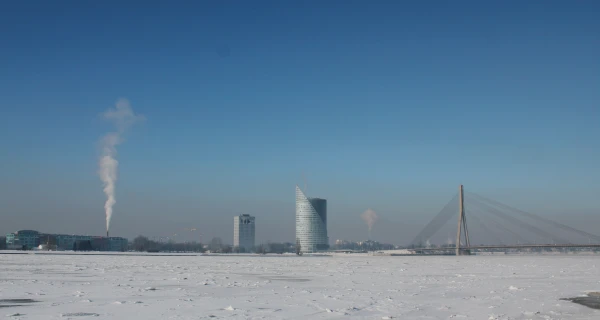
With the approach of the strongest frosts of this winter, the question of being on the ice — specifically, the possibility of crossing the frozen Daugava — has once again become relevant on social media. The Riga City Council explained to the tv3.lv portal whether this is currently allowed or if it may be permitted under stronger frost.
The municipality indicates that being on the ice is permissible in certain areas where regular monitoring of ice thickness is conducted. The allowed section on the Daugava is from Kengaraga Street, 8 to Latgales Street, 324D, no further than 150 meters from the shore. It is also permitted to be on the Little Daugava: from the Zakusala promenade, 29 to the Zakusala promenade, 27, as well as on the section from the beach in the Lucavsala Bay to Lucavsala Street, 77 — across the entire width of the river.
At the same time, the municipality emphasizes that crossing the Daugava on ice is still dangerous even during prolonged frosts. The main risk factor is the strong under-ice current, which affects the thickness of the ice and makes it uneven.
"Despite the stable frosts, crossing the Daugava River by moving on the ice is DANGEROUS for several reasons. There is a strong under-ice current in the Daugava, which significantly affects the thickness of the ice. The current undermines the ice from below, and its direction is unpredictable, resulting in uneven ice thickness," explained Cynthia Lukyanskaya, project coordinator of the External Communication Department of the Riga Municipality.
The municipality notes that in some places the ice thickness can reach 15 centimeters, but in others, it is only about five. The thinnest ice is usually found in the middle of the river, where the current is most intense.
The Riga City Council also warns that if someone falls through the ice, the consequences can be tragic, as rescue options in such conditions are extremely limited.
"Falling through in such a place, the victim is instantly swept under the ice by the current, and there is no chance of survival. In such conditions, unfortunately, even rescue services are powerless — it is impossible to save a person who has fallen under the ice," clarified Lukyanskaya.
The municipal police urge residents to be especially cautious, to go onto the ice only with special equipment, to supervise children, and to use individual protective gear, including swim-appropriate clothing, an ice axe, and ice spikes that can help get out of the water in case of falling through the ice.